Published: July 18, 2026
Asset: BTC/USDT
Reference Market: Binance Futures
Analysis Time: July 18, 2026, 2:48 PM EDT
Price at Analysis: Approximately $64,525
MARKET STATUS
Bias
Neutral
HTF Structure
Bearish Retracement Under Review
Trade Status
🚫 NO TRADE
Liquidity
☑ Previous UTAD TP Completed
☐ Monday Low Liquidity Untouched
Invalidation
Acceptance above $65,592
Next Confirmation
Monday Opening Range
Key Structural Problem
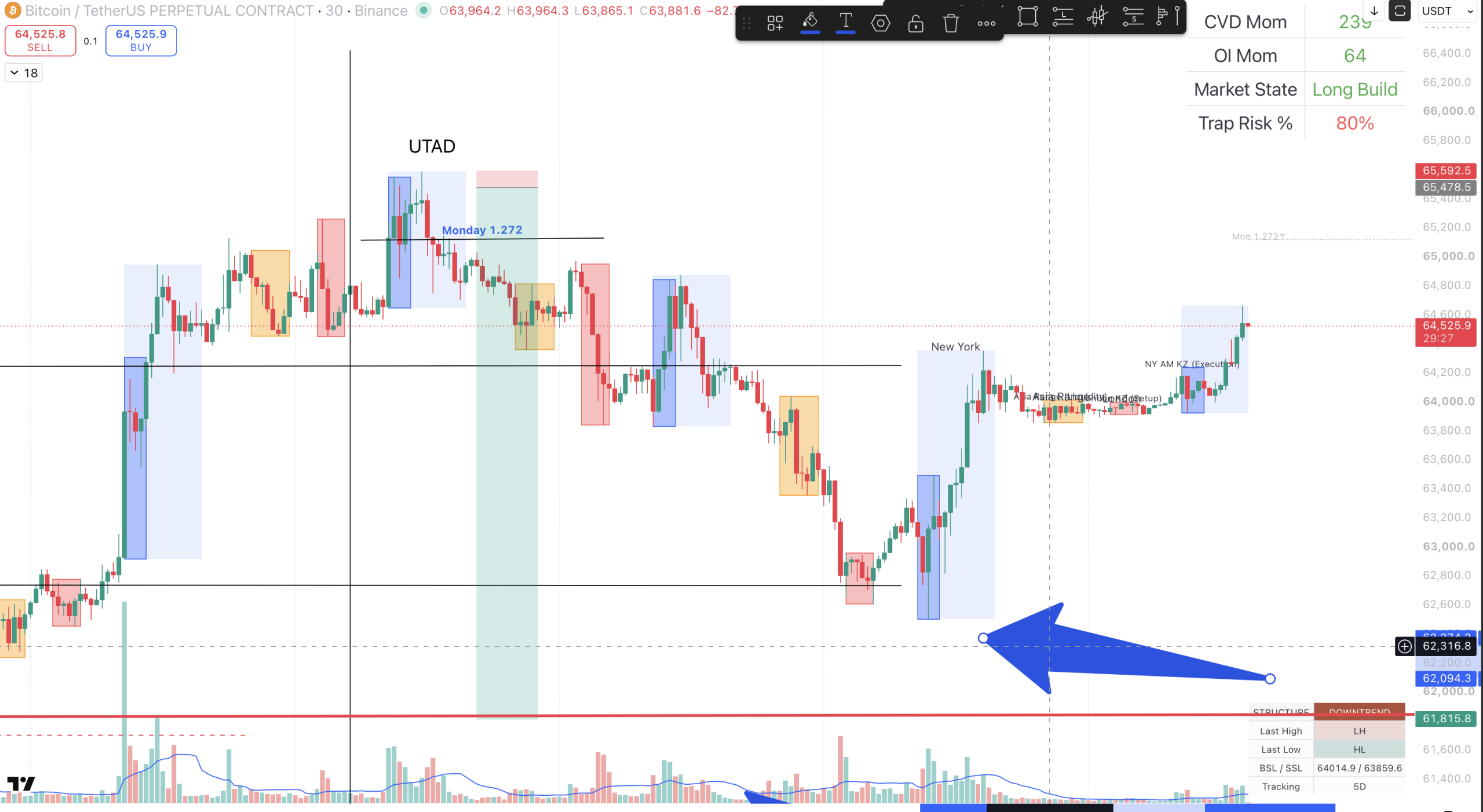
UTAD-driven downside displacement remains structurally relevant, but the reaction from Wyckoff AR support and thinner weekend liquidity interrupted continuation before the Monday Low and 1.272 downside extension were reached.
Weekend Relief Rally Interrupts—but Does Not Invalidate—the Bearish Structure
The bearish scenario outlined in our previous UTAD short setup and trade-management briefing largely unfolded as expected.
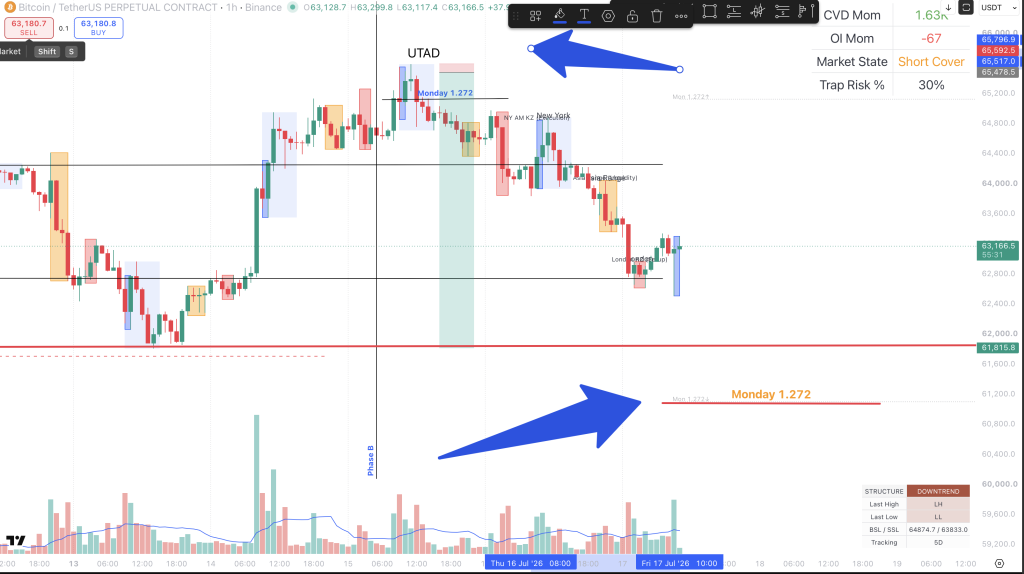
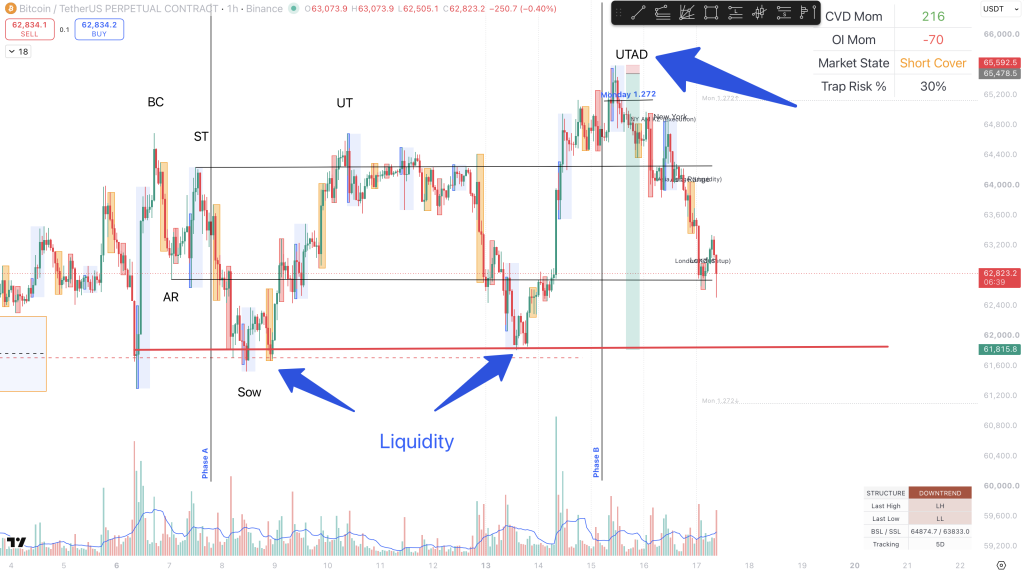
Following the Wyckoff UTAD—Upthrust After Distribution—Bitcoin entered the anticipated markdown phase and continued lower throughout the week.
The original distribution structure and lower-timeframe execution trigger were documented in Bitcoin 30M: Trading the Wyckoff UTAD Trap.
However, before reaching the final downside objective—the Monday Low liquidity and the 1.272 extension near $61,400—selling pressure began to fade around the previous Automatic Rally support zone.
Price reacted from AR and produced a short-term weekend recovery.
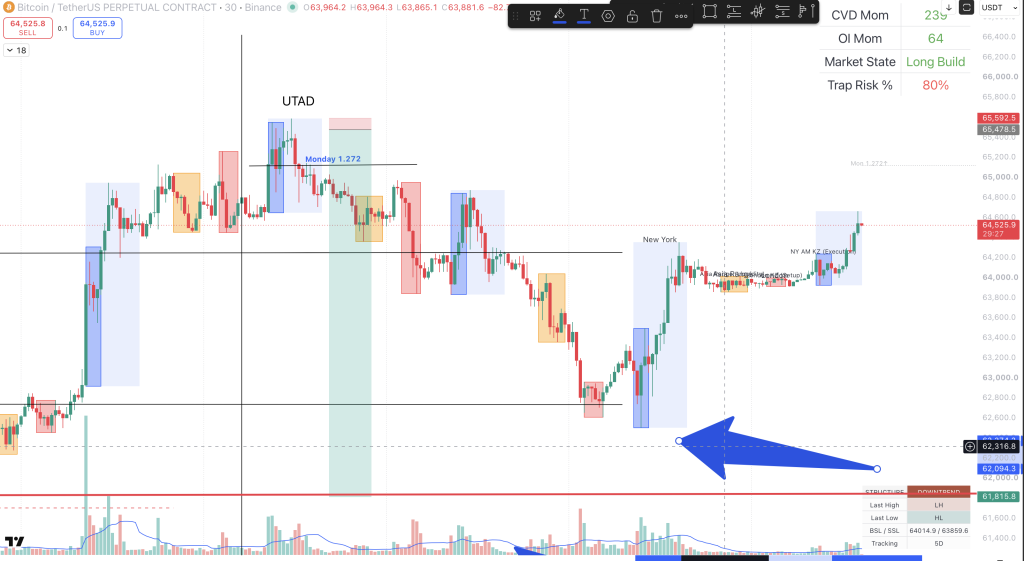
At the time of analysis, Bitcoin was trading near $64,525. This recovery should not yet be interpreted as confirmation of a new bullish trend.
The Higher-Timeframe Structure Remains Unresolved
Although Bitcoin recovered from AR support, the broader structural picture had not materially changed.
The weekly candle remained open at the time of analysis. The market had therefore not confirmed whether the rebound represented genuine accumulation or only a temporary interruption within the bearish retracement.
Bitcoin remained positioned between two unresolved liquidity objectives:
- Below price, the Monday Low and 1.272 extension remained untreated.
- Above price, the weekend recovery created fresh Buy-Side Liquidity around recent session highs.
Until one side develops confirmed acceptance, neither bullish nor bearish conviction offers a sufficiently clear execution advantage.
Liquidity and Institutional Intent
Confirmed Observation
- Bitcoin reacted higher from the previous AR support zone.
- The primary UTAD short objective was completed.
- Monday Low liquidity remained untouched.
- Positive CVD and open-interest momentum developed during the recovery.
- No confirmed higher-timeframe bullish reversal had occurred.
Structural Inference
The rebound appeared more consistent with short covering and weekend positioning than confirmed institutional accumulation.
After several days of downside movement, profitable short positions may be reduced before the weekend. Those buy-to-close orders can produce meaningful upside movement without representing durable spot demand or confirmed accumulation.
This remains a structural inference rather than a confirmed observation.
The market still lacked decisive bullish displacement, higher-timeframe acceptance, and a meaningful structural shift sufficient to confirm a new bullish phase.
Why We Closed the Short Early
One of the most common mistakes after correctly identifying a bearish move is assuming that price must reach every projected target before reacting.
The original roadmap included the Monday Low and 1.272 extension, but price found responsive buying around AR support before completing that final objective.
Once that reaction developed, the trade no longer offered the same reward-to-risk profile.
Closing the short was not an admission that the bearish thesis had failed. It was recognition that the execution phase of the existing trade had ended.
The UTAD short had already completed its primary objective. Continuing to press the position after price reacted from structural support would have exposed realized gains to a transition phase with reduced directional clarity.
The next position must be based on fresh confirmation—not on the desire to force the previous scenario to completion.
This follows the central principle explained in What Is a Liquidity Sweep? Confirmation, Failure, and Execution: a liquidity target is a destination, not confirmation.
Current Market Decision: No Trade
The AR reaction removed the immediate short-continuation setup, but it did not create a confirmed long setup.
- No confirmed bullish reversal
- No confirmed bearish continuation
- No clear asymmetric entry
- No validated acceptance beyond either structural boundary
The market was forming a weekend range between unresolved liquidity objectives.
For StructFirst, this is a clear No-Trade Condition.
The appropriate decision is to wait for Monday’s opening range to provide new evidence of acceptance, rejection, and directional intent.
Directional bias alone is not an execution trigger.
Structural Invalidation and Failure Logic
Bearish Invalidation
A decisive breakout and sustained acceptance above the previous UTAD high at $65,592 would invalidate the current bearish interpretation.
A temporary wick above the level would not be sufficient.
Price would need to demonstrate acceptance through sustained trading, structural continuation, or a successful retest above the UTAD region.
If acceptance develops, the decline toward AR should be reconsidered as a corrective retracement rather than confirmed markdown.
Bearish Reactivation
If Bitcoin loses the $62,000 region and develops acceptance below AR support, the unfinished downside objectives become active again:
- Monday Low liquidity
- The 1.272 extension near $61,400
- Additional sell-side liquidity beneath the current range
Until either boundary is confirmed, the structure remains unresolved.
Risk Assessment
Current Risk Level: High
Breakout execution inside the weekend range carries elevated risk because:
- Market participation is reduced.
- The order book is likely thinner than during active weekday sessions.
- Price has not confirmed acceptance above $65,592.
- Price has not confirmed acceptance below AR support.
- The supplied 30-minute indicator displayed an 80% Trap Risk reading.
The 80% reading should be treated as a chart-specific indicator output—not as an objective probability that 80% of trades will fail.
The primary risk is entering a breakout that sweeps nearby liquidity and then immediately returns inside the range.
This is the same failure logic examined in Research Note #004: The Liquidity Trap Breakout: a level break without structural acceptance, displacement, and follow-through remains vulnerable to reversal.
Until Monday establishes clearer participation and directional acceptance, the current structure offers poor asymmetry.
Target Liquidity and Execution
Bullish Scenario
A bullish setup requires:
- Acceptance above $65,592
- Bullish displacement rather than a temporary liquidity sweep
- A successful lower-timeframe retest
- Evidence that buyers can hold above the former UTAD region
Only then would the objective shift toward newly formed buy-side liquidity above the range.
Bearish Scenario
A bearish continuation setup requires:
- Failure to reclaim the weekend highs
- Loss of AR support
- Acceptance below approximately $62,000
- Lower-timeframe bearish displacement followed by a failed retest
The primary downside objective would remain the unfinished Monday Low liquidity, followed by the 1.272 extension near $61,400.
No-Trade Condition
Do nothing while price remains trapped between AR support and the UTAD invalidation level without confirmed acceptance on either side.
StructFirst Notes
Unfinished liquidity does not guarantee immediate continuation.
Likewise, a strong reaction from support does not automatically invalidate the broader bearish framework.
Earlier in the week, the UTAD structure correctly identified the primary bearish direction. As price approached AR support, however, the execution objective changed from pressing the position to protecting realized profits.
The market changed.
The plan had to change with it.
A market can remain structurally bearish while offering no valid short entry. It can also rally strongly without providing a confirmed long setup.
Professional execution requires separating market bias from trade availability.
At the time of analysis, the directional bias was neutral and the trade status was No Trade.
What We Will Watch Next
- Acceptance above $65,592, invalidating the bearish framework
- Failure of AR support, reactivating the unfinished Monday Low liquidity
- Formation of the Monday Opening Range and its first confirmed acceptance or rejection
Until one of these conditions develops, capital preservation takes priority over directional participation.
Key Takeaways
- The original UTAD short scenario largely unfolded as expected.
- The primary UTAD trade objective was completed.
- AR support interrupted the decline before the final liquidity objective was reached.
- Monday Low liquidity and the 1.272 extension remained untreated.
- Weekend buying appeared more consistent with short covering than confirmed accumulation.
- Breakout entries carried elevated trap risk.
- Acceptance above $65,592 invalidates the bearish framework.
- Acceptance below AR support reactivates the downside liquidity target.
- Current trade status: No Trade.
Expand Your Structural Edge
The current market is a practical example of why unfinished liquidity should never be confused with an immediate execution signal.
For the complete framework, read What Is a Liquidity Sweep? Confirmation, Failure, and Execution.
The bearish thesis had not been conclusively invalidated.
The market had simply stopped providing a new executable trade.
That distinction matters.
Structure must come before prediction. Confirmation must come before execution. Risk must be defined before targets.
Track the live order flow and volume footprint yourself directly on TradingView.
Leave a Reply