StructFirst Core Guide #011
You entered long after bullish displacement broke a meaningful high.
Price pulled back, traded beneath the most recent minor low, triggered your stop, and then continued higher without breaking the broader bullish structure.
On another trade, you did the opposite.
You ignored the loss of the low that actually supported the bullish thesis because a larger and more distant low still remained on the chart. Price accepted below the controlling structure, failed to reclaim it, and continued lower while you kept changing the timeframe.
Both problems come from the same misunderstanding:
The most recent swing is not automatically the swing that controls the trade.
A chart can contain micro swings, internal pivots, session highs and lows, execution references, range boundaries, liquidity pools, and higher-timeframe structural swings at the same time.
The trader’s task is not to protect every visible high or low.
The task is to identify which swing supports the entry, which swing supports the broader directional thesis, and what market behavior would invalidate each one.
The StructFirst sequence is:
Higher-Timeframe Structure
→ Liquidity Event
→ Displacement
→ Relevant Structure Break
→ Protected High or Low
→ Confirmation
→ Entry Invalidation
→ Thesis Invalidation
→ Target Liquidity
→ Risk Management
Quick Decision Summary
- The latest swing is simply the most recent pivot. It may be structurally minor.
- A protected swing supports a confirmed directional sequence.
- A lower-timeframe protected swing may invalidate an entry without invalidating the higher-timeframe thesis.
- A wick through a protected swing is not always structural failure.
- Candle-body acceptance, failed reclaim, and opposite displacement provide stronger invalidation evidence.
- If the controlling protected swing cannot be identified clearly, no-trade is a valid decision.
1. The Trader’s Problem
Most traders do not struggle because they cannot see highs and lows.
They struggle because the chart contains too many of them.
A single fifteen-minute chart can contain:
- A micro high formed by two or three candles.
- An internal swing controlling a short retracement.
- A session high or low containing liquidity.
- A local entry invalidation level.
- A higher-timeframe protected swing.
- An external range boundary.
- Equal highs or lows that function primarily as liquidity.
When all of these references are treated as equally important, trade management becomes inconsistent.
The trader may:
- Exit a valid higher-timeframe thesis because a micro swing failed.
- Keep a failed entry open because the larger thesis still appears possible.
- Move the stop from a local invalidation to a distant external swing.
- Treat one wick as proof that the trend reversed.
- Ignore candle-body acceptance through the actual protected swing.
- Change timeframes after the original execution model fails.
The result is often a painful combination of premature exits and delayed exits.
The trader leaves some good ideas too early and protects some bad ideas for too long.
This guide extends the decision hierarchy established in Why Market Structure Comes First: The StructFirst Trading Framework.
The objective is not to find one perfect swing that predicts every move.
The objective is to define which structural reference must remain intact for the original reasoning to remain valid.
2. What Are Protected Highs and Lows in Trading?
A protected high or low is a structural reference that supports a confirmed directional sequence.
Its failure would weaken or invalidate the price delivery, execution model, or directional thesis connected to it.
Protected Low
A protected low supports bullish delivery.
It may be connected to:
- The origin of a meaningful bullish displacement.
- The higher low that produced a relevant high break.
- The swing that preserves bullish continuation.
- The lower boundary whose failure would erase the bullish structural consequence.
When price establishes acceptance beneath that reference, fails to reclaim it, and produces bearish structural progression, the bullish thesis may no longer deserve protection.
Protected High
A protected high supports bearish delivery.
It may be connected to:
- The origin of meaningful bearish displacement.
- The lower high that produced a relevant low break.
- The swing that preserves bearish continuation.
- The upper boundary whose recovery would erase the bearish structural consequence.
A protected swing is therefore not defined by recency alone.
A protected swing is the structural reference whose failure changes the logic of the sequence it supports.
The term “protected” does not mean price can never wick through the level.
It means the market behavior around that level must remain defensible for the original thesis to survive.
3. Not Every Swing Is Protected
A swing exists whenever price forms a visible pivot.
Structural protection requires more evidence.
The chart may contain all of the following:
| Swing Type | Primary Function |
|---|---|
| Micro Swing | Short-term candle or pivot structure |
| Internal Swing | Controls a local retracement or execution sequence |
| Session High or Low | May contain liquidity or session-specific structure |
| Entry Reference | Defines failure of the immediate execution model |
| Protected Swing | Supports confirmed directional delivery |
| External Swing | Controls the broader range or higher-timeframe auction |
| Liquidity Reference | Contains resting orders but may not support the thesis |
Some swings can perform more than one function.
For example, an external low can also be the protected low of the higher-timeframe bullish thesis.
But this should be demonstrated through structural consequence rather than assumed from appearance.
Equal lows may contain sell-side liquidity without functioning as the protected low.
A recent five-minute higher low may protect a local entry without controlling the four-hour trend.
A large and visually obvious low may be less relevant than a newer higher low that produced the displacement controlling current delivery.
4. How a Protected Low Forms
A protected low should be traced from the structural result it created.
A common bullish sequence is:
Sell-Side Liquidity
→ Liquidity Sweep
→ Failed Acceptance Lower
→ Bullish Displacement
→ Relevant High Break
→ Higher Low Formation
→ Protected Low
→ Continuation Higher
The sequence begins with a meaningful liquidity interaction.
Price may trade beneath a prior low or a group of equal lows, accessing sell-side liquidity.
The sweep alone does not create a protected low.
Price must fail to establish sustained acceptance beneath the liquidity reference and then produce bullish displacement.
That displacement should affect a swing that matters.
If price breaks only a minor micro high and immediately returns, the structural consequence may be insufficient.
If price breaks the lower high controlling the bearish sequence, preserves the displacement origin, forms a higher low, and continues higher, the supporting low gains structural importance.
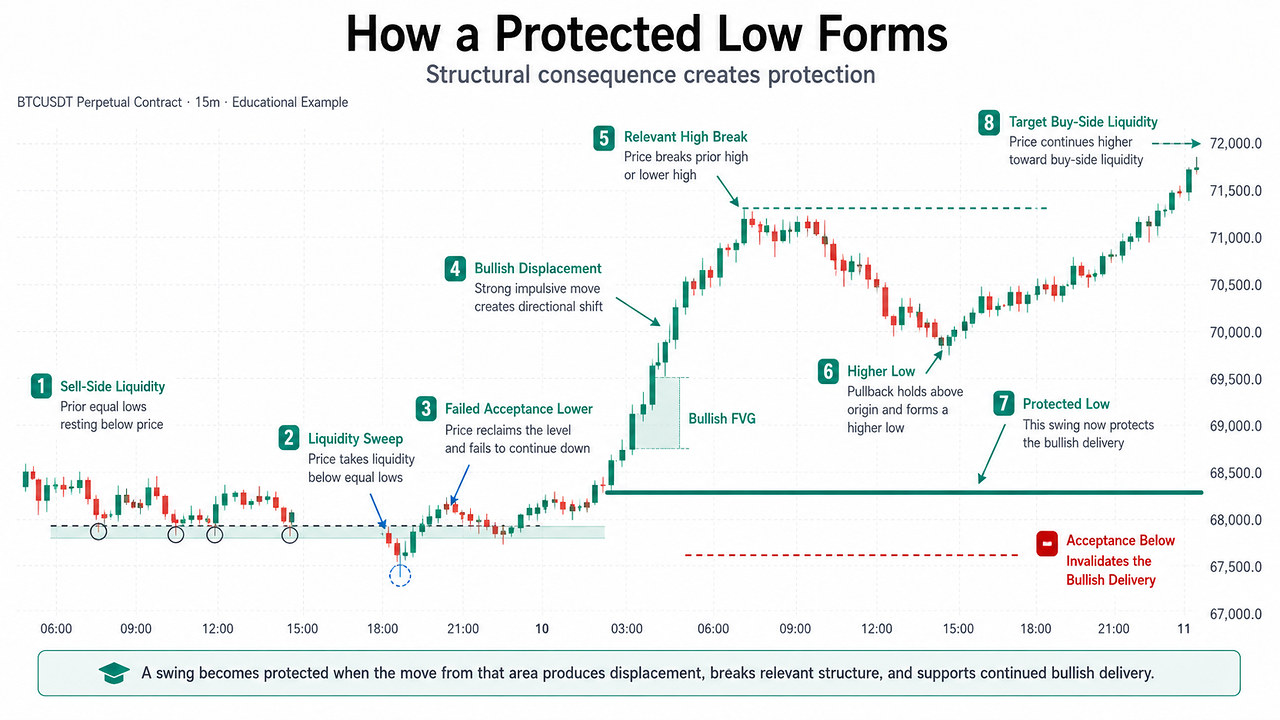
The protected low is not identified simply because it is the latest visible low.
In this sequence, price first accesses sell-side liquidity and fails to establish acceptance beneath the prior lows.
Bullish displacement then breaks a relevant high and changes the immediate delivery.
The subsequent higher low becomes structurally important because it preserves the bullish repricing and supports continuation toward opposing liquidity.
The swing is protected by the consequence created from it.
Acceptance beneath that reference would weaken or invalidate the bullish delivery it supports.
5. How a Protected High Forms
A protected high forms through the opposite bearish sequence:
Buy-Side Liquidity
→ Liquidity Sweep
→ Failed Acceptance Higher
→ Bearish Displacement
→ Relevant Low Break
→ Lower High Formation
→ Protected High
→ Continuation Lower
Price may first trade above a prior high or group of equal highs.
The move becomes structurally meaningful only after price fails to maintain acceptance higher and reprices lower with bearish displacement.
The displacement should break a relevant low, not merely a small internal pivot that does not affect the planned trade.
The lower high that preserves the new bearish structure may then become the protected high.
A recovery through that high, followed by acceptance and bullish structural progression, would weaken or invalidate the bearish thesis.
Liquidity sweeps require confirmation because a sweep can precede either reversal or continuation. The complete framework is explained in What Is a Liquidity Sweep? Confirmation, Failure, and Execution.
6. Latest Swing vs Protected Swing
The latest swing and protected swing may be the same level.
They often are not.
| Latest Swing | Protected Swing |
|---|---|
| The most recent visible pivot | The pivot supporting confirmed directional delivery |
| May be micro or internal structure | Connected to meaningful structural consequence |
| May fail during an ordinary retracement | Failure materially changes the thesis |
| Can define local entry management | Can define directional invalidation |
| May update frequently | Updates only after new structure is confirmed |
| Recency is its main characteristic | Structural function is its main characteristic |
Recency does not create structural importance.
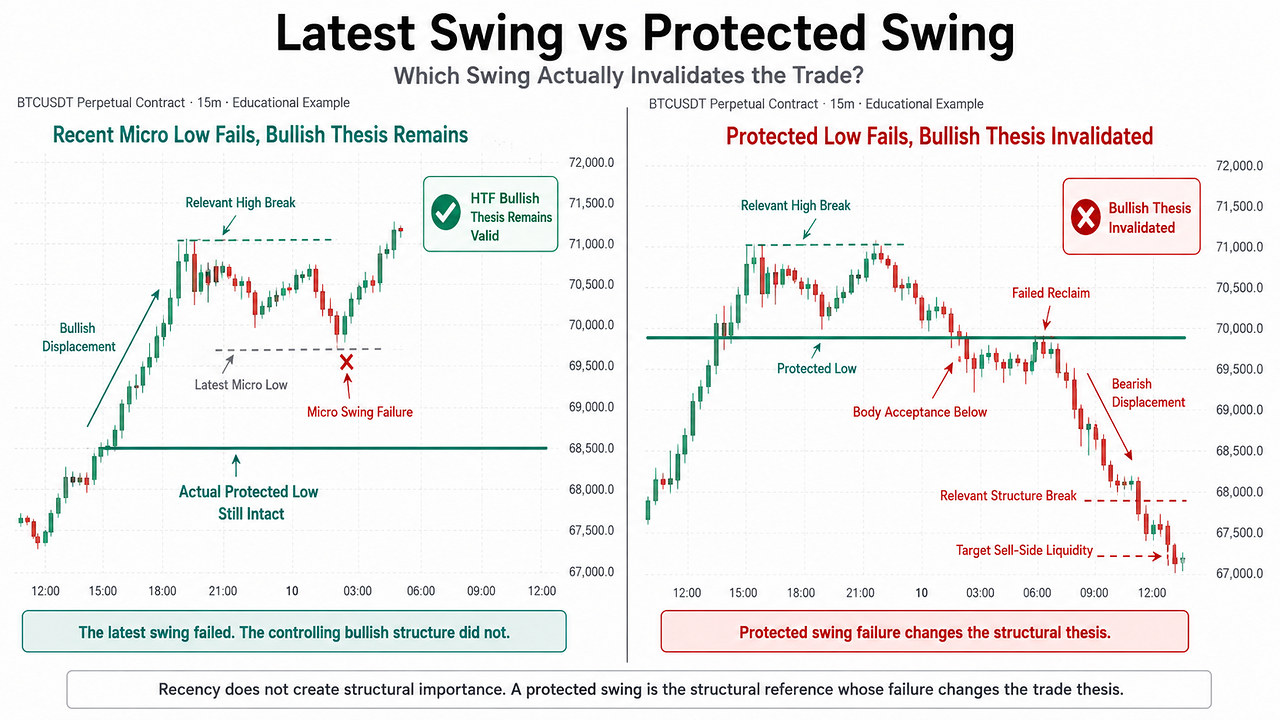
Both examples show price trading beneath a recent low, but the structural consequences are different.
In the first example, the latest micro low fails while the actual protected low remains intact.
The immediate entry sequence may weaken or fail, but the broader bullish delivery retains structural support.
In the second example, price establishes acceptance beneath the low supporting meaningful bullish displacement and the relevant high break.
The failed reclaim and bearish displacement confirm that the original bullish thesis no longer deserves protection.
The important question is not whether a low was broken.
It is whether that low controlled the entry, the local sequence, or the entire directional thesis.
7. Internal Protected Swing vs External Protected Swing
Internal Protected Swing
An internal protected swing supports a local execution or continuation sequence.
It may help define:
- A five-minute or fifteen-minute entry model.
- A session continuation trade.
- A lower-timeframe displacement origin.
- A local retest or mitigation structure.
- An entry stop or trade-management reference.
Its failure can invalidate the trade without invalidating the higher-timeframe directional thesis.
External Protected Swing
An external protected swing supports the broader trend, range, or higher-timeframe delivery.
It may define:
- The controlling four-hour or daily bullish low.
- The controlling bearish high.
- The range boundary preserving the larger thesis.
- The origin of a major displacement leg.
- The structural reference whose failure requires directional reassessment.
Before calling a swing protected, determine which analytical layer it supports.
The hierarchy between internal and external swings is explained in Internal vs External Market Structure: Which Swing Actually Controls the Trend?
8. Entry Invalidation vs Thesis Invalidation
This is one of the most important distinctions in practical trade management.
Entry Invalidation
Entry invalidation means the immediate execution model failed.
Examples include:
- A five-minute bullish displacement origin fails.
- A local protected low is lost.
- An Order Block mitigation does not produce confirmation.
- A retest fails to hold the reclaimed level.
- The lower-timeframe entry structure accepts in the opposite direction.
The position should be managed according to the failed entry plan.
The trader should not widen the stop to the higher-timeframe protected swing after the entry has already failed.
Thesis Invalidation
Thesis invalidation means the structure controlling the broader directional idea failed.
Examples include:
- Acceptance beneath the four-hour external protected low.
- Recovery above the external protected high of a bearish thesis.
- Loss of the higher-timeframe displacement origin.
- A failed reclaim followed by opposite displacement.
- A relevant external structure break against the thesis.
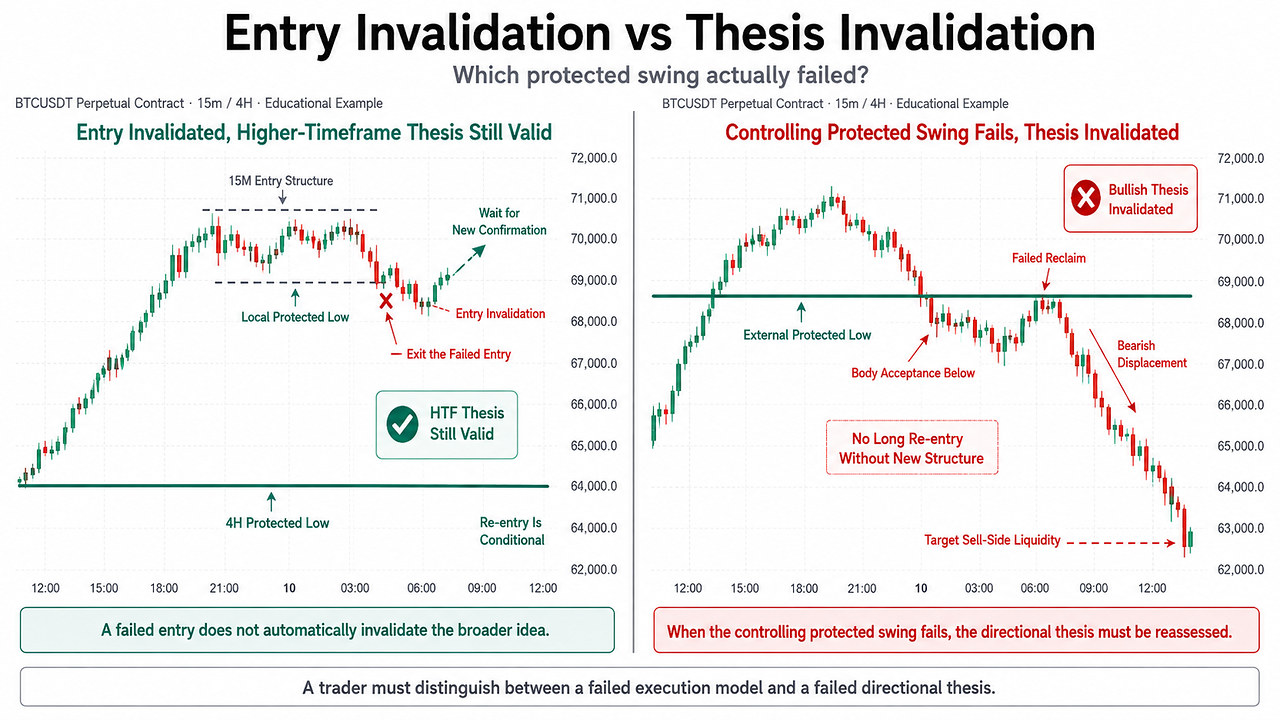
Both examples contain a failed bullish structure, but the failed structure belongs to a different analytical layer.
In the first example, the lower-timeframe entry model loses its local protected low.
The position should be exited because the execution logic failed, even though the higher-timeframe protected low and broader bullish thesis remain intact.
In the second example, price establishes acceptance beneath the external protected low, fails to reclaim it, and displaces lower.
The failure now affects the structure controlling the broader directional thesis.
Exit the failed entry without pretending the larger thesis failed. Abandon the larger thesis when its actual protected swing fails.
9. Liquidity Sweep vs Protected Swing Failure
A wick through a protected high or low does not automatically confirm structural failure.
The penetration may represent:
- A liquidity sweep.
- Deeper mitigation.
- A temporary volatility expansion.
- A failed breakout.
- The beginning of genuine acceptance.
The correct sequence of investigation is:
Penetration
→ Reclaim or Acceptance
→ Displacement
→ Structural Consequence
→ Retest or Failed Reclaim
A bullish protected low may remain defensible when price wicks beneath it, immediately reclaims the level, and produces bullish displacement.
The same level may be invalidated when candle bodies close below it, price remains beneath it, the reclaim fails, and bearish structure progresses lower.
The sweep is the event.
The response defines whether the swing survived.
10. Wick Penetration vs Candle-Body Acceptance
Wick Penetration
Wick penetration may show that price accessed liquidity beyond the protected reference.
Evidence that the structure may remain intact includes:
- The candle closes back inside the structure.
- The level is reclaimed quickly.
- Price does not build value on the invalidating side.
- Opposite displacement fails to develop.
- The original directional sequence resumes.
Candle-Body Acceptance
Acceptance provides stronger evidence that the protected swing failed.
Evidence may include:
- Repeated candle-body closes beyond the swing.
- Continued trade on the invalidating side.
- Failure to reclaim the former level.
- Displacement in the opposite direction.
- A break of additional relevant structure.
- Continuation toward opposing liquidity.
A wick can test a protected swing. Acceptance can invalidate it.
This does not mean every stop-loss must be placed beyond the full structural invalidation.
The execution stop and the thesis invalidation are related but distinct.
Protected-swing failure should therefore be evaluated through acceptance and rejection rather than through penetration alone. A wick beyond the level may only access liquidity, while sustained trade beyond it, a failed reclaim, and opposite displacement provide stronger evidence that the structure actually failed. For the complete framework, read What Are Acceptance and Rejection in Trading? Why One Wick or Close Is Not Enough.
11. Displacement Creates Structural Protection
A swing earns structural protection through the quality and consequence of the move that develops from it.
When grading the displacement, ask:
- Did candle bodies expand?
- Did overlap decrease?
- Did price move decisively away from the origin?
- Was a Fair Value Gap or imbalance created?
- Which swing was broken?
- Did price maintain acceptance beyond the broken structure?
- Was the displacement origin preserved during the next pullback?
A weak reaction that breaks only a minor pivot may not create a meaningful protected swing.
A decisive repricing event that changes delivery, breaks relevant structure, and supports continuation gives the originating swing greater structural importance.
The full displacement framework is explained in What Is Displacement in Trading? Why Strong Candles Alone Are Not Enough.
When the displacement leaves an imbalance, the relationship between the protected swing and the FVG should also be evaluated. See How to Read a Fair Value Gap in Market Structure.
12. BOS, CHoCH, MSS, and Protected Swings
Not every structural label creates a new protected high or low.
Internal BOS
An internal BOS may confirm local continuation without changing the external protected swing.
It can strengthen an entry model while remaining subordinate to higher-timeframe structure.
CHoCH
A CHoCH may warn that the immediate sequence weakened.
It does not independently prove that the controlling protected swing failed or that the external trend reversed.
Confirmed Market Structure Shift
A more credible structural transition may include:
- Failure of the relevant protected swing.
- Candle-body acceptance beyond it.
- Opposite displacement.
- A break of relevant structure in the new direction.
- A failed reclaim or confirmed retest.
- Continuation away from the prior thesis.
The distinction between BOS, CHoCH, and MSS is explained in BOS vs CHoCH vs Market Structure Shift: What Actually Confirms a Trend Change?
13. Protected Swings and Order Blocks
A structurally relevant Order Block may be connected to a protected high or low.
For a bullish example:
Liquidity Interaction
→ Bullish Order Block Origin
→ Bullish Displacement
→ Relevant High Break
→ Protected Low
→ Mitigation
→ Continuation
The Order Block and protected low may overlap, but they are not automatically identical.
Price may trade deeply into an Order Block while the protected low remains intact.
Conversely, if the protected low fails through acceptance and bearish structural progression, the bullish Order Block thesis becomes difficult to defend.
The complete Order Block framework is explained in What Is an Order Block in Trading? Why the Last Opposing Candle Is Not Enough.
14. Protected Swings and Breaker Formation
Protected-swing failure is an important part of Breaker formation.
A bearish Breaker sequence may develop as:
Bullish Order Block
→ Protected Low Failure
→ Acceptance Below
→ Bearish Displacement
→ Relevant Low Break
→ Retest From Underneath
→ Resistance Confirmation
The failure of the protected low identifies when the original bullish delivery lost structural support.
However, the failed level does not automatically become a Breaker.
Acceptance, new-direction displacement, and role transition during the retest are still required.
15. Protected Swings in Trending and Ranging Markets
Trending Market
In a healthy bullish trend, protected lows may update as new displacement legs break relevant highs and form higher lows.
In a bearish trend, protected highs may update as bearish displacement breaks relevant lows and forms lower highs.
Traders who treat every micro pullback as the new protected swing may exit repeatedly during normal trend development.
At the same time, a trend that stops producing meaningful displacement or fails to establish new protected swings may be maturing or losing directional quality.
Ranging Market
Inside a range, internal protected swings can change frequently.
The external range boundaries may carry more importance than local pivots around equilibrium.
Alternating BOS and CHoCH signals near the middle of the range may reflect rotation rather than a durable trend change.
The trader should avoid promoting every internal protected swing into an external directional thesis.
16. How to Identify the Swing That Controls the Trade
Do not begin with the most recent high or low.
Begin with the structural consequence.
- Identify the higher-timeframe market structure.
- Mark the relevant external and internal liquidity.
- Find the displacement move that changed delivery.
- Identify the meaningful swing broken by that displacement.
- Trace the displacement back to its origin.
- Identify the high or low that must remain intact to preserve the structural result.
- Classify that swing as internal or external.
- Determine whether its failure invalidates the entry, the local sequence, or the full thesis.
- Define the acceptance and reclaim behavior that confirms failure.
- Measure the distance from invalidation to the next liquidity target.
Start from structural consequence, then trace backward to the swing that made the consequence possible.
17. Protected High and Low Invalidation Framework
Bullish Thesis Failure
A bullish thesis may fail when price:
- Establishes acceptance beneath the protected low.
- Erases the bullish displacement origin.
- Fails to reclaim the former support level.
- Produces bearish displacement.
- Breaks a relevant structural low.
- Continues toward lower liquidity.
Bearish Thesis Failure
A bearish thesis may fail when price:
- Establishes acceptance above the protected high.
- Erases the bearish displacement origin.
- Fails to reject the former resistance level.
- Produces bullish displacement.
- Breaks a relevant structural high.
- Continues toward upper liquidity.
The trade should not be defended after the market confirms behavior that invalidates the reason for taking it.
18. A Practical Execution Framework
Protected highs and lows should be integrated into the complete execution process.
HTF Structure
→ Liquidity
→ Displacement
→ Relevant Structure Break
→ Protected Swing
→ Entry Confirmation
→ Entry Invalidation
→ Thesis Invalidation
→ Target Liquidity
→ Position Size
→ Trade Management
Do not choose the stop first and then search for a convenient swing behind it.
Identify the structural invalidation first.
Then decide whether the distance is compatible with the account risk and target opportunity.
If the only valid protected swing requires more risk than the trade plan allows, the professional decision may be no-trade.
19. Common Protected-Swing Mistakes
- Automatically protecting the latest swing. Recency does not prove structural importance.
- Treating a micro low failure as a higher-timeframe reversal. The failed swing may belong only to the entry layer.
- Changing timeframes after invalidation. A failed entry should not be converted into a larger trade.
- Confusing a wick with acceptance. The response after penetration determines whether structure survived.
- Ignoring a failed entry because the larger thesis remains possible. The position must still follow its execution plan.
- Using a distant thesis invalidation as the stop for every entry. Entry risk and thesis risk are not identical.
- Calling every CHoCH a protected-swing reversal. Structural weight depends on the swing and follow-through.
- Treating liquidity pools as protected structure. Liquidity can be accessed without invalidating the thesis.
- Marking every higher low as protected. The swing must support meaningful structural consequence.
- Selecting a closer swing because the correct invalidation is too expensive. An arbitrary stop does not improve the trade.
20. What This Framework Helps You Avoid
- Being stopped during ordinary retracement and assuming the entire thesis failed.
- Holding a failed entry because a larger scenario remains possible.
- Moving stops after the execution model breaks.
- Confusing internal noise with external trend failure.
- Ignoring acceptance through the actual protected swing.
- Using every visible high and low as an invalidation level.
- Repeated emotional re-entry without new confirmation.
- Allowing one manageable loss to become uncontrolled exposure.
This framework cannot eliminate stop-outs.
Its purpose is to make each stop-out more interpretable.
The trader should know whether the market invalidated the entry, the local structure, or the full directional thesis.
21. Practice Drill: Identify the Controlling Swing
Review 20 historical BTCUSDT examples and record the following:
- Mark the higher-timeframe external high and low.
- Identify the relevant liquidity event.
- Mark the displacement leg that changed delivery.
- Identify the meaningful swing broken by the displacement.
- Trace the move back to its origin.
- Mark the protected high or low candidate.
- Classify it as internal or external.
- Mark the latest micro swing separately.
- Record whether price wicked through or accepted beyond each swing.
- Record whether a reclaim succeeded or failed.
- Separate entry invalidation from thesis invalidation.
- Assess the evidence available before the final outcome was known.
Which swing had to remain intact for the original delivery to stay valid?
The goal is not to label every swing perfectly in hindsight.
The goal is to build a repeatable hierarchy that improves real-time risk decisions.
22. No-Trade Conditions
No-trade is appropriate when:
- The protected swing cannot be identified clearly.
- The supposed displacement is weak or heavily overlapping.
- No relevant structure break occurred.
- Internal and external structure conflict without a defined hierarchy.
- Price is rotating near equilibrium or the middle of a range.
- The structural invalidation is too far from the entry.
- The next liquidity target is too close.
- Wick penetration and acceptance cannot yet be distinguished.
- A closer arbitrary swing is being used only to reduce the stop distance.
- The thesis keeps changing across timeframes.
- New confirmation has not formed after a failed entry.
If the swing controlling the trade cannot be defined, the risk cannot be defined professionally.
23. The StructFirst Protected-Swing Decision Framework
Before using a protected high or low for execution, ask:
- Which higher-timeframe structure controls the trade?
- What liquidity event preceded the move?
- Which displacement changed price delivery?
- Which meaningful swing did that displacement break?
- Where did the structurally meaningful move begin?
- Which high or low must remain intact to preserve the result?
- Is that swing internal or external?
- Does its failure invalidate the entry or the full thesis?
- Did price merely wick through it or accept beyond it?
- Did the reclaim succeed or fail?
- Did opposite displacement develop?
- Where is the next opposing liquidity target?
- Does the target justify the structural risk?
- Would no-trade be the more professional decision?
Frequently Asked Questions
Is the Most Recent Low Always the Protected Low?
No. The most recent low may be a micro or internal pivot. A protected low supports a structurally meaningful bullish sequence whose failure changes the trade logic.
Does a Wick Below a Protected Low Invalidate the Bullish Thesis?
Not automatically. The wick may represent liquidity access. Reclaim, acceptance, displacement, failed reclaim, and follow-through determine whether the structure survived.
Can My Entry Fail While the Higher-Timeframe Thesis Remains Valid?
Yes. A lower-timeframe execution model can lose its local protected swing while the external protected swing remains intact. The failed entry should still be exited according to its original plan.
Should I Re-enter Immediately After a Stop-Out?
No automatic re-entry is justified. A new entry requires new confirmation, a new invalidation level, and sufficient distance to the next liquidity target.
Is a Protected Swing the Same as an Order Block?
No. An Order Block references a potential displacement origin or decision area. A protected swing identifies the structural high or low whose preservation supports the directional sequence. They may overlap but perform different analytical functions.
When Does a Protected Swing Update?
A protected swing should update after new displacement creates meaningful structural consequence and the subsequent swing is confirmed as supporting continued delivery. It should not update after every minor pivot.
Continue the Learning Path
- Internal vs External Market Structure: Which Swing Actually Controls the Trend?
- What Is a Liquidity Sweep? Confirmation, Failure, and Execution
- What Is Displacement in Trading? Why Strong Candles Alone Are Not Enough
- BOS vs CHoCH vs Market Structure Shift: What Actually Confirms a Trend Change?
- What Is an Order Block in Trading? Why the Last Opposing Candle Is Not Enough
- How to Read a Fair Value Gap in Market Structure
Expand Your Structural Edge
A chart contains many highs and lows.
Only some of them control the trade.
The latest swing may define a local entry.
The protected swing defines the structure that must remain intact for the directional logic to survive.
A failed entry should be exited without being converted into a larger position.
A valid higher-timeframe thesis should not be abandoned because of ordinary lower-timeframe noise.
When the controlling protected swing fails through acceptance, failed reclaim, and opposite displacement, the thesis must be reassessed.
Protect the process before protecting the opinion.
Track the live order flow and volume footprint yourself directly on TradingView.
Leave a Reply