StructFirst Core Guide #014
A Wyckoff Spring in trading is often reduced to one simple chart event: price moves below support, leaves a lower wick, and returns to the range.
That description identifies the initial liquidity event.
It does not confirm that the range is accumulation, that supply has been exhausted, or that a long entry is ready.
Price can trade below support and then:
- Reclaim the range and continue higher.
- Produce only a temporary bounce.
- Return below support after a weak recovery.
- Establish acceptance beneath the range.
- Continue into a confirmed breakdown.
The penetration below support creates a Spring candidate.
The reclaim, bullish response, structural progression, and failure logic determine whether that candidate becomes actionable.
A sweep identifies the liquidity event. The response determines whether the Wyckoff Spring thesis deserves risk.
The StructFirst sequence is:
Higher-Timeframe Structure
→ Trading-Range Boundaries
→ Active Support
→ Liquidity Sweep
→ Reclaim or Acceptance
→ Bullish Displacement
→ Relevant Structure Break
→ Spring Test
→ Invalidation
→ Execution
→ Target Liquidity
→ Risk Management
This follows the broader process established in Why Market Structure Comes First: The StructFirst Trading Framework.
Quick Decision Summary
- A move below support is not automatically a confirmed Spring.
- The relevant support is the boundary controlling the active trading range.
- A Spring does not always need to penetrate the original Selling Climax low.
- Price must fail to establish lasting acceptance beneath active support.
- A reclaim improves the Spring thesis but does not complete the trade.
- Bullish displacement and a relevant structure break provide stronger confirmation.
- A later test can improve execution clarity but should not be forced onto every chart.
- Acceptance below the active range invalidates the bullish Spring thesis.
- When the active range cannot be defined consistently, no-trade is valid.
1. The Trader’s Problem
You marked a range low, watched price trade beneath it, and immediately entered long because the move looked like a Spring.
Price bounced, but the bounce remained weak.
No meaningful resistance was broken. Candle bodies began closing beneath the former support, the reclaim failed, and price continued lower.
The loss did not occur because the liquidity sweep was invisible.
It occurred because the first reaction was treated as a completed structural decision.
The opposite mistake also occurs.
A trader may reject a valid Spring because it did not penetrate the oldest or deepest Selling Climax low visible on the chart—even though the market had already developed a newer active range above that low.
Both mistakes come from the same analytical problem:
The trader has not defined which support actually controls the current auction.
2. What Is a Wyckoff Spring in Trading?
A Wyckoff Spring is a temporary penetration beneath meaningful trading-range support followed by a return into the range.
Operationally, StructFirst separates the event into two stages.
Spring Candidate
Price trades beneath active support and accesses sell-side liquidity.
At this stage, the event may still become:
- A successful Spring.
- A temporary liquidity reaction.
- A failed breakdown.
- A weak reclaim before continuation lower.
- Confirmed acceptance beneath the range.
Confirmed Spring Thesis
The bullish interpretation becomes stronger when price:
- Fails to remain beneath active support.
- Reclaims the prior trading range.
- Produces bullish displacement.
- Breaks relevant resistance or controlling internal structure.
- Preserves the reclaimed boundary or a new protected low.
- Continues toward upper liquidity.
This distinction prevents the Wyckoff label from becoming an automatic reversal signal.
For the broader relationship between liquidity access, confirmation, and failure, read What Is a Liquidity Sweep? Confirmation, Failure, and Execution.
3. Define the Trading Range Before Naming the Spring
A Spring cannot be evaluated without first identifying the support level that price is attempting to Spring.
This creates an important distinction between the initial range and the active range.
Initial Trading Range
In a classic accumulation sequence, the Selling Climax and Automatic Rally help establish the first broad support and resistance references.
Those initial boundaries may continue controlling the structure.
They may also be refined as the range develops.
Active Trading Range
A long consolidation can form a newer phase with its own repeatedly defended support and resistance.
When that occurs, the active Spring may be evaluated against the support controlling the newer phase rather than against the oldest low on the chart.
That support must be demonstrated by price behavior. It should not be selected simply because it creates a convenient Spring label.
Evidence that a boundary is functioning as active support may include:
- Repeated reactions from the same lower area.
- Meaningful rallies beginning from that area.
- Visible internal structure developing above it.
- A clearly defined opposing upper boundary.
- Sustained balance between the two boundaries.
- A coherent invalidation point beneath the lower boundary.
The labels AR and ST in the supplied charts are working structural references for those specific active ranges. They should not be treated as a universal rule requiring every Wyckoff range to use the same boundary sequence.
4. A Liquidity Sweep Is Not Automatically a Wyckoff Spring
A Spring is not confirmed simply because price traded below support.
The penetration establishes only that price accessed liquidity beneath the active range.
The next questions are more important:
- Did price close back inside the range?
- Was the reclaim immediate or delayed?
- Did price remain above the reclaimed support?
- Did bullish displacement develop?
- Which meaningful resistance was broken?
- Was a protected low established?
- Did the market progress toward upper liquidity?
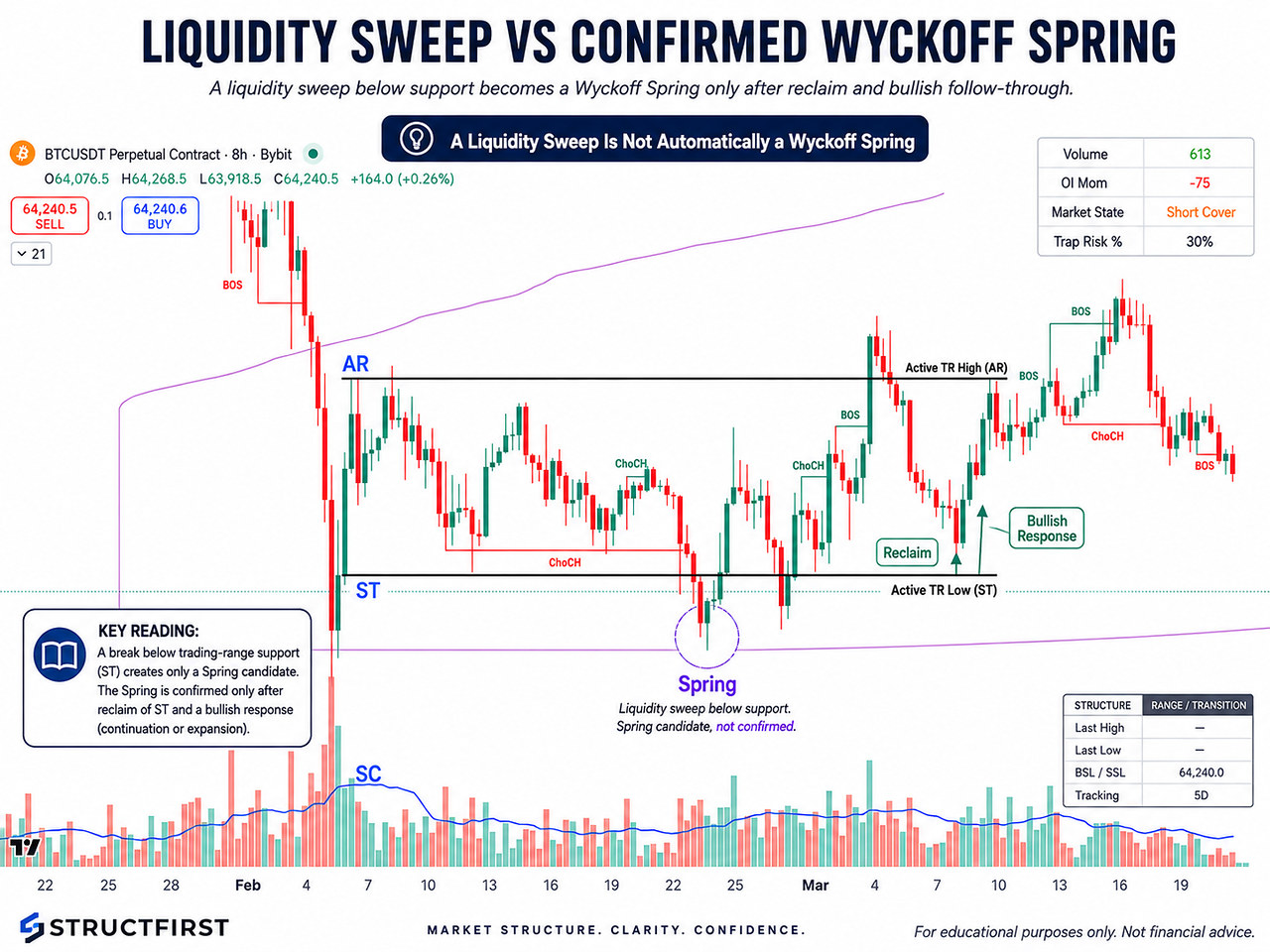
Price trading beneath active support identifies the liquidity event, but it does not complete the Wyckoff Spring interpretation.
In this example, the first move beneath the ST-based support creates only a Spring candidate. Price must still demonstrate that it cannot maintain acceptance below the range.
The later reclaim and bullish response provide stronger evidence that the lower excursion failed and that demand regained control of the active auction.
A sweep identifies where liquidity was accessed. Reclaim and structural follow-through determine whether the event becomes a confirmed Spring thesis.
5. Does a Spring Have to Sweep the Original Selling Climax Low?
No. A Wyckoff Spring does not always have to penetrate the original Selling Climax low.
It must penetrate a previously defined support level relevant to the current trading structure.
If the original SC continues to define the active range low, then a Spring at that range would normally need to interact with that support.
If the market later establishes a narrower phase with a higher support boundary, price may Spring that newer support without returning to the original SC low.
This is not permission to call every internal sweep a Spring.
The newer support must first prove that it controls an active range.
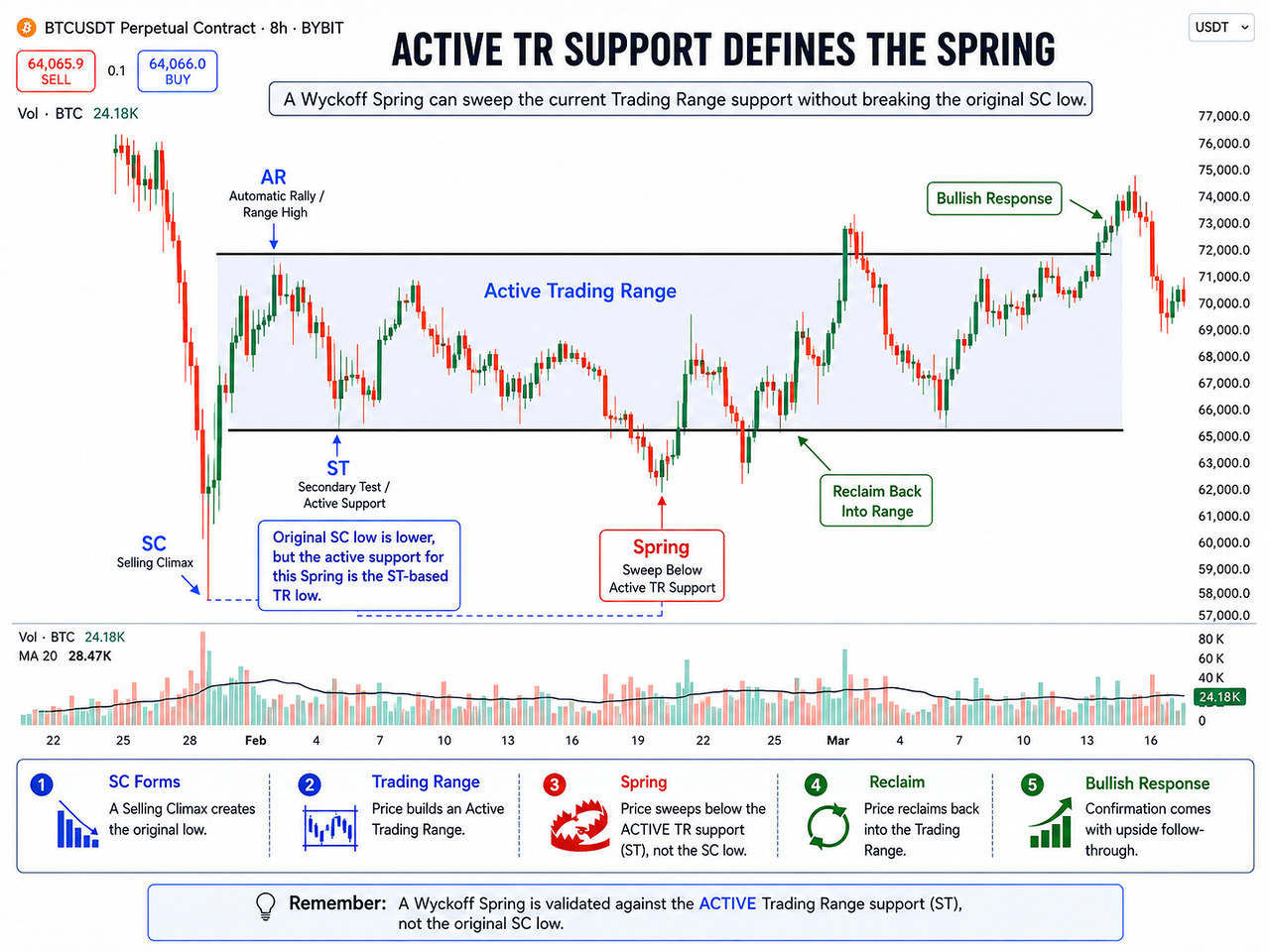
The original Selling Climax remains an important historical reference, but it does not automatically remain the support controlling every later auction.
In this chart, price develops a narrower active trading range above the original SC low. The AR establishes the active upper boundary, while the later ST area functions as the active lower boundary.
The Spring occurs when price trades below that active support, fails to maintain acceptance lower, and reclaims the range.
The original SC low remains untouched, but the support controlling the current range has still been swept.
This is a structural inference based on the active range shown by repeated price interaction. It should be invalidated if price accepts beneath that support instead of reclaiming it.
6. How a Wyckoff Spring Forms
A complete Spring sequence can be organized as:
Established Range
→ Active Support Test
→ Penetration Below Support
→ Failed Acceptance Lower
→ Reclaim
→ Bullish Displacement
→ Relevant Structure Break
→ Spring Test or LPS
→ Continuation
Established Range
Price must first demonstrate balance between recognizable upper and lower boundaries.
A random low inside an undefined market is not sufficient.
Penetration of Active Support
Price moves below the support level and accesses sell-side liquidity.
The depth, spread, volume, and duration of the penetration affect the quality of the candidate.
Failure to Accept Lower
Price cannot build durable trade beneath the range.
Candle bodies return toward or through the support boundary instead of continuing lower.
Reclaim and Bullish Response
Price returns inside the range and moves away from support with improving bullish delivery.
7. Why the Reclaim Matters
The reclaim separates a temporary penetration from sustained acceptance below support.
A stronger reclaim may show:
- A candle-body close back inside the range.
- Limited continued trade below the boundary.
- Rapid recovery from the sweep.
- Increasing bullish body expansion.
- Failure of sellers to regain the reclaimed level.
A weak reclaim may show:
- Repeated closes beneath support.
- Heavy overlap around the range low.
- No bullish displacement.
- No meaningful resistance break.
- A return below support after a short-lived bounce.
The distinction between the first reaction, confirmed rejection, and acceptance is explained in What Are Acceptance and Rejection in Trading? Why One Wick or Close Is Not Enough.
The Spring provides the location. The reclaim begins the confirmation process.
8. The Spring Test and Last Point of Support
After reclaiming the range, price may return toward the lower boundary in a Spring Test.
The test evaluates whether meaningful supply remains after the initial sweep and recovery.
A constructive test may include:
- A higher low above the Spring extreme.
- Narrower price spreads.
- Reduced selling volume.
- Limited candle-body acceptance beneath support.
- A renewed bullish response.
- Preservation of the reclaimed range low.
The test can become a Last Point of Support candidate when the market confirms continued demand and begins progressing toward the upper range.
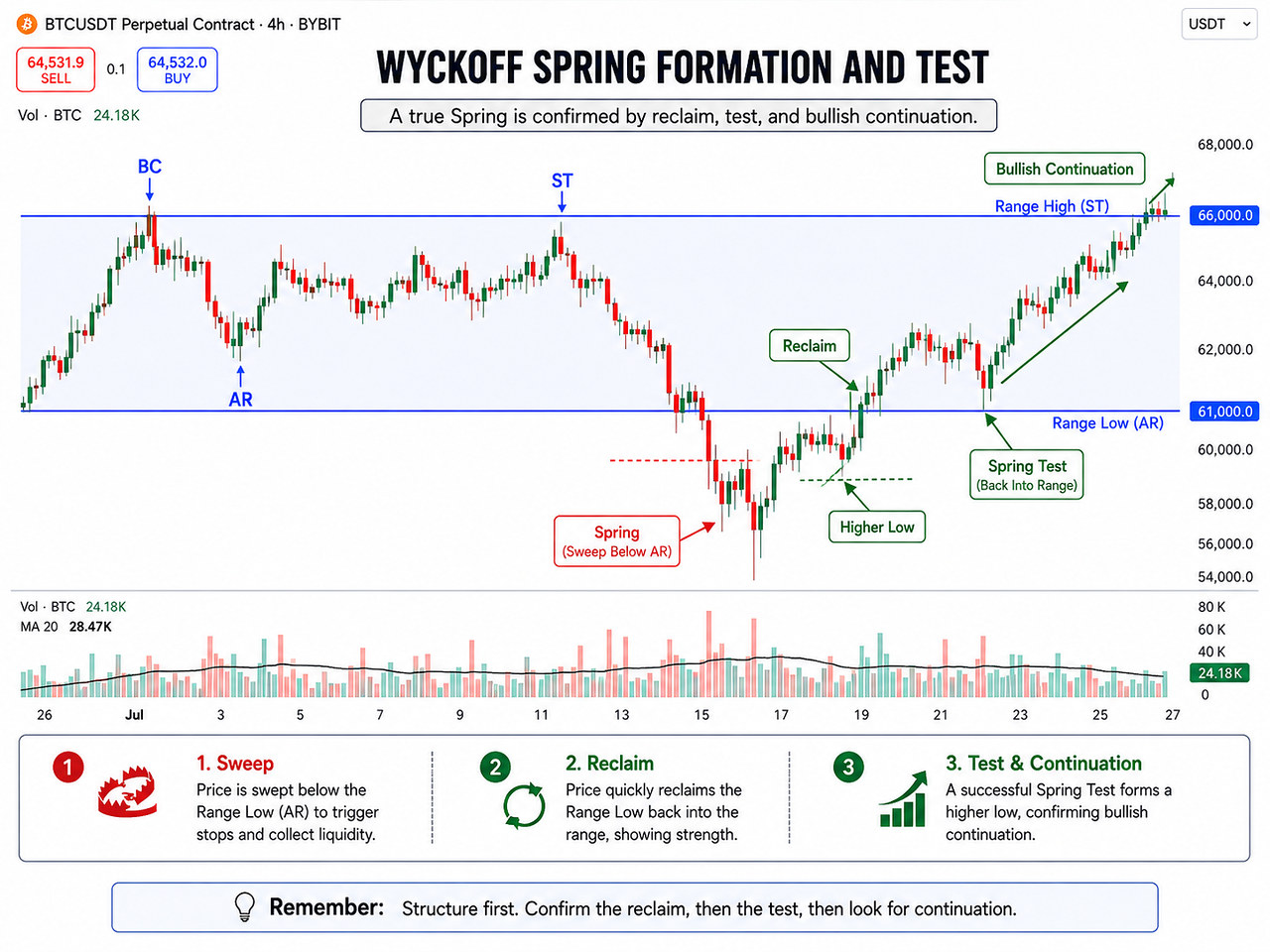
The initial Spring identifies a failure to maintain acceptance beneath active trading-range support.
The reclaim shows that price can return to the prior auction rather than continue building value below the range.
The later test provides additional evidence by holding above the Spring extreme and forming a higher low near the reclaimed boundary.
Bullish continuation after the test strengthens the interpretation that supply has weakened and that the lower boundary is functioning as support again.
A textbook test does not appear after every valid Spring. When price continues without returning, the directional interpretation may remain valid, but execution clarity can be reduced.
9. Volume and Effort Versus Result
Volume should be interpreted through the price result it produces.
A Spring candidate may be constructive when:
- Volume contracts as price approaches support.
- The penetration occurs on narrowing spread.
- Higher volume beneath support produces limited downward progress.
- The reclaim develops with stronger upward result.
- The later test shows reduced selling effort.
Warning signs may include:
- Expanding bearish spreads into and through support.
- Increasing volume with continued downside progress.
- Repeated closes beneath the range.
- A weak response despite heavy activity.
- Renewed selling during the supposed test.
High volume does not automatically prove accumulation or absorption.
The later structural result must reveal which side benefited from the activity.
10. Spring vs Ordinary Liquidity Sweep
| Ordinary Liquidity Sweep | Confirmed Spring Thesis |
|---|---|
| May occur around any visible low | Occurs relative to meaningful active range support |
| Initial reaction may be temporary | Price fails to maintain acceptance lower |
| Reclaim may be weak or absent | The range is decisively reclaimed |
| Relevant resistance may remain intact | Bullish displacement affects meaningful structure |
| No clear protected low may form | New bullish structure defines invalidation |
| Continuation lower remains possible | Price progresses toward upper range liquidity |
The Spring label should follow the structural evidence.
It should not be used to convert every lower wick into an accumulation narrative.
11. Valid Spring vs Failed Spring and Range Breakdown
Valid Spring Thesis
- The active range is clearly defined.
- Support is penetrated temporarily.
- Price reclaims the range.
- Bullish displacement develops.
- A meaningful internal or external resistance is broken.
- The reclaimed support is preserved.
- Price continues toward upper liquidity.
Failed Spring Thesis
- The reclaim remains weak or incomplete.
- Price returns beneath support.
- Candle bodies establish acceptance lower.
- The proposed protected low fails.
- Bullish displacement is erased.
- The former range low becomes resistance.
- Bearish continuation develops toward lower liquidity.
A return below support after the reclaim is not a reason to widen the Spring. It is evidence that the thesis may have failed.
12. Spring Confirmation Through Market Structure
A lower-timeframe CHoCH can show that immediate bearish delivery weakened.
It does not independently confirm that the entire range has transitioned into markup.
Stronger evidence may include:
- Bullish displacement through a controlling lower high.
- A relevant BOS in the direction of the reclaim.
- Acceptance above the broken structure.
- A protected low formed during the recovery.
- A successful retest or higher low.
- Progress toward the upper range boundary.
The distinction between early warning and confirmed structural transition is explained in BOS vs CHoCH vs Market Structure Shift: What Actually Confirms a Trend Change?.
The quality of the bullish move should also be evaluated through What Is Displacement in Trading? Why Strong Candles Alone Are Not Enough.
13. Internal Spring vs External Range Reversal
A Spring can occur inside a smaller active range while the broader higher-timeframe structure remains unresolved or bearish.
This creates two different analytical layers.
Internal Spring
- Occurs relative to a local active support.
- May produce only an internal rotation.
- Can target internal or session liquidity.
- Does not automatically reverse the higher-timeframe trend.
External Spring
- Occurs at support controlling the larger range.
- Interacts with external sell-side liquidity.
- Produces displacement through meaningful higher-timeframe resistance.
- Can support a broader accumulation or reversal thesis.
The hierarchy between the two layers is explained in Internal vs External Market Structure: Which Swing Actually Controls the Trend?.
14. Location: Premium, Discount, and the Active Range
A Spring occurring near the lower portion of a controlling higher-timeframe dealing range may offer better location than the same pattern near external Premium.
Location alone does not validate the Spring.
Use Premium and Discount to answer:
- Is price interacting with meaningful higher-timeframe support?
- Is the Spring occurring near external Discount?
- Has sell-side liquidity already been accessed?
- How far is the next buy-side liquidity objective?
- Does the structural target justify the invalidation distance?
The full location framework is explained in What Are Premium and Discount in Trading? Why the 50% Level Is Not a Buy or Sell Signal.
15. Fair Value Gaps and Order Blocks After the Spring
Bullish displacement after the Spring may leave a Fair Value Gap or begin from an Order Block candidate.
These areas can help refine execution, but they should not create the Spring thesis.
The correct sequence is:
Active Support Sweep
→ Reclaim
→ Bullish Displacement
→ Relevant Structure Break
→ FVG or Order Block Retest
→ Confirmation
A three-candle imbalance without meaningful displacement is not enough. See How to Read a Fair Value Gap in Market Structure.
An opposing candle near the Spring low is also not automatically a valid Order Block. See What Is an Order Block in Trading? Why the Last Opposing Candle Is Not Enough.
16. Wyckoff Spring Invalidation
Invalidation must be defined before the target.
A bullish Spring thesis may fail when price:
- Establishes candle-body acceptance beneath active support.
- Returns below the range after a weak reclaim.
- Breaks the protected low supporting the bullish response.
- Erases the displacement origin.
- Fails to reclaim the former range boundary.
- Produces bearish displacement toward lower liquidity.
The Spring low may define structural invalidation in some setups.
In other setups, a nearer lower-timeframe protected low can define entry invalidation while the broader Spring thesis remains possible.
The distinction is developed in What Are Protected Highs and Lows in Trading? Which Swing Actually Invalidates the Trade?.
17. A Practical Wyckoff Spring Execution Framework
Use the complete sequence before committing risk:
- Define the higher-timeframe structure.
- Identify the initial and active trading ranges.
- Mark the support controlling the current auction.
- Identify the sell-side liquidity beneath that support.
- Observe the penetration below the boundary.
- Determine whether price reclaims the range.
- Evaluate bullish displacement.
- Identify the meaningful resistance broken.
- Mark the protected low.
- Observe the Spring Test or another confirmation model.
- Define entry invalidation.
- Define thesis invalidation.
- Identify the next internal and external liquidity targets.
- Confirm that the target justifies the required risk.
Do not place a limit order simply because price enters the Spring area.
The sweep provides location. The response provides evidence. The invalidation defines the risk.
18. Common Wyckoff Spring Mistakes
- Calling every support sweep a Spring. The support must belong to a meaningful trading range.
- Forcing accumulation before confirmation. A range after a decline can also become redistribution or continued balance.
- Requiring every Spring to break the original SC low. A later active phase may establish higher support.
- Using an arbitrary internal low as active support. The boundary must be demonstrated through repeated market interaction.
- Entering before reclaim. The initial penetration may continue into a breakdown.
- Treating one green candle as bullish confirmation. Displacement and structural consequence matter more.
- Calling every CHoCH a Sign of Strength. The controlling resistance may remain intact.
- Ignoring acceptance below the range. Repeated closes lower weaken the Spring thesis.
- Forcing a textbook test. Some valid recoveries continue without a deep retest.
- Using the Spring low as every entry stop. Entry invalidation and thesis invalidation may differ.
- Projecting targets before defining failure. Risk must be established first.
- Claiming accumulation as confirmed institutional activity. Intent remains an inference until price produces the expected result.
19. What This Framework Helps You Avoid
- Buying every wick beneath support.
- Confusing a temporary reaction with failed acceptance lower.
- Forcing the original SC low onto every later active range.
- Entering before bullish displacement develops.
- Using internal CHoCH labels as external reversal confirmation.
- Holding after price accepts below the range.
- Moving the invalidation after the reclaim fails.
- Calling every range after markdown accumulation.
- Taking trades with no clear upper liquidity target.
This framework does not guarantee that every reclaimed Spring will continue higher.
Its purpose is to separate incomplete liquidity events from better-confirmed structural opportunities.
20. Practice Drill: Grade the Spring Candidate
Review 30 historical BTCUSDT range interactions and record:
- The higher-timeframe structure before the range.
- The original Selling Climax candidate.
- The initial Automatic Rally.
- The initial trading-range boundaries.
- Any later active range formed inside the broader structure.
- The support controlling the Spring candidate.
- The liquidity positioned beneath that support.
- The depth and duration of the penetration.
- Volume and spread during the sweep.
- Whether price reclaimed the boundary.
- Whether bullish displacement developed.
- Which meaningful resistance was broken.
- Whether a protected low formed.
- Whether a Spring Test occurred.
- The structural invalidation.
- The next opposing liquidity target.
Classify each example as:
- Ordinary liquidity sweep.
- Unconfirmed Spring candidate.
- Confirmed Spring thesis.
- Successful Spring Test.
- Failed Spring.
- Range breakdown.
- Unresolved / no-trade.
Which support controlled the active range, and what did price do after trading beneath it?
21. No-Trade Conditions
No-trade is appropriate when:
- The trading range cannot be defined clearly.
- The active support boundary is arbitrary.
- Price remains in the middle of a broad unresolved range.
- The sweep produces no reclaim.
- The reclaim produces no displacement.
- No meaningful resistance is broken.
- Volume and price result remain contradictory.
- The proposed protected low is unclear.
- Internal and external structure conflict without a defined hierarchy.
- Price has already moved too far from efficient execution.
- The invalidation is too distant relative to the next liquidity target.
- The setup depends primarily on calling the range accumulation.
An incomplete Spring is not an invitation to predict the missing confirmation.
It is a reason to remain flat.
22. The StructFirst Wyckoff Spring Decision Framework
Before trading a Wyckoff Spring, ask:
- What higher-timeframe structure preceded the range?
- What are the initial trading-range boundaries?
- Has the market formed a newer active phase?
- Which support controls the current auction?
- What liquidity sits beneath that support?
- Did price penetrate the boundary temporarily or accept below it?
- Did price reclaim the active range?
- Was the reclaim followed by bullish displacement?
- Which meaningful resistance was broken?
- Did a protected low form?
- Did a constructive test or higher low develop?
- What invalidates the entry?
- What invalidates the broader Spring thesis?
- Where is the next upper liquidity target?
- Does the opportunity justify the structural risk?
- Would no-trade be the more professional decision?
Frequently Asked Questions
Is Every Sweep Below Support a Wyckoff Spring?
No. The sweep creates a Spring candidate only when it occurs relative to meaningful trading-range support. Reclaim, bullish response, structural progression, and failure logic determine whether the thesis becomes actionable.
Must a Spring Trade Below the Original Selling Climax Low?
No. A later active phase can establish a higher support boundary. The Spring may penetrate that active support without reaching the original SC low, provided the newer range is clearly established.
Does a Wick Back Inside the Range Confirm the Spring?
Not by itself. The wick shows a lower excursion and possible rejection. Candle-body reclaim, bullish displacement, structural consequence, and follow-through provide stronger confirmation.
Does Every Spring Need a Test?
No. Some markets reclaim and continue without returning deeply. A constructive test can improve entry clarity and confirm reduced supply, but it should not be forced onto every chart.
What Invalidates a Wyckoff Spring?
Acceptance beneath active support, failure of the reclaimed boundary, loss of the protected low, erased bullish displacement, and continuation toward lower liquidity can invalidate the thesis.
Does a Spring Confirm That the Range Is Accumulation?
No. A Spring strengthens the accumulation hypothesis only when the market produces the expected bullish structural result. Until then, the range remains an unresolved auction.
Continue the Learning Path
- What Is a Liquidity Sweep? Confirmation, Failure, and Execution
- What Are Acceptance and Rejection in Trading? Why One Wick or Close Is Not Enough
- What Is Displacement in Trading? Why Strong Candles Alone Are Not Enough
- Internal vs External Market Structure: Which Swing Actually Controls the Trend?
- What Are Protected Highs and Lows in Trading? Which Swing Actually Invalidates the Trade?
- What Are Premium and Discount in Trading? Why the 50% Level Is Not a Buy or Sell Signal
- How to Read a Fair Value Gap in Market Structure
- Research Note #002 — Bitcoin 12H Wyckoff Accumulation Hypothesis: What Would Confirm the Range?
- Bitcoin Wyckoff Redistribution: How the 6H Structure Confirmed Markdown
Expand Your Structural Edge
A Spring is not defined by the wick alone.
It begins with a penetration beneath support that controls a meaningful trading range.
The original Selling Climax may define that support.
A later active phase may establish a newer boundary above it.
The sweep identifies the liquidity event.
The reclaim shows that price can return to the prior auction.
Displacement and structural progression provide confirmation.
The protected low defines failure.
The next liquidity pool defines the objective.
When those elements do not align, the professional conclusion is not a forced Spring label.
It is no-trade.
Track the live order flow and volume footprint yourself directly on TradingView.
Leave a Reply