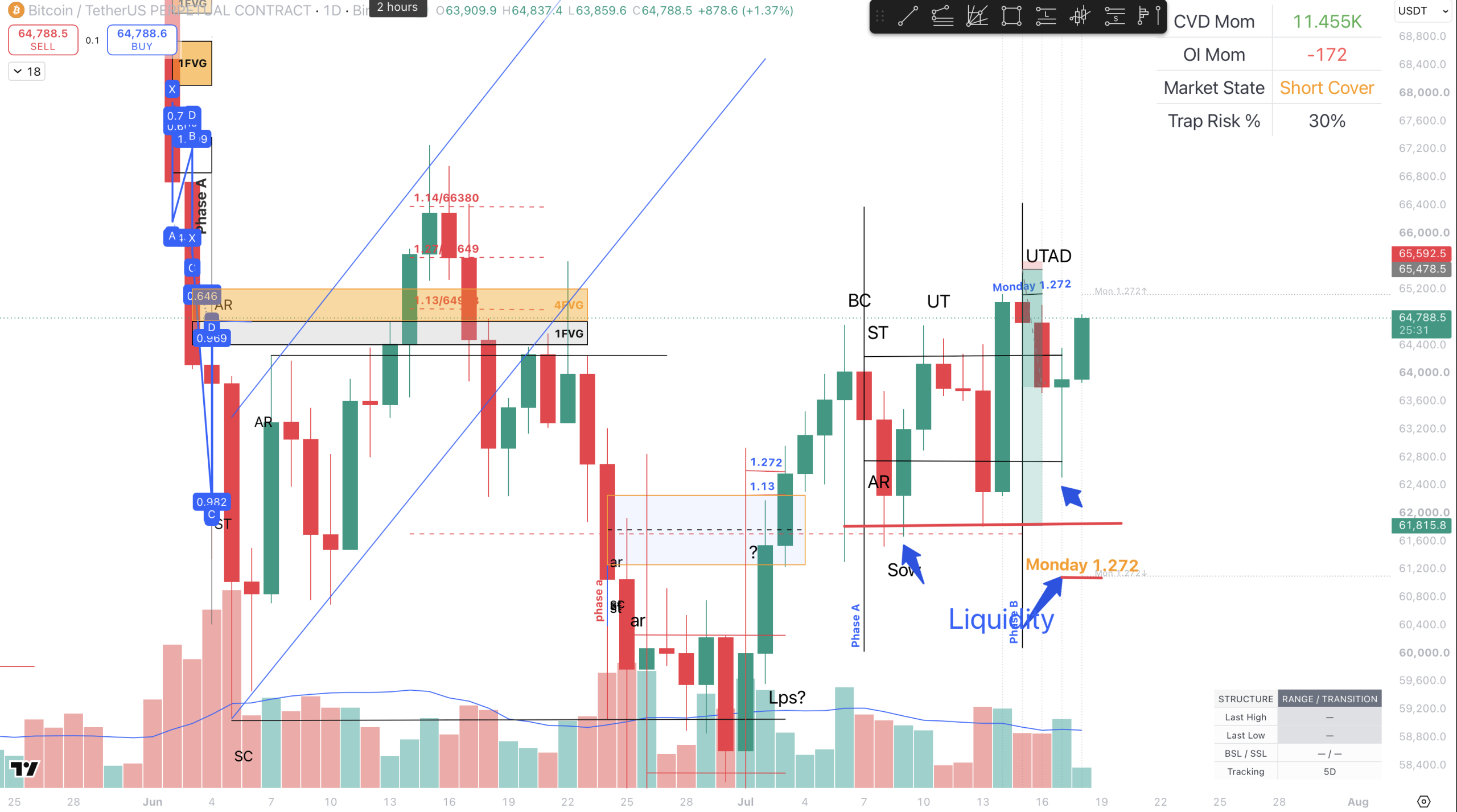
Markets rarely reward a trader simply for choosing the correct direction.
A bullish opinion can still produce a losing trade when the entry is late, the invalidation is undefined, or the target is positioned directly into opposing liquidity. A bearish thesis can be structurally reasonable and still fail when price establishes acceptance above the level that was expected to hold.
This is why StructFirst begins with market structure rather than prediction.
Structure does not eliminate uncertainty. It organizes it.
It defines the market environment, identifies where liquidity is concentrated, separates observation from inference, and establishes what must occur before capital is committed. Most importantly, it provides a clear answer to the question that directional analysis often ignores:
What would prove the thesis wrong?
The StructFirst analytical sequence is:
HTF Structure → Liquidity → Intent → Confirmation → Failure Logic → Execution → Risk Management
Each stage has a separate purpose. Skipping one creates a gap between analysis and execution.
This guide explains how those stages work together and why market structure must come before indicators, patterns, narratives, and directional conviction.
What Does “Structure First” Mean?
Structure First does not mean that price is perfectly predictable.
It means that the trader defines the structural conditions before forming an executable directional thesis.
Before deciding whether to buy or sell, the trader should determine:
- Whether the controlling market is trending, ranging, accumulating, distributing, or structurally unresolved
- Where major swing highs, swing lows, and range boundaries are located
- Whether price is interacting with internal or external liquidity
- Whether the current movement shows acceptance, rejection, or compression
- What evidence would confirm a change in control
- What structural development would invalidate the thesis
- Whether the remaining target justifies the required risk
This process changes the trader’s first question.
Instead of asking:
Is price going up or down?
The trader asks:
What environment is price operating within, where is liquidity positioned, and what must happen before either direction becomes executable?
That difference is the foundation of StructFirst.
A directional opinion may be useful as a working hypothesis. It should never replace structural evidence.
HTF Structure Defines the Environment
Higher-timeframe structure establishes the environment in which lower-timeframe signals must be interpreted.
A five-minute bullish Change of Character can produce a short-term reaction while the Daily chart remains bearish. A 15-minute break above resistance may be meaningful for an intraday trader but irrelevant to the broader weekly structure. A lower-timeframe reversal signal should not automatically be promoted into a higher-timeframe trend reversal.
The controlling timeframe depends on the trade being planned.
A swing trader may use the Weekly and Daily charts to define the environment, the 4H chart to locate the setup, and the 1H or 15-minute chart to confirm execution. An intraday trader may use the Daily and 4H charts for context, the 1H chart for location, and the 15-minute or 5-minute chart for entry confirmation.
The exact combination can change. The hierarchy should not.
Higher timeframes answer:
- Is the market expanding or consolidating?
- Is the larger structure bullish, bearish, or neutral?
- Is price operating in premium, discount, or equilibrium?
- Is the current level part of an external range boundary or internal noise?
- Is the proposed trade aligned with or counter to the larger structure?
Lower timeframes answer:
- Has liquidity been accessed?
- Has displacement occurred?
- Has relevant structure changed?
- Has a retracement created an efficient entry?
- Where does the execution thesis fail?
The lower timeframe improves precision. It does not automatically override the higher timeframe.
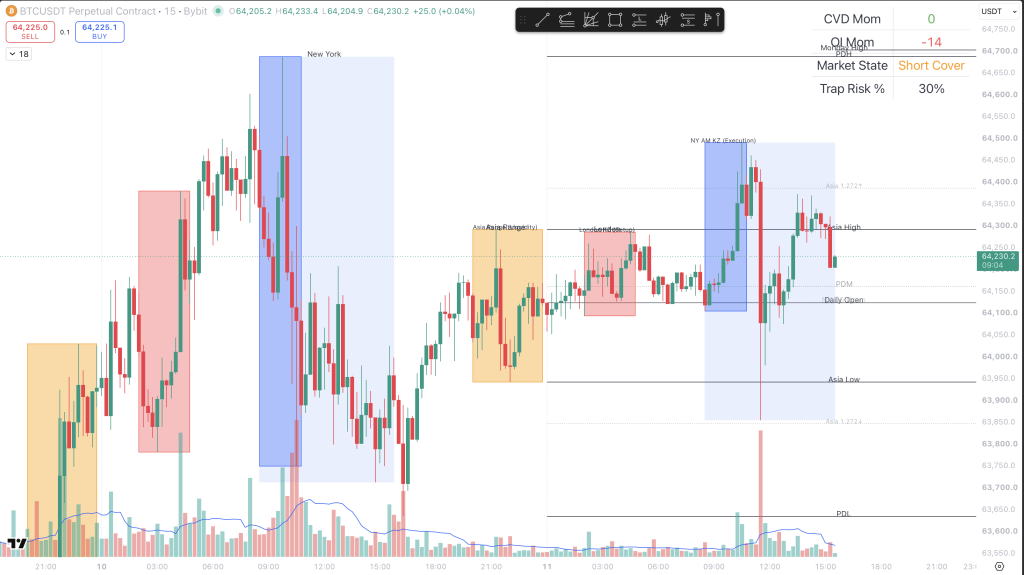
Session behavior also becomes more meaningful after the higher-timeframe environment has been defined.
An Asian-session low, London high, New York opening range, or prior-day boundary can provide an important liquidity reference. However, session timing alone is not a trade signal. It identifies when and where activity may increase. Structure and confirmation still determine whether the movement is executable.
Liquidity Defines the Decision Location
Market structure tells us where the market is operating. Liquidity helps explain why certain boundaries matter.
Liquidity frequently accumulates around visible references such as:
- Previous swing highs and lows
- Equal highs and equal lows
- Range boundaries
- Session highs and lows
- Prior-day and prior-week extremes
- Breakout levels
- Areas containing clustered stop-loss orders
Buy-side liquidity generally rests above visible highs. It can include stop-loss orders from short positions and buy-stop entries from breakout traders.
Sell-side liquidity generally rests below visible lows. It can include stop-loss orders from long positions and sell-stop entries from breakdown traders.
These areas matter because larger orders require counterparties. However, the presence of liquidity does not independently prove institutional intent.
A move above a previous high does not automatically mean larger participants are selling. A move below a previous low does not automatically mean they are accumulating long positions.
It confirms only that price traded into an area where orders were likely concentrated.
What happens afterward determines the structural meaning.
For a complete explanation of this distinction, read What Is a Liquidity Sweep? Confirmation, Failure, and Execution.
The Three Possible Outcomes
After liquidity is accessed, price can produce three broad outcomes.
Reversal
Price trades through the liquidity level, rejects the new area, displaces in the opposite direction, and breaks meaningful lower-timeframe structure.
Continuation
Price accesses internal or opposing liquidity but quickly realigns with the controlling higher-timeframe trend. The sweep provides liquidity for continuation rather than reversal.
Breakout and acceptance
Price trades through the liquidity boundary, remains beyond it, builds value, and potentially retests the former boundary as support or resistance.
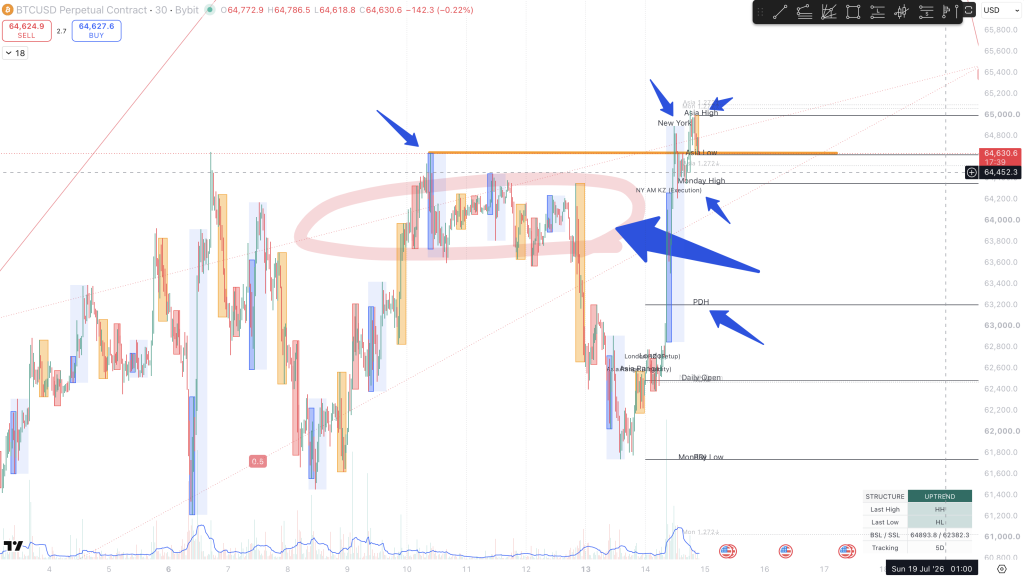
The liquidity event is not the complete trade.
It identifies where the investigation begins.
Intent Must Be Inferred, Not Claimed
Traders often use phrases such as “institutional intent” or “smart money manipulation” as though the motives of every market participant can be known directly.
They cannot.
Intent must be inferred from visible evidence, including:
- Structural location
- Candle-body acceptance
- Wick behavior
- Volume
- Displacement
- Effort versus result
- Failure to continue
- Successful or failed retests
- Repricing away from a level
StructFirst separates analysis into three categories.
Confirmed Observation
A confirmed observation describes what the chart visibly shows.
Examples:
- Price traded above a previous swing high.
- A 4H candle closed above the range boundary.
- Volume expanded during the move.
- A meaningful 15-minute low was broken.
Structural Inference
A structural inference explains what the evidence may suggest.
Examples:
- Buying may be encountering significant supply.
- The breakout may be failing to establish acceptance.
- The displacement may indicate a shift in short-term control.
- The range may be transitioning into redistribution.
An inference can be reasonable without being certain.
Unconfirmed Possibility
An unconfirmed possibility identifies a scenario that may develop but has not yet produced sufficient evidence.
Examples:
- The sweep could become a UTAD.
- The reaction could develop into a Spring.
- The harmonic PRZ could produce a reversal.
- The breakout could fail and return to the range.
These possibilities should guide observation—not justify immediate execution.
A professional analysis does not hide uncertainty. It defines what evidence would reduce it.
Confirmation Comes After the Event
A liquidity sweep, harmonic completion, resistance test, Wyckoff label, or lower-timeframe CHoCH is an event.
Confirmation is the market’s response to that event.
Useful confirmation may include:
- Strong displacement away from the decision level
- A break of a structurally meaningful swing
- Candle-body acceptance back inside or beyond a range
- Failure to reclaim the displacement origin
- A successful retest of the broken boundary
- Volume that supports the price response
- Continued value formation on the confirmed side of the structure
No individual signal should be treated as universally sufficient.
A wick through a high can show that price traded above it. It does not independently prove a bearish reversal.
A large candle through resistance can show displacement. It does not independently prove sustained acceptance if price immediately returns below the level.
A CHoCH can show that one local sequence changed. It does not automatically confirm that the entire higher-timeframe trend has reversed.
Candles should therefore be read as footprints within structure rather than isolated patterns. The difference between a wick, body close, displacement candle, and absorption event is examined in Candles Are Footprints: Reading Liquidity, Volume, and Institutional Intent.
Confirmation must be proportional to the trade.
A short-term scalp may require lower-timeframe evidence. A swing trade challenging the Daily trend requires stronger and more durable structural confirmation.
Invalidation Must Come Before Targets
Many trading plans define an entry and several profit targets but provide only a vague stop-loss rule.
StructFirst reverses that priority.
Before calculating a target, define what price behavior proves that the thesis is wrong.
A bearish rejection thesis may fail if price:
- Closes decisively above resistance
- Maintains acceptance above the swept high
- Converts former resistance into support
- Invalidates the bearish displacement
- Continues forming higher lows above the reclaimed boundary
A bullish reversal thesis may fail if price:
- Returns below the reclaimed level
- Loses the displacement origin
- Breaks the swing supporting the bullish shift
- Fails to hold the range recovery
- Establishes acceptance beneath the supposed reversal zone
Invalidation is not simply the price at which the trader no longer wants to lose money.
It is the structural event that proves the logic behind the trade is no longer valid.
A setup with an arbitrary stop may appear attractive but lacks analytical consistency. A valid stop should sit beyond the structure that disproves the thesis.
Only after that invalidation is defined should the trader assess the next target liquidity and determine whether the available reward justifies the risk.
The updated Bitcoin 4H Resistance Zone: Liquidity, Confirmation, and Invalidation Research Note demonstrates this two-sided process: rejection required structural failure, while sustained acceptance above resistance invalidated the bearish thesis.
Failure Logic Prevents Thesis Attachment
Invalidation identifies where a trade thesis fails. Failure logic explains how it fails.
This distinction matters because a thesis often weakens before a hard stop is reached.
Suppose price sweeps a range high and initially rejects. The bearish interpretation begins to weaken if price:
- Reclaims the high
- Erases the bearish displacement
- Holds above the former resistance
- Builds repeated higher lows
- Fails to continue toward sell-side liquidity
The trader should not continue describing the movement as a bearish liquidity trap after the market has begun establishing acceptance above the supposedly failed breakout.
Failure logic prevents a market opinion from becoming an identity.
It gives the trader permission to reduce risk, exit, or remain flat when the expected sequence stops developing.
Execution Comes After Confirmation
A correct location is not automatically an entry.
Execution should occur only after the market provides enough evidence to define the entry, invalidation, and target as one connected structure.
A typical StructFirst execution sequence is:
- Define the controlling higher-timeframe environment.
- Mark external and internal liquidity in advance.
- Wait for price to reach a meaningful decision location.
- Observe whether liquidity is accessed.
- Evaluate displacement and acceptance.
- Confirm that meaningful structure has changed or held.
- Wait for an efficient retracement when available.
- Define structural invalidation.
- Identify the next opposing liquidity target.
- Confirm that the reward justifies the risk.
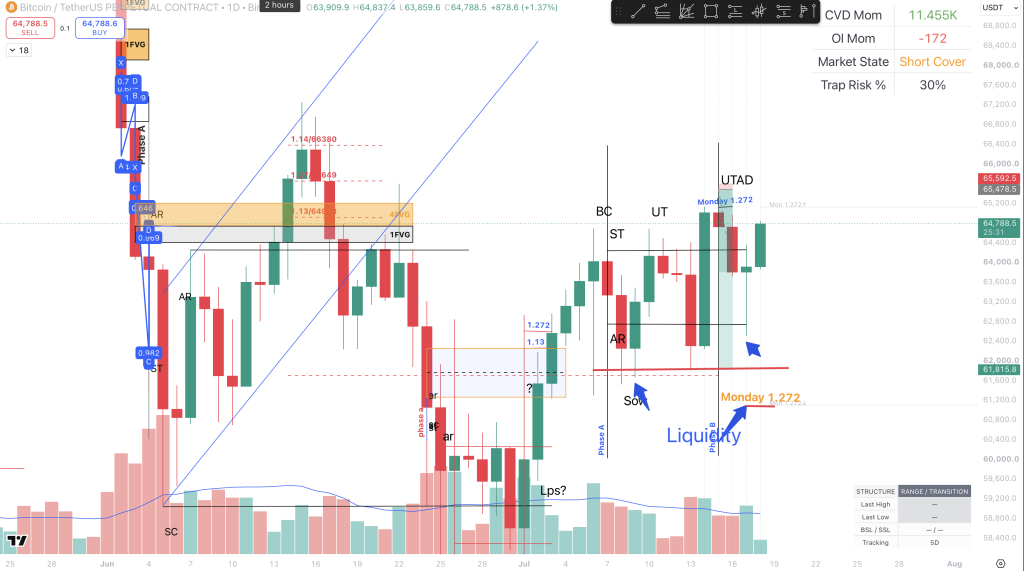
Potential execution tools may include:
- Fair Value Gaps
- Order Blocks
- Breakers
- Mitigation areas
- Premium and discount
- Session-based liquidity
- Retests of broken structure
These tools refine execution. They should not create a thesis that the larger structure does not support.
A Fair Value Gap without relevant displacement is simply an imbalance. An Order Block that fails to produce a structural response should not be defended indefinitely. A retracement into premium is useful only when the bearish thesis has already earned confirmation.
How ICT, Wyckoff, Harmonics, and MDA Fit Together
StructFirst does not treat ICT, Wyckoff, Harmonic patterns, volume analysis, and MDA as competing systems.
Each framework answers a different question.
ICT
ICT concepts help identify liquidity, imbalances, session timing, premium and discount, and lower-timeframe execution locations.
They are most useful when the higher-timeframe structure and target liquidity have already been defined.
Wyckoff
Wyckoff analysis helps evaluate the progression of supply and demand inside a range.
Accumulation, distribution, redistribution, Springs, Upthrusts, Signs of Strength, and Signs of Weakness should only be labeled when the sequence of price and volume supports them.
The chart should produce the label. The label should not be forced onto the chart.
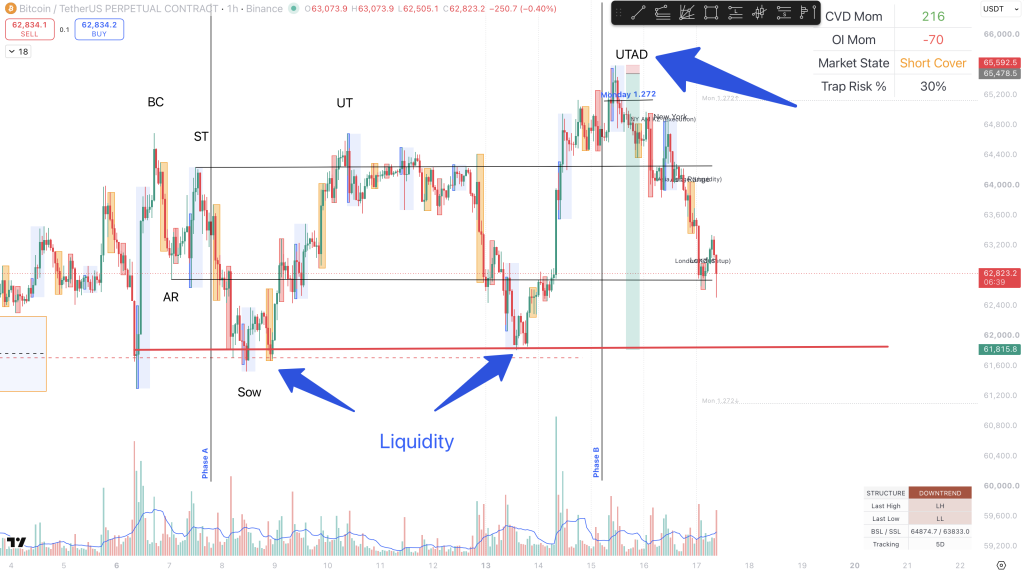
A practical application is available in Bitcoin Wyckoff Redistribution: How the 6H Structure Confirmed Markdown.
Harmonic Patterns
Harmonic structures identify potential reaction zones through Fibonacci relationships.
A Potential Reversal Zone is a location—not a reversal signal.
Price must still demonstrate acceptance or rejection at the PRZ. A harmonic completion without structural confirmation may continue through the expected reversal area or extend to a deeper ratio.
Volume and Candle Footprints
Volume helps compare effort with result.
Large volume with limited price progress may suggest absorption. Strong volume combined with decisive displacement may support a repricing event. Low-volume continuation into resistance may indicate weakening demand, but the structural response must still confirm the interpretation.
MDA D1–D10
MDA should verify alignment and contradiction across multiple structural dimensions.
It should not be used to manufacture certainty by requiring every observation to support the preferred thesis.
The purpose is to identify:
- Which dimensions align
- Which dimensions conflict
- Which evidence remains unavailable
- Whether lower-timeframe confirmation supports the controlling structure
- Whether the setup remains executable despite unresolved contradictions
No framework should override contradictory price behavior.
Common Structural Trading Mistakes
Predicting Direction Before Defining Structure
Directional conviction creates confirmation bias when the trader has not first identified the market environment and failure condition.
Treating Every Sweep as a Reversal
A sweep confirms liquidity access. It can lead to reversal, continuation, or acceptance.
Promoting a Minor CHoCH Into an HTF Reversal
A lower-timeframe structural shift may provide a reaction without changing the Daily or Weekly trend.
Confusing a Breakout With Acceptance
A level can be broken temporarily and still fail. Acceptance requires continued trading and value formation beyond the boundary.
Forcing Wyckoff Labels
Not every consolidation is accumulation or distribution. A range can remain unresolved for longer than expected.
Trading a Harmonic PRZ Without Confirmation
Fibonacci geometry identifies a possible reaction area. It does not provide automatic permission to enter.
Defining Targets Before Invalidation
A projected target has little value when the trader cannot explain where the thesis fails.
Entering in the Middle of a Range
The center of a consolidation often offers poor invalidation, unclear intent, and weak reward relative to both liquidity boundaries.
Holding a Thesis After the Market Invalidates It
The market is not required to respect the analysis. The analysis must change when the structure changes.
The StructFirst Execution Checklist
Before entering a trade, ask:
- What is the controlling higher-timeframe structure?
- Is the market trending, ranging, or structurally unresolved?
- Where are external and internal liquidity positioned?
- Has a meaningful liquidity event occurred?
- What is confirmed observation, and what is only inference?
- Has the market shown displacement or acceptance?
- Was the broken swing structurally meaningful?
- What specifically confirms the thesis?
- What specifically invalidates it?
- Where is the next opposing liquidity target?
- Does the available reward justify the structural risk?
- Is no-trade the more professional decision?
A setup that cannot answer these questions is not ready for execution.
No-Trade Is a Structural Decision
A professional framework must explain when not to participate.
No-trade is appropriate when:
- Price remains in the middle of unresolved structure
- External liquidity has not been accessed
- A sweep occurs without displacement
- A breakout occurs without acceptance
- Lower-timeframe signals contradict the higher-timeframe environment
- Invalidation is too wide relative to the next target
- The efficient entry has already passed
- Volume and candle behavior remain inconclusive
- The thesis depends more on prediction than observable evidence
Missing a move is less damaging than forcing a trade that lacks structural clarity.
Capital preservation is not separate from the trading edge. It is part of the edge.
How the StructFirst Knowledge System Works
StructFirst content is divided into three connected layers.
Structure Guides Explain the Concepts
Structure Guides provide evergreen explanations of liquidity, market structure, confirmation, invalidation, volume, Wyckoff, ICT, Harmonics, and execution.
For example, the Liquidity Sweep Guide explains why liquidity access is only the beginning of the analysis.
Research Notes Document the Evidence
Research Notes examine how those concepts appeared in specific charts and market conditions.
The Liquidity Trap Breakout Research Note examines how a breakout can become a trap only after acceptance fails and lower-timeframe structure confirms weakness.
Live Briefings Define Current Conditions
Live Briefings focus on current structure, active liquidity, required confirmation, invalidation, target liquidity, and no-trade conditions.
The UTAD Short Setup Live Briefing provides a practical example of moving from higher-timeframe location to lower-timeframe execution.
The three content types should not repeat one another.
A Structure Guide explains the model. A Research Note documents the case. A Live Briefing defines the active decision conditions.
Together, they create one connected structural knowledge system.
Frequently Asked Questions
Is market structure more important than indicators?
Market structure defines the environment in which indicators should be interpreted. An indicator can provide supporting information, but it should not override contradictory price structure, acceptance, liquidity positioning, or invalidation.
Does a CHoCH confirm a trend reversal?
Not automatically. A CHoCH confirms that a local sequence changed. Its significance depends on the timeframe, the swing that was broken, the higher-timeframe context, displacement, and subsequent acceptance.
Is a liquidity sweep always a reversal signal?
No. A liquidity sweep confirms that price accessed an identifiable order pool. Price may reverse, continue with the existing trend, or establish acceptance beyond the liquidity boundary.
Why must invalidation be defined before targets?
Invalidation establishes whether the thesis is structurally testable. Once the failure condition is known, the trader can compare the required risk with the next logical liquidity target and decide whether the trade is executable.
When is no-trade the correct decision?
No-trade is correct when confirmation is absent, structure is unresolved, invalidation is unclear, or the remaining target does not justify the required risk.
Expand Your Structural Edge
Market structure does not provide certainty.
It provides a disciplined process for operating without certainty.
Higher-timeframe structure defines the environment. Liquidity defines the decision location. Price behavior provides evidence of intent. Confirmation determines whether the thesis becomes executable. Failure logic and invalidation protect the trader when the market does not follow the expected sequence.
The purpose of StructFirst is not to produce stronger opinions.
It is to produce clearer decisions.
Define the structure before predicting direction. Identify liquidity before choosing an entry. Demand confirmation before committing risk. Define failure before calculating the target.
Structure identifies the environment.
Liquidity identifies the event.
Confirmation defines the trade.
Invalidation controls the risk.
Track the live order flow and volume footprint yourself directly on TradingView.
Leave a Reply