StructFirst Core Guide #004
BOS vs CHoCH is often taught as a simple distinction between continuation and reversal.
Most traders learn market structure through a collection of labels.
A previous high breaks, and the chart prints BOS.
A protected low fails, and the indicator marks CHoCH.
Price accelerates through a swing, and the move is described as a Market Structure Shift.
The definitions look clear. The chart looks organized. The decision appears easy.
Buy after bullish BOS.
Sell after bearish CHoCH.
Assume the trend has reversed after MSS.
That simplicity is appealing, but it creates one of the most persistent mistakes in structural trading:
A BOS is not automatically continuation. A CHoCH is not automatically reversal. An MSS is not meaningful merely because a line on the chart was crossed.
The market does not reverse because a CHoCH label appears.
A CHoCH appears because price may already be responding to liquidity, positioning, order flow, a failed auction, or a meaningful higher-timeframe location.
The label is not the cause of the move.
It is evidence produced by the move.
At StructFirst, market structure is read through a broader decision sequence:
Higher-Timeframe Structure
→ Location
→ Liquidity
→ Institutional Intent
→ Confirmation
→ Failure Logic
→ Execution
→ Risk Management
This sequence expands on the central principle introduced in Why Market Structure Comes First: directional prediction should never come before structural context.
The framework developed through repeated study of live Bitcoin price action—not by memorizing idealized textbook diagrams.
There were many occasions when a bearish CHoCH appeared and price reclaimed the broken level almost immediately. Bullish BOS signals frequently formed inside ranges and failed before external liquidity had been reached. Potential Wyckoff Springs appeared without meaningful acceptance. Harmonic reversal zones reacted briefly, then extended toward 1.406 or 1.618. High volume appeared, but price did not produce the expected directional response.
The labels were not necessarily incorrect.
The mistake was asking the labels to provide information they could not provide on their own.
A structural break can tell us that a swing was violated. It cannot independently tell us:
- whether meaningful liquidity had already been taken,
- whether price was trading at premium or discount,
- whether the break occurred inside a range or through external structure,
- whether displacement confirmed aggressive repricing,
- whether the broken level was accepted,
- whether the move aligned with the higher timeframe,
- or where the structural thesis should fail.
This guide explains how BOS, CHoCH, and Market Structure Shift should be used inside a complete trading process.
The objective is not to label more swings.
The objective is to understand which structural changes deserve attention, which require additional confirmation, and which should be ignored.
Why Most Traders Misread BOS and CHoCH
Most traders do not misunderstand the basic definitions of BOS and CHoCH.
They misunderstand the role those definitions should play in a real trading decision.
A common educational model teaches:
- BOS confirms trend continuation.
- CHoCH warns of a possible trend reversal.
- MSS confirms that order flow has changed.
Those statements are directionally useful.
They become dangerous when treated as automatic entry instructions.
A single consolidation can contain dozens of lower-timeframe structural breaks. Every minor swing can be labeled. Each five-minute rotation can produce another BOS, CHoCH, or MSS depending on the sensitivity of the indicator.
The result is often a chart full of labels but without a clear hierarchy.
Context Separates Information From Noise
Consider two bearish CHoCH events.
The first appears near the middle of a wide trading range. No major high has been swept. Price breaks a small internal low with overlapping candles and remains above the range midpoint.
The second appears after price reaches higher-timeframe premium, sweeps a well-defined prior high, fails to maintain acceptance above it, displaces lower, and breaks a meaningful protected low.
Both events may be labeled bearish CHoCH.
They do not carry the same information.
The first may represent:
- internal rebalancing,
- short-term profit-taking,
- a minor session rotation,
- stop collection,
- or ordinary range noise.
The second may represent:
- rejection after buy-side liquidity was taken,
- a failed breakout,
- a Wyckoff UTAD,
- distribution,
- or the beginning of sustained bearish repricing.
The label is identical.
The process behind the label is not.
A Recurring Bitcoin Lesson
Repeated review of Bitcoin structure revealed a common pattern: early structural changes often appeared before the market completed its larger liquidity objective.
A bearish CHoCH could form below a local high, attract early shorts, and then fail when price returned to take the more important external high.
A bullish CHoCH could form before a final sell-side liquidity run, stopping early long positions before the genuine reversal sequence began.
The structural reaction was visible.
The liquidity process was incomplete.
That distinction led to a more useful question:
What liquidity event gives this structural break meaning?
Without an answer, the label remains incomplete.
This is why StructFirst does not begin with BOS or CHoCH.
It begins with location and liquidity.
The same problem can be seen in Bitcoin Asian Range Liquidity Trap: 1.272–1.618 Sweep and Reclaim, where an apparent breakout could not be evaluated correctly without first understanding the liquidity sitting beyond the session range.
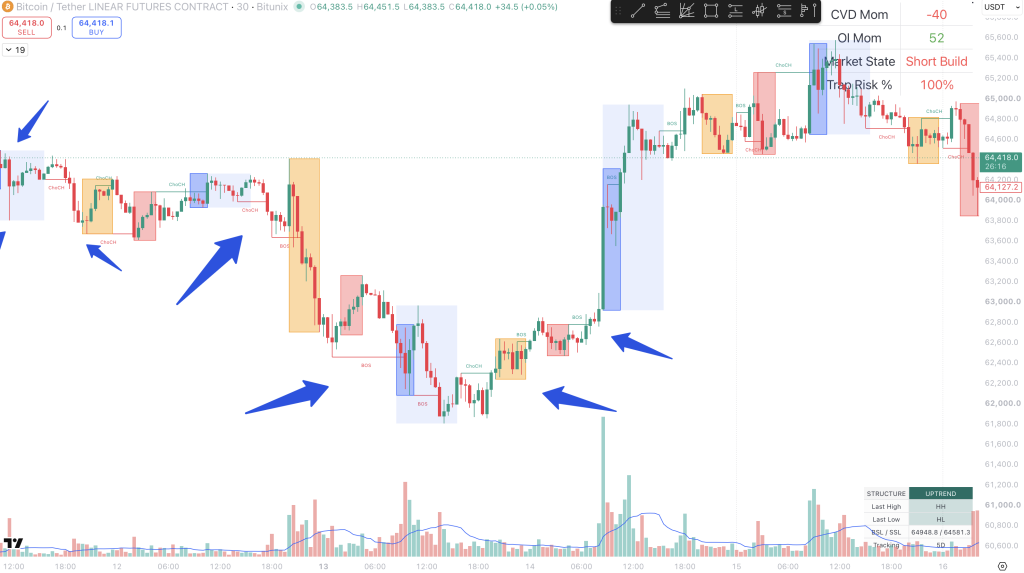
The same structural label can carry very different meaning depending on whether it appears inside a range or after liquidity is taken at a meaningful external level.
The chart should not be read as a collection of independent signals.
It should be read as a hierarchy.
Some breaks change only the internal auction.
Others materially alter the external structure.
Understanding that distinction matters more than the label itself.
What BOS, CHoCH, and Market Structure Shift Actually Mean
Different trading communities do not always use these terms in exactly the same way.
ICT traders, discretionary price-action traders, algorithmic indicators, and social-media educators may apply different swing rules or naming conventions.
The terminology becomes more useful when it is tied to observable market behavior.
Break of Structure: Continuation Through a Meaningful Swing
A Break of Structure, or BOS, usually describes price breaking a previous structural swing in the direction of the prevailing order flow.
In a bullish sequence:
- price forms a higher high,
- retraces,
- protects a higher low,
- then breaks the previous high.
In a bearish sequence:
- price forms a lower low,
- retraces,
- protects a lower high,
- then breaks the previous low.
BOS is commonly interpreted as continuation.
However, a meaningful BOS should involve more than a wick through a small pivot.
The trader should ask:
- Was the swing structurally important?
- Was it internal or external?
- Did price close through it?
- Was there displacement?
- Did price hold beyond the break?
- Was the move immediately rejected?
- Did the break follow a meaningful liquidity event?
- Is there a logical liquidity objective beyond it?
A minor wick above an intraday high does not carry the same information as a decisive close through an external swing with expansion and follow-through.
The difference between a wick, a candle-body break, and genuine acceptance is explored more fully in Candlestick Footprints: Reading Institutional Intent.
BOS should therefore be understood as:
Evidence that the current directional auction may be continuing.
It is confirmation, not certainty.
Change of Character: The First Meaningful Challenge to Prior Order Flow
A Change of Character, or CHoCH, usually describes the first meaningful structural break against the prior directional sequence.
In a bullish structure, price may stop producing higher highs and higher lows, then break a protected higher low.
In a bearish structure, price may stop producing lower lows and lower highs, then break a protected lower high.
CHoCH can reveal the first behavioral change.
That phrase is important.
A CHoCH tells us that prior order flow has been challenged.
It does not automatically confirm that a new trend has begun.
A bullish CHoCH inside a bearish higher-timeframe structure may produce only:
- a corrective rally,
- short covering,
- a move into premium,
- a return to an imbalance,
- or a lower high before continuation downward.
A bearish CHoCH inside a bullish higher-timeframe structure may produce only:
- a pullback,
- a move toward discount,
- a rebalance,
- or a higher low before continuation upward.
CHoCH is best understood as:
The first credible warning that previous directional behavior may be weakening.
It creates a hypothesis.
It does not complete the trade thesis.
Market Structure Shift: A Structural Change Supported by Repricing
A Market Structure Shift, or MSS, should carry a higher standard than a small countertrend swing break.
At StructFirst, MSS requires evidence that the auction is no longer behaving the same way.
That usually includes:
- a meaningful liquidity event,
- decisive displacement,
- a break through a relevant protected swing,
- expanding candle range,
- limited overlap,
- strong closes,
- potential imbalance or Fair Value Gap,
- and acceptance beyond the broken structure.
Many charting tools use CHoCH and MSS interchangeably.
StructFirst does not.
A small swing violation may qualify as a local CHoCH.
A true MSS should demonstrate repricing.
It should show urgency.
It should show that one side of the auction lost control.
It should show more than a technical line break.
Market Structure Does Not Begin With BOS
A common trading model begins like this:
- Wait for BOS.
- Enter on the retest.
- Place the stop beyond the swing.
- Target the next high or low.
This can work during clean directional markets.
It becomes unreliable when the trader does not first determine where price is trading within the larger auction.
BOS is an outcome.
It is not the original reason the market moved.
Price may produce BOS because:
- external liquidity has been cleared,
- trapped traders are being forced to exit,
- inventory is being repriced,
- a failed auction has reversed,
- imbalance is being delivered,
- or an existing trend is continuing toward the next liquidity pool.
The trader must decide which process is more likely.
The StructFirst Sequence
A more complete structural sequence is:
Higher-Timeframe Structure
→ Key Location
→ Liquidity Event
→ Price Response
→ Displacement
→ CHoCH or MSS
→ Retest
→ BOS
→ Execution
Not every trade will display every stage in exactly the same form.
Markets are adaptive, and execution models should not become rigid rituals.
But the sequence prevents a major mistake:
Entering because a structural label appeared before the market completed the event that gave the label meaning.
Why Early Entries Often Fail
Suppose Bitcoin is trading below a major prior high.
A minor bearish CHoCH appears on the five-minute chart.
A trader enters short.
Price falls briefly, reverses, takes the prior high, and only then produces decisive bearish displacement.
The original CHoCH was valid at the internal level.
But it occurred before the more important buy-side liquidity was reached.
The market still had unfinished business above.
This pattern appeared repeatedly in live chart review: a lower-timeframe break looked convincing, but the higher-timeframe liquidity map suggested that the larger objective had not yet been completed.
The practical lesson became:
Do not ask only whether structure broke. Ask whether the market had a reason to break there.
For a complete explanation of the difference between a sweep, a reversal, and genuine breakout acceptance, read What Is a Liquidity Sweep? Confirmation, Failure, and Execution.
Location Determines Whether Structure Matters
A structural break gains or loses significance according to where it occurs.
This is one of the most important principles in the guide.
A bearish CHoCH at higher-timeframe premium after buy-side liquidity has been swept is not equivalent to a bearish CHoCH in the middle of a range.
A bullish BOS at higher-timeframe discount after sell-side liquidity has been reclaimed is not equivalent to a bullish BOS forming directly into major resistance.
Meaningful Locations May Include
- higher-timeframe support and resistance,
- external swing highs and lows,
- previous day high and previous day low,
- previous week high and previous week low,
- Asian session high and low,
- New York session liquidity,
- premium and discount zones,
- order blocks,
- breaker structures,
- Fair Value Gaps,
- high-volume acceptance areas,
- Wyckoff Springs and UTADs,
- harmonic Potential Reversal Zones,
- Fibonacci extensions such as 1.272 and 1.618,
- channel boundaries,
- range extremes,
- and major unfilled liquidity pools.
Location does not guarantee reversal.
It creates the conditions in which a structural response becomes worth monitoring.
The higher-timeframe role of location is visible in Bitcoin Resistance Block: The 4H Structural Problem, where lower-timeframe reactions had to be interpreted inside a much larger resistance structure.
Location Creates the Setup, Not the Trade
A harmonic PRZ identifies an area where reversal risk may increase.
A Wyckoff Spring identifies a potential sell-side liquidity event.
A UTAD identifies a possible failed auction above a range.
A premium zone identifies where short opportunities may become more attractive.
None of these confirms execution by itself.
The sequence remains:
Location
→ Liquidity Event
→ Response
→ Confirmation
→ Execution
A Practical Lesson From the 1.272 Extension
In repeated Bitcoin analysis, the 1.272 extension frequently acted as a potential reaction zone.
Sometimes price responded immediately.
At other times, the move continued toward 1.406 or 1.618 before a meaningful structural change developed.
The conclusion was not that the 1.272 level had failed as a concept.
The lesson was that a harmonic extension identifies location—not an obligation for price to reverse.
The zone becomes actionable only when the market demonstrates acceptance or rejection through:
- liquidity behavior,
- displacement,
- volume response,
- structural confirmation,
- and follow-through.
The same principle applies to support, resistance, order blocks, and Wyckoff labels.
A level creates interest. Confirmation creates the trade.
The live Butterfly case in When Harmonics Meet Liquidity Traps illustrates this distinction clearly: pattern completion identified a potential reaction zone, but the liquidity response determined whether that zone could support an actual trade.
Liquidity Creates the Event
Structure shows how price is organizing.
Liquidity often explains why price moves toward specific levels before structure changes.
Markets frequently travel toward areas where orders are concentrated.
These may include:
- stop losses above prior highs,
- stop losses below prior lows,
- breakout orders,
- equal highs and equal lows,
- session boundaries,
- obvious trendline liquidity,
- resting orders around major swings,
- or traders trapped after a failed breakout.
When price reaches those pools, the interaction can create the conditions for structural change.
A Liquidity Sweep Is Not Automatically a Reversal
This principle must remain explicit.
Price can sweep a high and continue higher.
Price can sweep a low and continue lower.
A wick through liquidity proves that the level was traded through.
It does not prove that the opposing side gained control.
After the sweep, the trader must evaluate the response.
Questions include:
- Did price reclaim the level?
- Did candle bodies accept back inside the range?
- Was there displacement away from the sweep?
- Did volume expand without equivalent price progress?
- Was the response sustained?
- Did price break a meaningful opposing swing?
- Did the market hold the retest?
- Was there follow-through?
This is where liquidity and structure become connected.
The distinction between a liquidity trap and a confirmed breakout is also examined in The Liquidity Trap Breakout, where the quality of acceptance matters more than the initial move beyond the level.
A Higher-Quality Bearish Sequence
Higher-Timeframe Premium
→ Buy-Side Liquidity Sweep
→ Failed Acceptance Above the High
→ Bearish Displacement
→ Bearish CHoCH or MSS
→ Retest
→ Bearish BOS
→ Delivery Toward Sell-Side Liquidity
A Higher-Quality Bullish Sequence
Higher-Timeframe Discount
→ Sell-Side Liquidity Sweep
→ Reclaim
→ Bullish Displacement
→ Bullish CHoCH or MSS
→ Retest
→ Bullish BOS
→ Delivery Toward Buy-Side Liquidity
The sweep itself is not the signal.
The response to the sweep reveals whether the event produced a meaningful transfer of control.
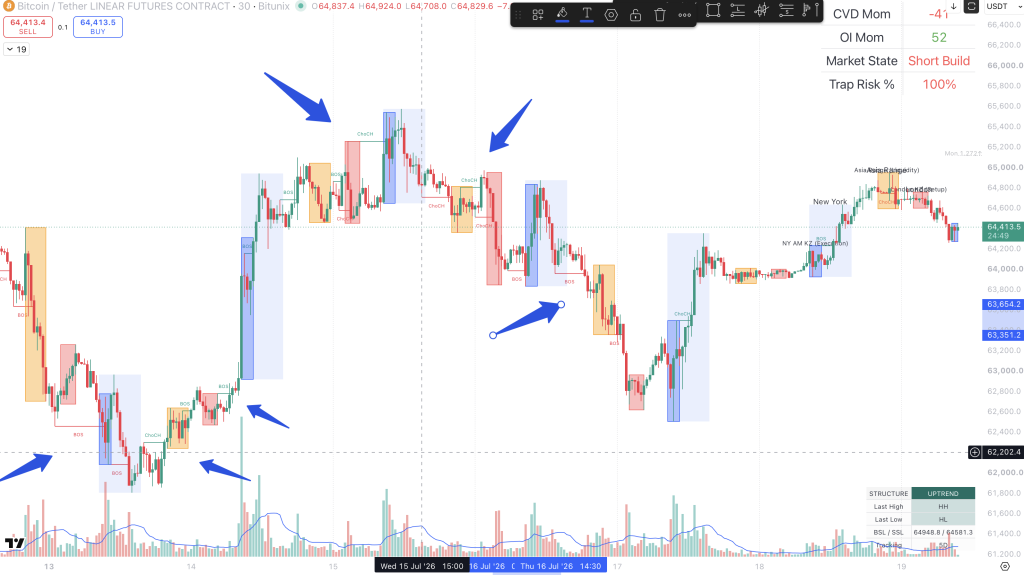
A session high or low becomes meaningful only when the liquidity sweep is followed by a decisive structural response.
Session-based price action makes the sequence especially visible.
A move beyond the Asian high or low may initially look like a breakout. If price fails to sustain acceptance, displaces through an opposing swing, and holds a retest, the breakout may have functioned primarily as a liquidity event.
Conversely, if price breaks the session boundary, accepts beyond it, retests successfully, and continues, the move may represent genuine continuation.
The same location can produce opposite outcomes.
Confirmation separates them.
A practical intraday version of this sequence appears in BTC 30M: The London Session Liquidity Sweep and ICT Turtle Soup, where session liquidity was taken before lower-timeframe structure became useful.
CHoCH Is the First Behavioral Shift, Not the Final Verdict
CHoCH is useful because it can reveal that the prior directional pattern is no longer intact.
But traders often place too much weight on the first countertrend break.
A CHoCH should be treated as an alert:
Something changed. Now determine whether the change is temporary, corrective, or structural.
What a Meaningful CHoCH Should Challenge
In a bullish structure, a bearish CHoCH should ideally break a meaningful protected higher low.
In a bearish structure, a bullish CHoCH should ideally break a meaningful protected lower high.
The swing should matter to the sequence.
Breaking a small internal pivot inside a larger range is not equivalent to breaking the level that was actively maintaining the prior trend.
The swing that CHoCH breaks must be structurally relevant. The most recent visible pivot is not automatically the swing protecting the directional thesis. For the complete framework, read What Are Protected Highs and Lows in Trading? Which Swing Actually Invalidates the Trade?.
CHoCH Can Lead to Several Outcomes
A bearish CHoCH may lead to:
- a shallow pullback,
- a deeper retracement,
- a rotation toward discount,
- a range move,
- a full bearish reversal,
- or a failed breakdown followed by continuation higher.
A bullish CHoCH may lead to:
- short covering,
- a corrective rally,
- a move toward premium,
- accumulation,
- a full bullish reversal,
- or a failed breakout followed by new lows.
This is why CHoCH should not be traded in isolation.
The trader must evaluate:
- higher-timeframe direction,
- location,
- liquidity already taken,
- displacement quality,
- volume behavior,
- the importance of the broken swing,
- retest behavior,
- and the BOS that follows.
Real Trading Lesson
Many losing trades share the same sequence.
The trader sees the first CHoCH and enters immediately.
The location may be reasonable, but the market has not demonstrated acceptance. The break may be too small. The displacement may be weak. The liquidity event may still be incomplete. Price returns through the level, stops the position, and only later develops the larger directional move.
The lesson is not to ignore CHoCH.
The lesson is to use it for what it provides:
Early evidence of behavioral change.
That evidence must then be tested.
A stronger process is:
Liquidity Sweep
→ CHoCH
→ Retest
→ Hold or Rejection
→ BOS
→ Execution or Continuation Management
Sometimes the CHoCH retest itself offers a valid entry, especially when displacement is strong and invalidation is clear.
At other times, waiting for BOS reduces uncertainty.
The choice depends on the setup, timeframe, execution model, and risk tolerance.
The principle does not change:
CHoCH creates a hypothesis. Price behavior after CHoCH determines whether that hypothesis deserves capital.
MSS Requires Displacement, Not Just a Broken Swing
One of the largest sources of confusion in modern market structure analysis is the relationship between CHoCH and MSS.
Many platforms use the labels interchangeably.
Many educators do the same.
StructFirst does not.
Although both terms describe a change in market behavior, they should not represent the same quality of event.
Why Every Swing Break Should Not Be Called MSS
Imagine price is trending higher.
A small bearish candle breaks the most recent internal higher low.
One indicator prints CHoCH.
Another prints MSS.
The more important question is:
Did the market actually reprice?
Or did it simply drift through a local swing before returning?
A genuine Market Structure Shift should demonstrate that the auction is no longer behaving as it did before.
The change should display urgency.
That urgency normally appears through displacement.
Displacement Is Evidence of Repricing
Traders often measure structure by counting swings.
A more useful approach is to examine how price moved through those swings.
Did price move slowly with repeated candle overlap?
Or did it accelerate through several levels with decisive closes?
Characteristics of displacement may include:
- large candle bodies,
- expansion in range,
- minimal overlap,
- one-sided closes,
- Fair Value Gap formation,
- rapid movement through protected structure,
- and limited immediate retracement.
Displacement is not important because large candles look dramatic.
It matters because aggressive participation is changing the balance between buyers and sellers.
A small CHoCH can therefore be technically valid while still failing to produce any meaningful change.
Price broke the swing.
The label appeared.
But the market immediately reclaimed the level.
The market had paused.
It had not repriced.
That leads to a practical rule:
A broken swing without displacement is often a warning—not a decision.
BOS Confirms Continuation After the Shift
Many traders think BOS starts the trend.
In reality, BOS often confirms that the transition has already occurred.
CHoCH asks:
Has prior order flow weakened?
MSS asks:
Is the market repricing?
BOS then asks:
Is the new directional auction continuing?
That is why sequence matters.
Liquidity
→ Displacement
→ CHoCH or MSS
→ Retest
→ BOS
→ Continuation
BOS appears later than many traders expect.
That is intentional.
By the time BOS develops, the market may already have shown:
- a meaningful location,
- a completed liquidity event,
- a change in order flow,
- acceptance beyond the broken swing,
- and a successful retest.
Waiting Improves Confirmation but Changes Reward-to-Risk
Entering immediately after CHoCH can produce excellent reward-to-risk.
It also produces more failed setups.
Waiting for BOS sacrifices part of the move.
It often removes some false reversals.
Neither approach is universally correct.
The correct choice depends on:
- timeframe,
- volatility,
- execution skill,
- confidence in the liquidity event,
- clarity of invalidation,
- and the trader’s risk model.
Both approaches should begin from the same foundation:
Meaningful location and liquidity—not labels.
Internal Structure vs External Structure
This distinction is essential.
Many traders accidentally confuse internal structure with trend-defining structure.
The result is constant bias changes and excessive trading.
A five-minute chart can produce many BOS and CHoCH labels inside a four-hour range.
The external auction may remain unchanged.
Internal Structure
Internal structure consists of smaller swings inside a broader range or trend leg.
It can help traders:
- refine entries,
- identify local shifts,
- reduce execution risk,
- time retests,
- and manage positions.
External Structure
External structure consists of major swing highs and lows that define the broader auction.
It helps determine:
- directional bias,
- major liquidity objectives,
- trend continuation,
- range boundaries,
- and whether the market has materially changed state.
Internal structure assists execution.
External structure defines context.
Confusing the two creates unnecessary trades.
A Practical Example
Suppose Bitcoin is approaching a major four-hour premium zone.
Several bullish BOS labels appear on the five-minute chart.
Should the higher-timeframe bias immediately become bullish?
Not necessarily.
Those internal BOS events may simply be carrying price toward premium before a larger distribution or rejection develops.
The lower timeframe may be bullish while the higher-timeframe trade location is becoming increasingly bearish.
This is not a contradiction.
It is a matter of structural hierarchy.
The Same BOS Can Mean Completely Different Things
Two charts can display the same bearish BOS label.
One leads to a sustained markdown.
The other fails immediately.
Why?
Because BOS never exists alone.
It belongs to a sequence.
Weak Example
- Middle of a range
- No external liquidity sweep
- No higher-timeframe confluence
- Weak displacement
- Heavy candle overlap
- Minor internal swing
- Immediate reclaim
A bearish BOS appears.
The informational value remains limited.
Stronger Example
- Higher-timeframe premium
- Buy-side liquidity swept
- Failed breakout
- Bearish displacement
- Meaningful CHoCH or MSS
- Retest rejection
- Bearish BOS
- Clear sell-side liquidity objective
The label is still BOS.
Everything around it has changed.
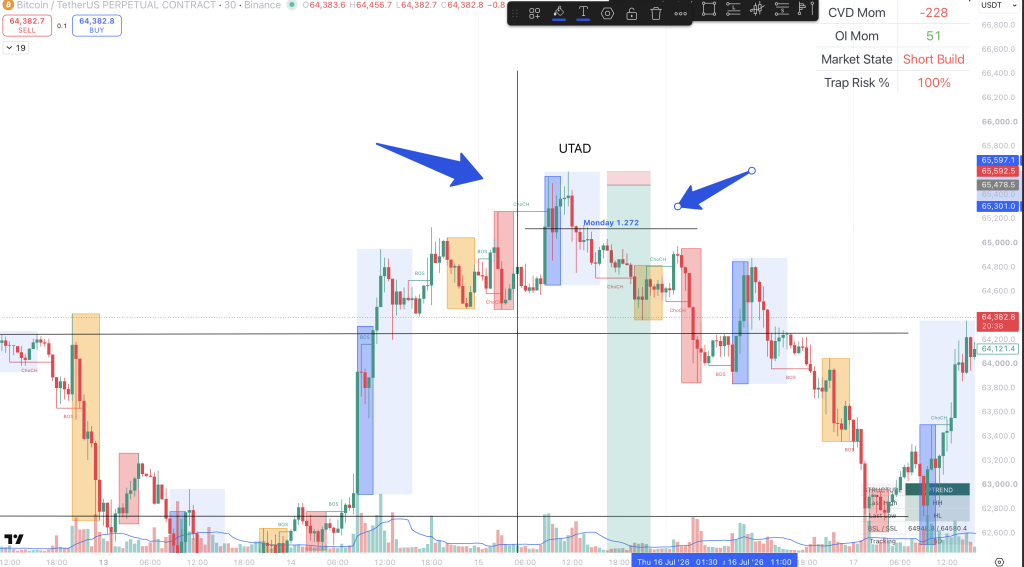
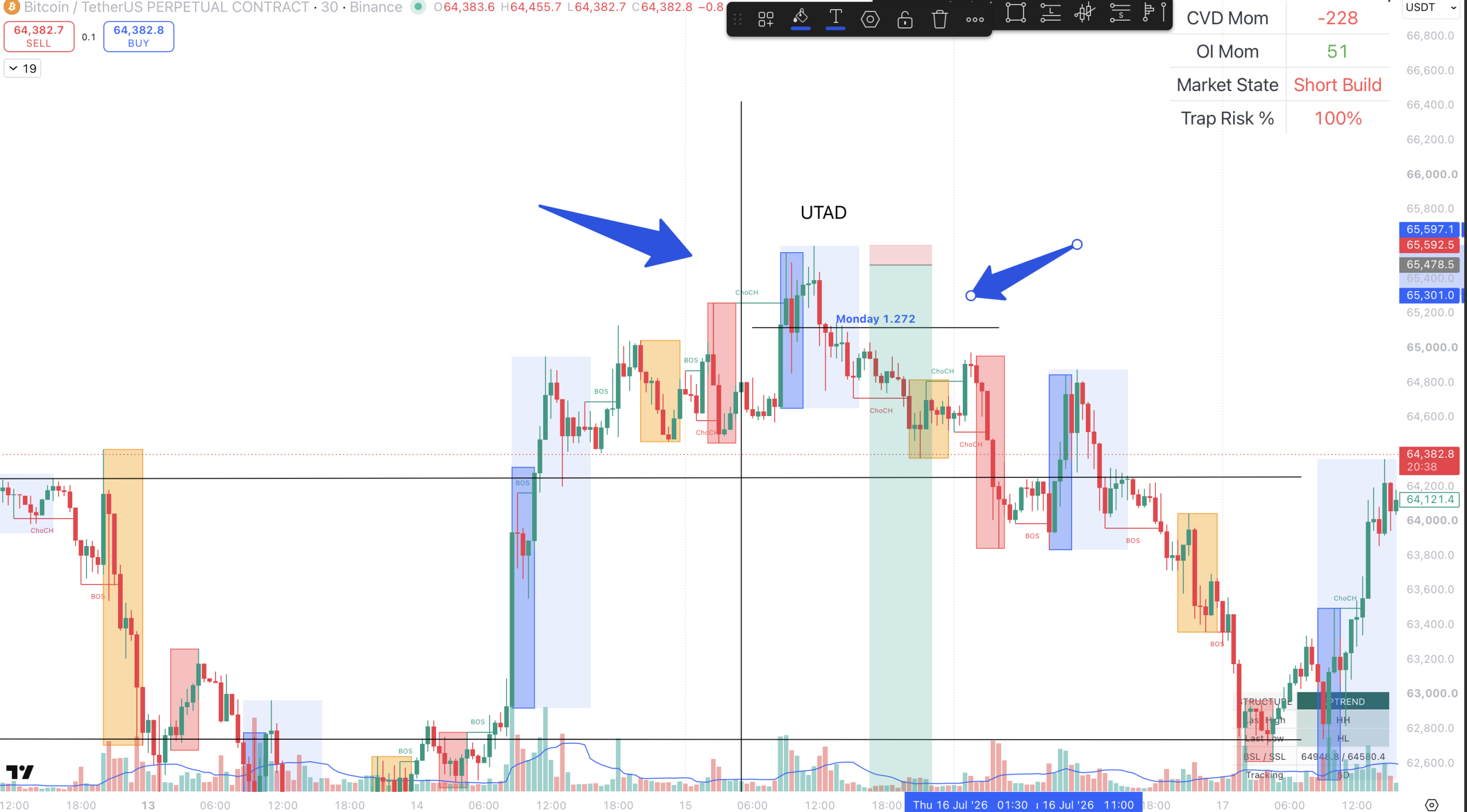
The bearish BOS matters because it follows premium location, a buy-side liquidity sweep, failed acceptance, displacement, and a confirmed change in order flow.
This example demonstrates why the sequence matters more than the label.
Price first traded into a higher-timeframe premium area.
Buy-side liquidity above previous highs was taken.
A harmonic extension near 1.272 aligned with the potential exhaustion zone.
The market failed to maintain acceptance above the breakout.
Bearish displacement followed.
The subsequent CHoCH became meaningful because it occurred after the liquidity event and through a relevant structural swing.
The later BOS then confirmed continuation toward lower liquidity.
The BOS did not create the opportunity.
The sequence created the opportunity.
A live execution example of this logic appears in UTAD Short Setup: Structural Trading and Trap Execution, where the failed breakout mattered only after the market revealed rejection and provided a structural failure point.
ICT, Wyckoff, and Harmonics Describe Different Parts of the Same Process
Traders often debate which methodology is superior.
ICT?
Wyckoff?
Harmonics?
Traditional price action?
StructFirst approaches the question differently.
Instead of asking which framework is best, ask what each framework contributes to the decision process.
ICT
ICT emphasizes:
- liquidity,
- session behavior,
- stop runs,
- dealing ranges,
- displacement,
- Fair Value Gaps,
- and price delivery.
Wyckoff
Wyckoff emphasizes:
- accumulation,
- distribution,
- Springs,
- Upthrusts,
- UTAD,
- effort versus result,
- absorption,
- and the transition between balance and trend.
Harmonics
Harmonic analysis emphasizes:
- geometric structure,
- Fibonacci relationships,
- extension targets,
- exhaustion zones,
- and Potential Reversal Zones.
Market Structure
Market structure helps measure:
- swing progression,
- continuation,
- behavioral change,
- protected highs and lows,
- acceptance,
- and failure.
These frameworks are not necessarily competing systems.
They often describe different parts of the same auction.
A harmonic PRZ may define location.
An ICT liquidity sweep may define the event.
A Wyckoff UTAD may describe the failed auction.
Displacement may reveal intent.
CHoCH or MSS may confirm behavioral change.
BOS may confirm continuation.
This integrated reading is particularly useful when comparing Bitcoin Wyckoff Redistribution on the 6H Chart with BTC 12H Structure: The Wyckoff Accumulation Hypothesis. Similar range behavior can support opposite hypotheses until liquidity, acceptance, and follow-through clarify which interpretation is gaining evidence.
The StructFirst principle is simple:
Use each framework where it adds information. Do not force every framework to answer every question.
Harmonic Patterns Define Location, Not Confirmation
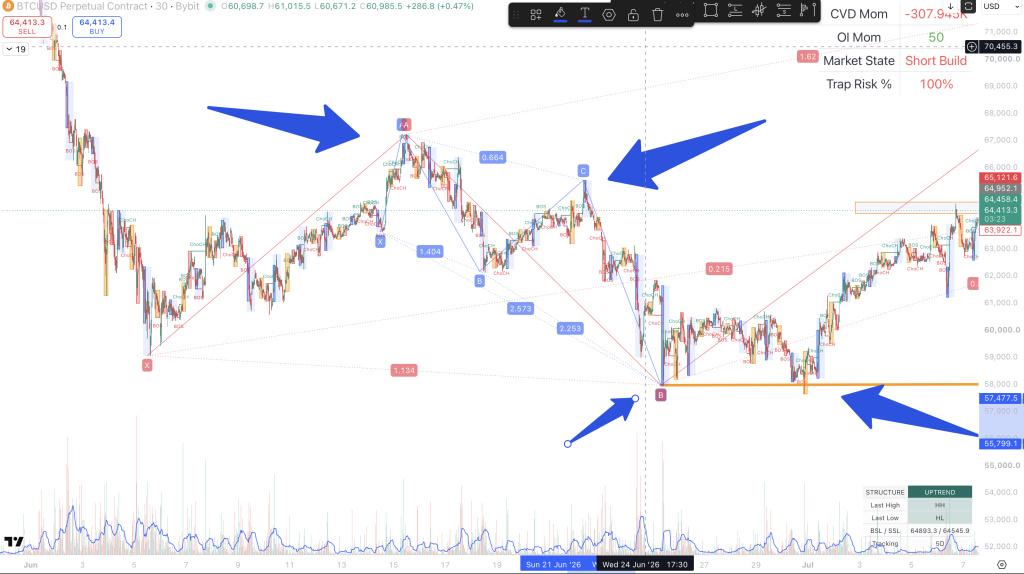
The harmonic pattern defines a potential reaction zone, while BOS, CHoCH, liquidity behavior, and acceptance determine whether price is reversing or continuing toward the next structural objective.
This Bitcoin chart combines a completed Butterfly pattern with a developing Shark structure.
Inside the larger harmonic framework, numerous bullish and bearish BOS and CHoCH labels appear.
At first glance, the chart may seem structurally confusing.
In reality, it demonstrates a critical distinction:
Internal structure can change repeatedly while the larger external structure remains intact.
The Butterfly completion identified a location where reaction risk increased.
It did not guarantee a durable reversal.
Price continued to rotate, retrace, and form multiple internal structural changes before the larger liquidity narrative became clearer.
The developing Shark pattern should be interpreted in the same way.
It is not a prediction that must complete.
It is a structural hypothesis.
Its value depends on how price behaves around meaningful external levels.
In this case, repeated defense of the major low near the lower range boundary carries more significance than many smaller bearish CHoCH labels above it.
A bearish CHoCH inside the range may represent a local rotation.
A decisive break of the external low with displacement and acceptance would represent a materially different event.
This is why StructFirst separates three layers:
Harmonic Location
→ Liquidity Interaction
→ Structural Confirmation
The harmonic pattern identifies where to pay attention.
Liquidity behavior explains what the market is testing.
BOS, CHoCH, and MSS help determine whether the reaction is becoming executable.
Weak BOS vs High-Probability BOS
A structural break does not become high probability merely because the line was crossed.
The quality of the setup comes from the evidence surrounding the break.
Characteristics of a Weak BOS
A weak BOS often:
- occurs near the middle of a range,
- follows no meaningful liquidity event,
- breaks only a small internal swing,
- lacks displacement,
- shows heavy candle overlap,
- produces little follow-through,
- immediately returns inside the broken level,
- or trades directly into opposing higher-timeframe structure.
The BOS may be technically valid.
The trade thesis remains incomplete.
Characteristics of a Higher-Quality BOS
A stronger BOS often develops after:
- a clearly defined higher-timeframe location,
- premium or discount alignment,
- an external liquidity sweep,
- decisive displacement,
- a meaningful CHoCH or MSS,
- acceptance beyond broken structure,
- a successful retest,
- and a visible liquidity objective ahead.
Notice that BOS appears near the end of the sequence.
The market has already revealed much of its intent before continuation is confirmed.
Bullish Structural Execution Model
A higher-quality bullish setup may develop as follows:
Higher-Timeframe Discount
→ External Sell-Side Liquidity
→ Liquidity Sweep
→ Spring, Turtle Soup, or Failed Breakdown
→ Bullish Displacement
→ Bullish CHoCH or MSS
→ Retest
→ Bullish BOS
→ Execution
→ Buy-Side Liquidity Target
Step 1: Establish Higher-Timeframe Context
The trader identifies:
- broader trend,
- range structure,
- premium and discount,
- major swing lows,
- and potential sell-side liquidity.
Without this step, a bullish lower-timeframe break may simply be a retracement inside a bearish market.
Step 2: Wait for the Liquidity Event
Price trades beneath a meaningful low.
That move alone is not enough.
The trader watches whether price:
- quickly reclaims the level,
- closes back inside the prior range,
- produces absorption,
- or displaces away from the sweep.
Step 3: Require a Meaningful Response
Bullish displacement should challenge a relevant bearish swing.
A minor bounce is not the same as a shift in order flow.
Step 4: Evaluate the Retest
The retest should help answer:
- Is the reclaimed level holding?
- Is the imbalance being respected?
- Are sellers regaining control?
- Is price accepting above the broken structure?
Step 5: Define Execution and Invalidation
The entry should be linked to a clear failure point.
Possible invalidation may sit:
- below the sweep,
- below the protected higher low,
- beneath the displacement origin,
- or beyond the level whose reclaim justified the trade.
Step 6: Target Liquidity
The target should be structural.
Potential objectives include:
- internal highs,
- session highs,
- previous day high,
- external buy-side liquidity,
- or a higher-timeframe imbalance.
Bearish Structural Execution Model
A higher-quality bearish setup may develop as:
Higher-Timeframe Premium
→ External Buy-Side Liquidity
→ Liquidity Sweep
→ UTAD, Failed Breakout, or Harmonic PRZ
→ Bearish Displacement
→ Bearish CHoCH or MSS
→ Retest
→ Bearish BOS
→ Execution
→ Sell-Side Liquidity Target
Step 1: Establish Premium and External Liquidity
The trader identifies:
- a major swing high,
- range premium,
- previous day or week high,
- session liquidity,
- harmonic extension,
- or a potential Wyckoff Upthrust.
Step 2: Observe the Sweep
Price trades through the high.
The trader does not assume reversal.
The critical issue is whether price can sustain acceptance above the level.
Step 3: Look for Failed Acceptance and Displacement
A failed breakout becomes more meaningful when price:
- closes back below the swept level,
- displaces through a protected low,
- leaves imbalance,
- and shows reduced ability to reclaim.
Step 4: Interpret CHoCH or MSS
A bearish CHoCH warns that bullish order flow has weakened.
A bearish MSS provides stronger evidence when the break is supported by displacement.
Step 5: Evaluate the Retest
A failed reclaim of the broken structure may offer execution.
The trader must still define invalidation before entry.
Step 6: Target Lower Liquidity
Potential targets may include:
- internal lows,
- session lows,
- previous day low,
- range equilibrium,
- external sell-side liquidity,
- or a higher-timeframe downside objective.
A live version of this sequence can be studied in BTC 30M: Trading the Wyckoff UTAD Trap, where the Upthrust itself was not enough; the failed acceptance and subsequent structural response created the bearish case.
Invalidation Defines Professional Trading
Perhaps the largest difference between amateur and professional trading is not analysis.
It is invalidation.
Many traders ask:
Where should I take profit?
A stronger process begins with:
Where does my thesis become objectively wrong?
A structural idea without invalidation is an opinion.
Invalidation Must Come Before Targets
Suppose a bullish setup develops after a sell-side liquidity sweep.
Price reclaims the level.
Bullish displacement appears.
A CHoCH or MSS forms.
The retest initially holds.
The trader must still ask:
- What price behavior would disprove the bullish interpretation?
- Would acceptance back below the sweep invalidate the setup?
- Would bearish displacement through the protected low invalidate it?
- Would failure to hold the reclaimed range invalidate it?
- Would the higher-timeframe structure remain compatible with the trade?
Only after those questions are answered should targets be planned.
Harmonic Invalidation
A harmonic PRZ does not become a successful reversal merely because price reacts.
Nor does it automatically fail because price slightly exceeds a Fibonacci level.
The structural thesis fails when market behavior demonstrates sustained acceptance beyond the zone that justified the idea.
This distinction matters because price can briefly overshoot a PRZ, sweep liquidity, and then reverse.
It can also touch the PRZ, bounce weakly, and later continue through it.
Failure is defined by market behavior—not by the trader’s emotional attachment to the pattern.
Common Mistakes When Trading BOS and CHoCH
1. Trading Every BOS
Not every structural break deserves capital.
A BOS inside a range may be valid but irrelevant to the higher-timeframe thesis.
2. Treating Every CHoCH as Reversal
CHoCH often marks the beginning of a corrective move rather than a full trend reversal.
3. Ignoring Liquidity
Structure without liquidity lacks context.
The trader sees the break but does not understand what event produced it.
4. Ignoring Higher-Timeframe Location
A bullish CHoCH at higher-timeframe premium may offer poor upside.
A bearish CHoCH at deep discount may offer poor downside.
5. Entering Before Displacement
Anticipation can improve reward-to-risk.
It also increases the number of failed entries.
Aggressive execution requires greater skill and clearer invalidation.
6. Confusing Internal and External Structure
A five-minute BOS does not automatically reverse a four-hour trend.
Timeframe hierarchy must remain clear.
7. Ignoring Acceptance
A wick through structure is not the same as sustained trading beyond it.
The close, follow-through, and retest matter.
8. Using Volume Without Price Response
High volume alone does not confirm direction.
High effort with limited result may indicate absorption.
The next structural response must reveal which side gained control.
9. Forcing Wyckoff Labels
Not every low is a Spring.
Not every high is a UTAD.
The label must remain a hypothesis until the market confirms acceptance or rejection.
10. Forcing Harmonic Completion
A PRZ is not a reversal signal.
It is a location where confirmation becomes worth monitoring.
11. Entering Because the Directional Thesis Feels Correct
A trader may ultimately be right about the destination and still lose through poor timing.
Direction and execution are separate skills.
12. Defining Targets Before Invalidation
A large target does not justify a weak setup.
Risk must be structurally defined first.
Real Trading Lesson: Correct Direction, Poor Execution
One of the most important lessons from repeated Bitcoin analysis was that good directional analysis did not automatically produce good trades.
There were times when the larger bearish thesis eventually proved correct.
The trade still failed because the entry came:
- after the first minor CHoCH,
- before external liquidity was taken,
- before displacement confirmed intent,
- in the middle of a range,
- or too close to support.
There were also occasions when a meaningful sell-side sweep occurred and a short position was correctly reduced, yet the trader struggled to take the temporary long opportunity because the broader bearish thesis remained psychologically dominant.
The market could be bearish on the higher timeframe and bullish on the lower timeframe.
Recognizing that intellectually was easier than executing it.
This revealed a critical distinction:
Bias describes the larger path. Execution responds to the current sequence.
A trader can maintain a bearish higher-timeframe destination while still respecting a lower-timeframe bullish liquidity reaction.
Likewise, a trader can maintain a bullish macro thesis while avoiding a premature long entry before the market completes a sell-side sweep.
The better question became:
Has the market confirmed enough evidence for me to risk capital now?
Not:
Am I ultimately right about direction?
That change improved the process more than adding another indicator.
The StructFirst BOS–CHoCH Checklist
Before entering a structural trade, ask:
Higher-Timeframe Structure
- What is the dominant higher-timeframe condition?
- Is price trending, ranging, accumulating, or distributing?
- Which external highs and lows define the auction?
Location
- Is price in premium, discount, or equilibrium?
- Is the setup forming at a meaningful higher-timeframe level?
- Is price near support, resistance, a range extreme, PRZ, Spring, or UTAD?
Liquidity
- What liquidity has already been taken?
- What liquidity remains unfinished?
- Was the move a sweep or genuine acceptance?
- Is the relevant liquidity internal or external?
Response
- Did price reclaim or reject the level?
- Did displacement occur?
- Did volume produce meaningful price progress?
- Did candle bodies accept beyond the structure?
Structural Confirmation
- Is the break CHoCH, MSS, or BOS?
- Was the broken swing meaningful?
- Is the structure internal or external?
- Did the retest hold?
- Did follow-through appear?
Execution
- Is the entry early, confirmed, or late?
- Is the reward-to-risk still reasonable?
- Is the setup aligned with the selected timeframe?
- Is the target based on liquidity rather than hope?
Failure Logic
- Where is the thesis objectively invalidated?
- What price behavior would prove the interpretation wrong?
- Can the risk be defined before entry?
When several answers remain unclear, the correct decision may be:
No Trade.
No-Trade Conditions
Professional trading is not about always having a position.
It is about knowing when the available evidence is insufficient.
StructFirst considers no-trade a valid decision when:
- price is trapped near the middle of a range,
- higher-timeframe structure is unclear,
- internal and external structure conflict,
- meaningful liquidity has not yet been reached,
- the sweep produced no displacement,
- acceptance is ambiguous,
- invalidation cannot be defined,
- the target is too close,
- the setup depends on forcing a Wyckoff or harmonic label,
- volume and price response disagree,
- or the trade is based primarily on prediction.
No trade is not failure.
It is preserved capital and preserved decision quality.
What Changed My Process
The earlier process often began with a structural label.
A CHoCH appeared.
A BOS formed.
The trade seemed ready.
The updated process begins much earlier:
Higher-Timeframe Structure
→ Meaningful Location
→ Liquidity Objective
→ Sweep or Acceptance
→ Price Response
→ Displacement
→ CHoCH or MSS
→ Retest
→ BOS
→ Execution
→ Invalidation
→ Liquidity Target
Today, BOS is no longer treated as the signal.
CHoCH is no longer treated as the reversal.
A Spring is no longer assumed from a wick below support.
A UTAD is no longer confirmed by a brief move above a range.
A harmonic PRZ is no longer treated as a guaranteed turning point.
Each is one piece of information inside a broader structural process.
The improvement did not come from labeling more accurately.
It came from becoming more selective about which labels deserved capital.
Frequently Asked Questions
Is BOS Enough to Enter a Trade?
No.
BOS should be evaluated together with higher-timeframe structure, location, liquidity, displacement, acceptance, retest behavior, and invalidation.
A technically valid BOS can still be low quality.
Does CHoCH Always Mean Trend Reversal?
No.
CHoCH usually indicates the first meaningful challenge to prior order flow.
It may lead to a retracement, range rotation, or complete reversal.
The outcome depends on context and follow-through.
What Is the Difference Between CHoCH and MSS?
CHoCH describes the first meaningful behavioral change against the previous structure.
MSS should demonstrate stronger repricing, usually through displacement and a break of a relevant protected swing.
StructFirst applies a higher evidentiary standard to MSS.
Does BOS Always Come After CHoCH?
Not in every labeling system or market sequence.
In a reversal framework, CHoCH or MSS often appears first, followed by BOS in the new direction.
During trend continuation, BOS may appear without a prior countertrend CHoCH.
The sequence should be interpreted behaviorally rather than mechanically.
Is a Wick Through a Swing Enough to Confirm BOS?
Not necessarily.
A wick can represent liquidity collection without acceptance.
Candle closes, displacement, follow-through, and retest behavior provide stronger confirmation.
Which Is More Important: Liquidity or Structure?
They answer different questions.
Liquidity helps explain what the market is seeking or testing.
Structure helps show how price responds.
In many higher-quality setups, the liquidity event occurs first and structural confirmation follows.
Does a Liquidity Sweep Guarantee Reversal?
No.
A sweep proves that liquidity was traded through.
It does not prove rejection.
Price may accept beyond the level and continue.
The response after the sweep determines its meaning.
Are Harmonic Patterns Enough to Enter a Reversal?
No.
A harmonic completion identifies a potential reaction zone.
Execution still requires confirmation through liquidity behavior, displacement, structure, acceptance, and invalidation.
Is a Wyckoff Spring Automatically Bullish?
No.
A move below support becomes a stronger Spring candidate only when price reclaims the range, shows meaningful response, and confirms strength.
A failed reclaim may instead support continuation lower.
For the complete Spring framework—including active trading-range support, the liquidity sweep, reclaim, displacement, Spring Test, failure logic, and invalidation—read What Is a Wyckoff Spring in Trading? Why a Sweep Below Support Is Not Enough.
Is UTAD Automatically Bearish?
No.
A move above resistance becomes a stronger UTAD candidate when price fails to sustain acceptance, returns to the range, and confirms weakness.
Acceptance above the range invalidates the bearish interpretation.
Should I Enter on CHoCH or Wait for BOS?
Both approaches can be valid.
Entering after CHoCH usually offers better reward-to-risk but less confirmation.
Waiting for BOS provides more confirmation but may create a later entry.
The choice should depend on location, displacement, clarity of invalidation, timeframe, and execution skill.
Which Timeframe Should Define Structure?
The timeframe should match the decision.
Higher timeframes define broader bias and external structure.
Lower timeframes refine entries and internal structure.
A lower-timeframe CHoCH should not automatically override higher-timeframe context.
What Invalidates a Structural Setup?
Invalidation depends on the logic of the trade.
It may include:
- acceptance back through a reclaimed level,
- failure of the protected swing,
- displacement against the thesis,
- failure to hold the retest,
- or a higher-timeframe structural break.
Invalidation should be defined before entry.
Conclusion
The greatest mistake in structural trading is believing that labels create opportunities.
They do not.
Markets move as liquidity is sought, positions are transferred, imbalances are delivered, and auctions are accepted or rejected.
BOS, CHoCH, and MSS describe how parts of that process become visible on a chart.
The trader’s task is not to memorize more labels.
It is to understand the sequence that gives those labels meaning.
A BOS in the middle of a range is not equivalent to a BOS after an external liquidity sweep.
A CHoCH without displacement is not equivalent to an MSS that reprices through a protected swing.
A harmonic PRZ is not a reversal.
A Wyckoff label is not confirmation.
A liquidity sweep is not automatically rejection.
The complete decision process remains:
Structure
→ Location
→ Liquidity
→ Intent
→ Confirmation
→ Failure Logic
→ Execution
→ Risk
That process does not eliminate uncertainty.
It organizes uncertainty.
It replaces automatic signals with conditional reasoning.
It shifts the trader away from prediction and toward evidence.
And that is the central StructFirst principle:
BOS and CHoCH do not create trading opportunities. They confirm how the market responded to liquidity at a meaningful structural location.
Continue Building Your Structural Framework
BOS, CHoCH, and MSS become more useful when they are connected to the broader concepts that give structural breaks meaning.
Begin with Why Market Structure Comes First to establish the higher-timeframe framework behind every StructFirst analysis.
Continue with Candlestick Footprints: Reading Institutional Intent to understand how wicks, candle bodies, volume, and acceptance reveal the quality of a structural response.
Then read What Is a Liquidity Sweep? Confirmation, Failure, and Execution to connect liquidity events with confirmation, invalidation, and trade execution.
For applied Bitcoin case studies, compare Bitcoin Wyckoff Redistribution on the 6H Chart with BTC 12H Structure: The Wyckoff Accumulation Hypothesis. Together, they demonstrate why a structural label must remain a hypothesis until the market confirms acceptance, failure, and directional follow-through.
Leave a Reply