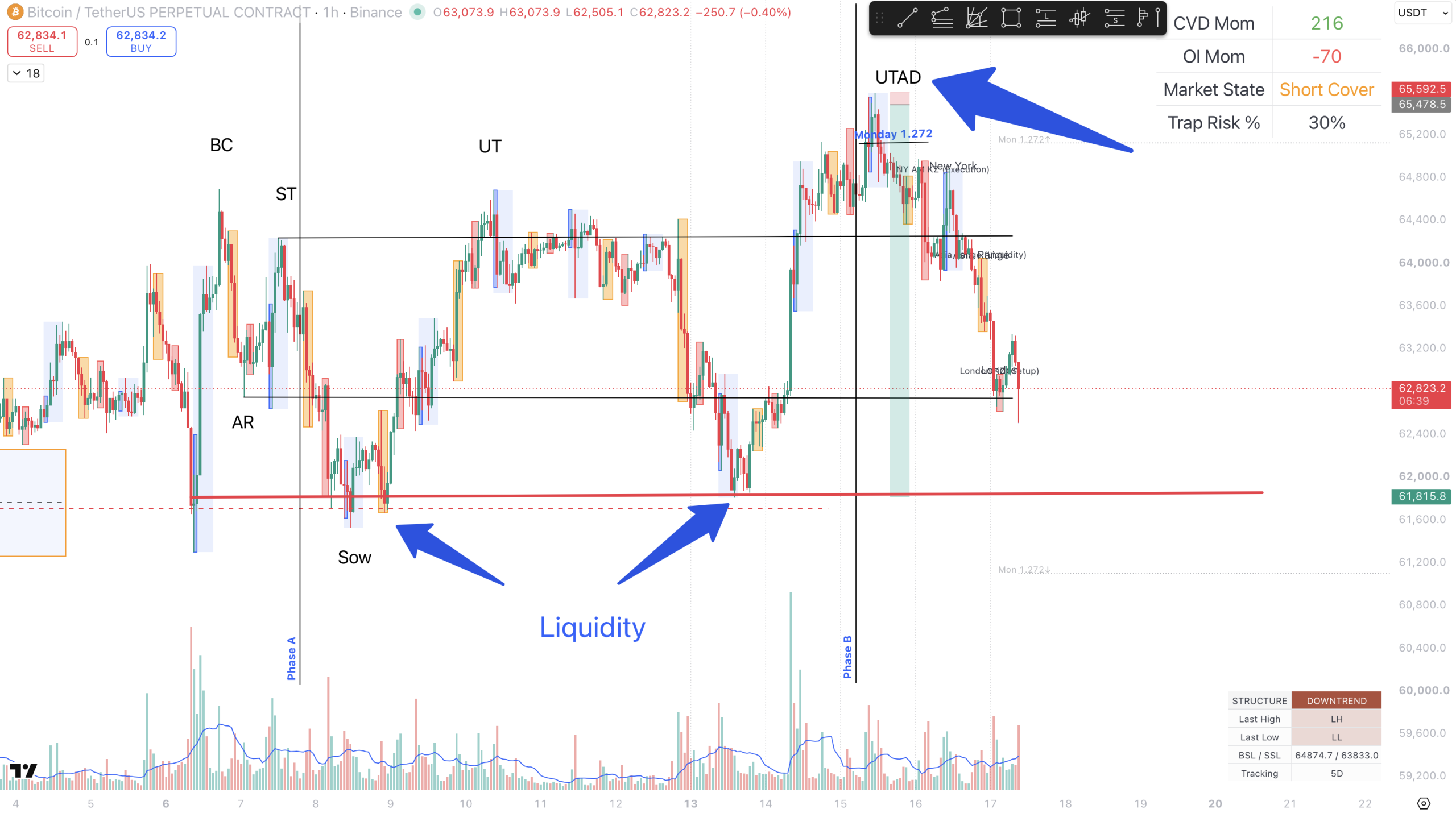
A liquidity sweep occurs when price trades through an identifiable pool of resting orders—often above a prior high or below a prior low—before either rejecting the level, accepting beyond it, or continuing through it.
The visible movement may appear simple. Price moves beyond a high, triggers stops, and returns below it. Or price trades below a low and quickly recovers.
The interpretation is more difficult.
A sweep confirms that liquidity was accessed. It does not automatically confirm why it was accessed or where price will move next. This is why StructFirst does not treat a liquidity sweep as a standalone entry signal. A liquidity sweep is where the investigation begins—not where the analysis ends.
TL;DR: The Three Outcomes of a Liquidity Sweep
Before committing risk, you must determine which of the three structural outcomes is unfolding. Never predict the outcome before the sweep occurs. Wait for the market to reveal its intent through displacement and structural acceptance.
| Outcome | Core Evidence | Strategic Meaning |
| 1. Reversal Sweep | Strong displacement away from the level, acceptance back inside the prior range, and a break of relevant lower-timeframe structure. | Opposing participants absorbed the liquidity to initiate a genuine shift in control. |
| 2. Continuation Sweep | Price briefly sweeps a local level but immediately aligns back with the higher-timeframe trend without breaking major structure. | The market accessed internal liquidity merely to fuel the continuation of the existing trend. |
| 3. Breakout & Acceptance | Price trades through the liquidity pool and holds beyond it, often consolidating or retesting the old boundary as support/resistance. | The market has repriced. The sweep did not fail; the boundary was permanently broken. |
StructFirst Rule: Invalidation must always be defined before targets. If you enter on a sweep, know exactly where the structural thesis fails before you aim for the next liquidity pool.
What Is Liquidity in Trading?
Liquidity refers to the availability of orders that can be matched in the market. Large participants cannot enter or exit meaningful positions without counterparties. Their orders require available buy and sell interest.
Areas containing concentrated stop-loss orders, breakout entries, resting limit orders, and forced liquidations become important execution zones. Liquidity often accumulates around clearly visible structural references, including:
- Previous swing highs and lows
- Equal highs and equal lows
- Session and prior-day highs/lows
- Range boundaries and consolidation extremes
The level itself is not important merely because it is a high or low. It matters because of the orders likely positioned around it.
Buy-Side and Sell-Side Liquidity
Buy-side liquidity generally rests above visible highs. It includes stop-loss orders from short positions and buy-stop breakout orders. When price trades above those highs, these orders provide buying activity, acting as counterparties for larger sell-side execution.
Sell-side liquidity generally rests below visible lows. It includes stop-loss orders from long positions and sell-stop breakout orders. When price trades below those lows, those orders provide selling activity, acting as counterparties for larger buy-side execution.
However, this does not mean every move above a high is institutional selling or every move below a low is institutional buying. Liquidity identifies where orders may be available; it does not independently prove the intent behind the transaction.
HTF Structure Comes Before the Sweep
Liquidity should not be analyzed in isolation. Before evaluating the sweep, determine the higher-timeframe (HTF) environment. Ask yourself:
- Is the market trending or ranging?
- Is price in a higher-timeframe premium or discount area?
- Is the sweep occurring at external or internal liquidity?
A five-minute sweep below a local low can look bullish while the daily structure remains firmly bearish. That lower-timeframe reaction may still be tradable, but it should not automatically be interpreted as a confirmed daily reversal.
For a deeper understanding of why higher-timeframe alignment dictates the outcome of a sweep, review the StructFirst Manifesto: Why Market Structure Comes First.
How to Confirm a Liquidity Sweep
Confirmation should be proportional to the timeframe, structure, and risk of the trade. Follow this sequence:
- Identify the HTF structure: Do not begin with a directional prediction.
- Define the liquidity pool in advance: Marking liquidity only after price reverses creates hindsight bias.
- Observe the quality of the sweep: Did volume expand? Was it a wick or a full body close?
- Look for displacement: Displacement is a decisive movement away from the swept area, characterized by strong-bodied candles and clear imbalance.
- Evaluate structural change: A break of market structure (BOS) or change of character (CHoCH) supports the thesis, provided the broken swing was structurally meaningful.
- Define invalidation before entry: A setup is invalidated if price accepts beyond the swept level or the displacement leg fails.
Common Retail Mistakes
Entering on the Wick Alone
A long wick is often described as rejection. But a wick only shows that price traded into an area and moved away before the candle closed. It does not independently explain why the move occurred or whether the reaction will continue.
A wick becomes meaningful only when combined with structural location, volume response, and displacement. For a detailed breakdown of how to read these elements, see Candlestick Footprints: Liquidity, Volume, and Institutional Intent.
Treating Every Sweep as a Trend Reversal
A lower-timeframe shift should not be promoted into a higher-timeframe reversal without evidence. A sweep may simply create a brief reaction that provides a better continuation entry for participants trading with the larger structure.
Confusing the Liquidity Target With Confirmation
A liquidity target is a destination, not a confirmation. When price reaches a major objective, you may reduce risk or take partial profit. You still require fresh evidence before reversing direction. This distinction prevents a correct target from becoming an unjustified entry. Review BTC Liquidity Trap Analysis to see how price behaves after reaching major objectives.
Liquidity Sweeps in Wyckoff Context
Liquidity sweeps frequently appear inside Wyckoff structures, but the label should not be forced.
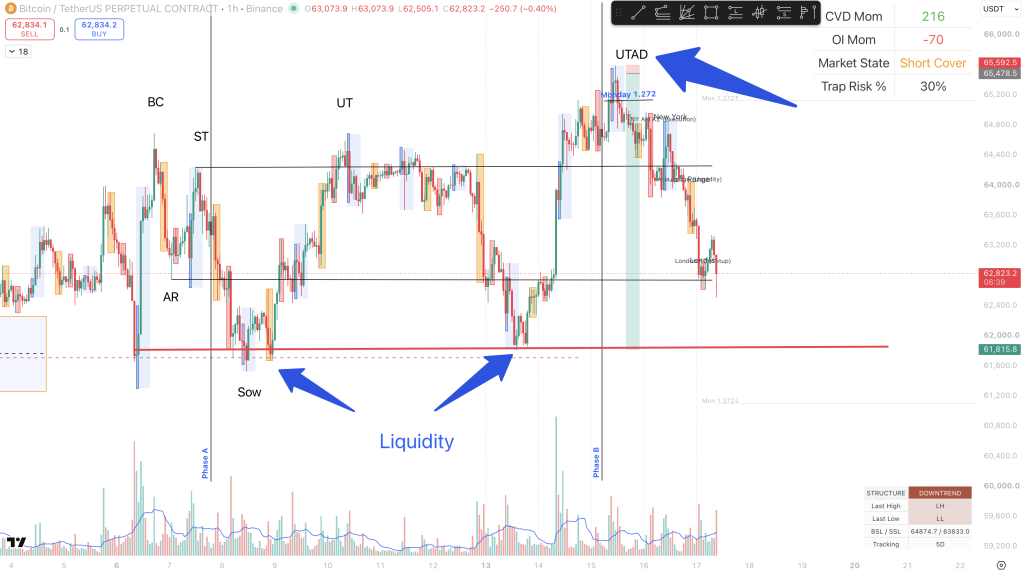
- Spring: May trade below the support of a trading range (Accumulation) before recovering. A confirmed Spring requires recovery into the range and evidence of demand.
- UTAD (Upthrust After Distribution): May trade above range resistance and then return below it. It requires failure to hold above the range and bearish displacement.
A sweep above local resistance during a broader bearish trend may simply be part of redistribution. The Wyckoff label must follow the evidence, not the other way around.
See these practical StructFirst examples to observe sweeps within a complete range:
- Wyckoff Redistribution Guide: BTC 6H
- BTC 12H Wyckoff Accumulation Structure
- SpaceX Wyckoff Distribution Trap: 2H
Liquidity Sweeps During Trading Sessions
Session highs and lows frequently become visible intraday liquidity references (e.g., Asian session, London session, New York opening range). During active trading windows, price may sweep one side of the session range before expanding toward the other.
However, session timing alone does not confirm the trade. It still requires displacement and defined invalidation.
- BTC 30M: The London Session Liquidity Sweep and ICT Turtle Soup
- BTC 30M: Wyckoff UTAD Trap in the New York Killzone
Liquidity Sweeps and Harmonic PRZs
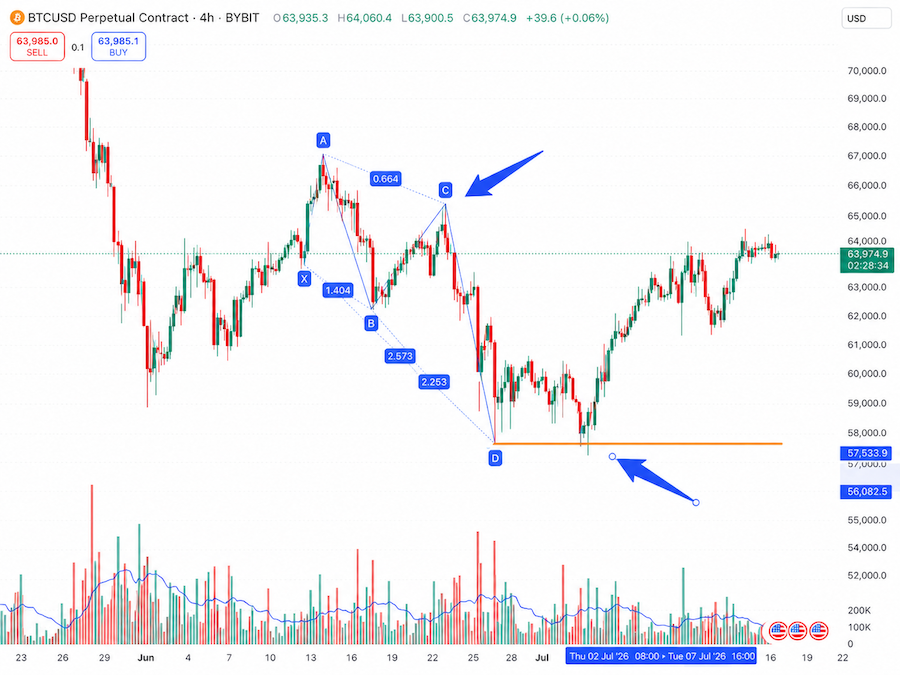
A harmonic Potential Reversal Zone (PRZ) can overlap with a liquidity pool. That confluence improves the importance of the location, but it does not confirm a reversal. A bullish harmonic PRZ below sell-side liquidity identifies an area where a reaction is possible. The trade still requires evidence that price is rejecting the zone and accepting higher.
For a case study on waiting for confirmation at a PRZ, see BTC: When Harmonics Meet Liquidity Traps — The Bullish Butterfly.
Failure Logic: How a Sweep Thesis Breaks Down
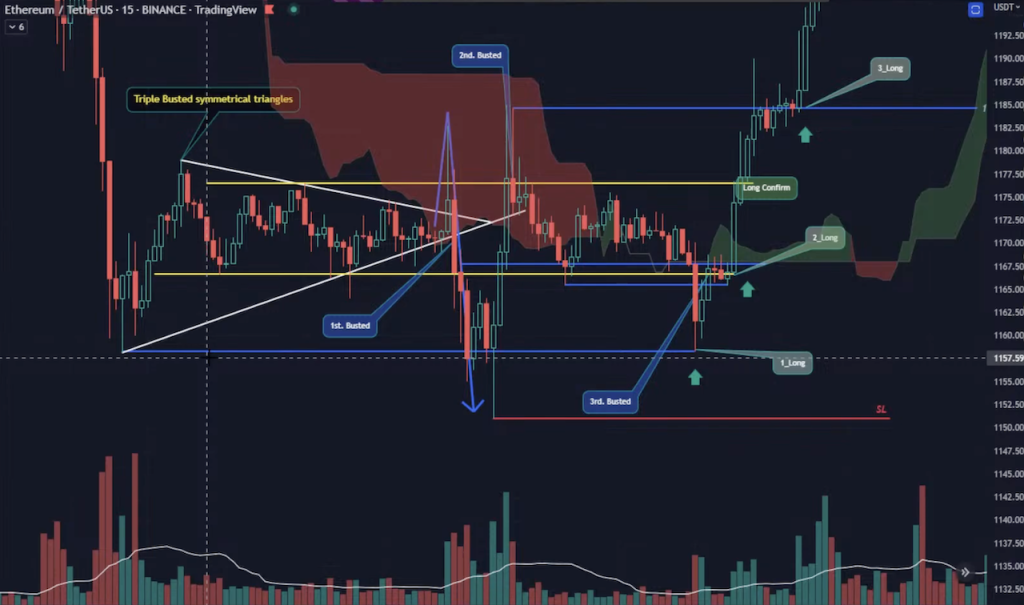
Every sweep thesis needs failure logic. Suppose price sweeps a prior high and you expect a bearish reversal. That thesis weakens if price:
- Reclaims the high after initial rejection.
- Closes and holds above the liquidity area.
- Builds support above the former resistance.
- Invalidates the bearish displacement.
Failure logic prevents you from remaining committed to the original interpretation after the market has invalidated it.
StructFirst Execution Checklist
Before taking a liquidity-based trade, evaluate:
- Structure: Is the market trending or ranging? Internal or external liquidity?
- Location: Is price in premium or discount?
- Intent: Was there meaningful displacement away from the swept level?
- Confirmation: Was relevant structure broken and held?
- Failure Logic: What evidence proves the thesis wrong?
- Risk: Is the reward justified by the remaining target liquidity based on the strict invalidation point? Is no-trade the more professional decision?
Missing a reversal is less damaging than forcing an unconfirmed entry. A professional process does not require participation in every move.
Frequently Asked Questions
Is a liquidity sweep bullish or bearish? Neither by itself. Its meaning depends on which liquidity was taken, the higher-timeframe structure, and how price behaves afterward.
Does a wick through a previous high confirm a bearish reversal? No. A wick may show rejection, but a bearish reversal requires additional evidence such as displacement, structural failure, acceptance below the level, and defined invalidation.
Can price sweep liquidity and continue in the same direction? Yes. A sweep may provide liquidity for continuation rather than reversal. This is why waiting for post-sweep displacement is critical.
What invalidates a liquidity sweep reversal setup? Typical invalidation includes price accepting beyond the swept level, reclaiming the displacement leg, breaking the confirming structure, or continuing in a manner inconsistent with the reversal thesis.
Continue the Learning Path
- What Is Displacement in Trading? Why Strong Candles Alone Are Not Enough
- What Is a Liquidity Sweep? Confirmation, Failure, and Execution
- Internal vs External Market Structure: Which Swing Actually Controls the Trend?
- What Are Acceptance and Rejection in Trading? Why One Wick or Close Is Not Enough
- What Is an Order Block in Trading? Why the Last Opposing Candle Is Not Enough
- What Are Premium and Discount in Trading? Why the 50% Level Is Not a Buy or Sell Signal
Expand Your Structural Edge
A liquidity sweep is valuable because it reveals where the market accessed concentrated orders. It becomes tradable only when structure, intent, confirmation, and invalidation align. Do not ask only whether liquidity was swept. Ask whether the market rejected or accepted the new price area, whether meaningful structure changed, and where the thesis fails.
The sweep identifies the event. The response reveals intent. The confirmation defines the trade.
Track the live order flow and volume footprint yourself directly on TradingView.
Leave a Reply