StructFirst Core Guide #010
You marked a swing low and a swing high, waited for price to return below the 50% level, and bought because the market was trading in Discount.
Price reacted briefly.
Then it continued lower, broke the range low, and forced you to decide whether to exit or buy again because price had become “even cheaper.”
The same problem appears in reverse.
Price moves above equilibrium, enters Premium, and looks expensive. You short the first rejection, but the bullish structure remains intact and price continues toward the liquidity above the range.
The calculation may be mathematically correct.
The trade logic may still be structurally wrong.
Premium and Discount do not independently identify a reversal, entry, target, or fair-value opportunity. They describe where price is located inside a selected dealing range.
The useful sequence is:
Correct Dealing Range
→ Higher-Timeframe Structure
→ Liquidity Context
→ Premium or Discount Location
→ Confirmation
→ Invalidation
→ Execution
→ Target Liquidity
The 50% level provides context only after the range controlling the trade has been identified.
1. The Trader’s Problem
Premium and Discount appear simple because the calculation is simple.
Select a low and a high. Divide the range at 50%. Treat the upper half as Premium and the lower half as Discount.
The practical difficulty is not drawing the equilibrium line.
The difficulty is deciding:
- Which high and low define the active dealing range?
- Is the selected range internal or external?
- Does that range control the broader auction or only a local retracement?
- Has relevant liquidity already been accessed?
- Is price rejecting the location or establishing acceptance through it?
- What confirms that the location has become executable?
- What proves the trade thesis has failed?
Without those answers, the 50% line can create false confidence.
The trader sees a precise numerical level and assumes the analysis must also be precise.
A precise calculation does not repair an incorrect structural assumption.
This guide follows the broader process established in Why Market Structure Comes First: The StructFirst Trading Framework.
Structure defines the environment. Liquidity identifies the decision location. Confirmation determines whether the location has earned a trade.
2. What Are Premium and Discount in Trading?
Premium and Discount describe the relative position of price inside a defined dealing range.
- Premium is the upper half of the selected range.
- Discount is the lower half of the selected range.
- Equilibrium is the 50% midpoint between the range high and range low.
The calculation can be expressed simply:
Equilibrium = Range Low + 50% of the Distance to the Range High
However, the terms “Premium” and “Discount” are relative rather than absolute.
Bitcoin trading below the midpoint of a selected range does not prove that Bitcoin is fundamentally cheap. It means only that price is located in the lower half of that particular range.
The same price can be:
- Discount inside a four-hour external range.
- Premium inside a fifteen-minute internal retracement.
- Near equilibrium inside a separate one-hour impulse leg.
All three observations can be mathematically correct at the same time.
The trader must assign each range a structural role.
Premium and Discount describe location. They do not independently confirm value, direction, or execution.
3. The Dealing Range Comes First
Before marking Premium, Discount, or equilibrium, define the dealing range that controls the planned trade.
A useful dealing range may be formed by:
- A meaningful external low and external high.
- A confirmed impulse leg that changed price delivery.
- A higher-timeframe protected swing sequence.
- A clearly established trading range.
- A displacement leg that broke relevant structure.
- A major range boundary containing the current internal swings.
A weak dealing range may be created by:
- Selecting the nearest convenient high and low.
- Using a minor pivot because it makes the current position appear favorable.
- Redrawing the range after price moves against the trade.
- Using an internal swing to justify an external reversal thesis.
- Using a range whose boundaries have already been invalidated.
- Ignoring the displacement leg that actually controls the current auction.
This is why traders can place the same Fibonacci tool on the same chart and reach opposite conclusions.
The tool is not deciding which range matters.
The analyst must make that decision through structure.
A precise 50% level calculated from the wrong range is still structurally wrong.
4. External Range vs Internal Range
The distinction between external and internal ranges is essential.
An external dealing range usually contains the major highs, lows, or boundaries controlling the broader auction.
An internal range describes a smaller swing, retracement, session rotation, or execution sequence inside that broader structure.
The external range may help answer:
- Is price broadly operating in Premium or Discount?
- Which external liquidity pool remains open?
- Where would the larger structural thesis fail?
- Is the market near a meaningful range boundary?
The internal range may help answer:
- Where is the current retracement located?
- Is the execution leg extended?
- Where might a lower-timeframe retest become efficient?
- Which internal swing provides entry invalidation?
An internal range can improve precision.
It should not be allowed to overrule the external range without sufficient structural evidence.
This hierarchy is explained in Internal vs External Market Structure: Which Swing Actually Controls the Trend?
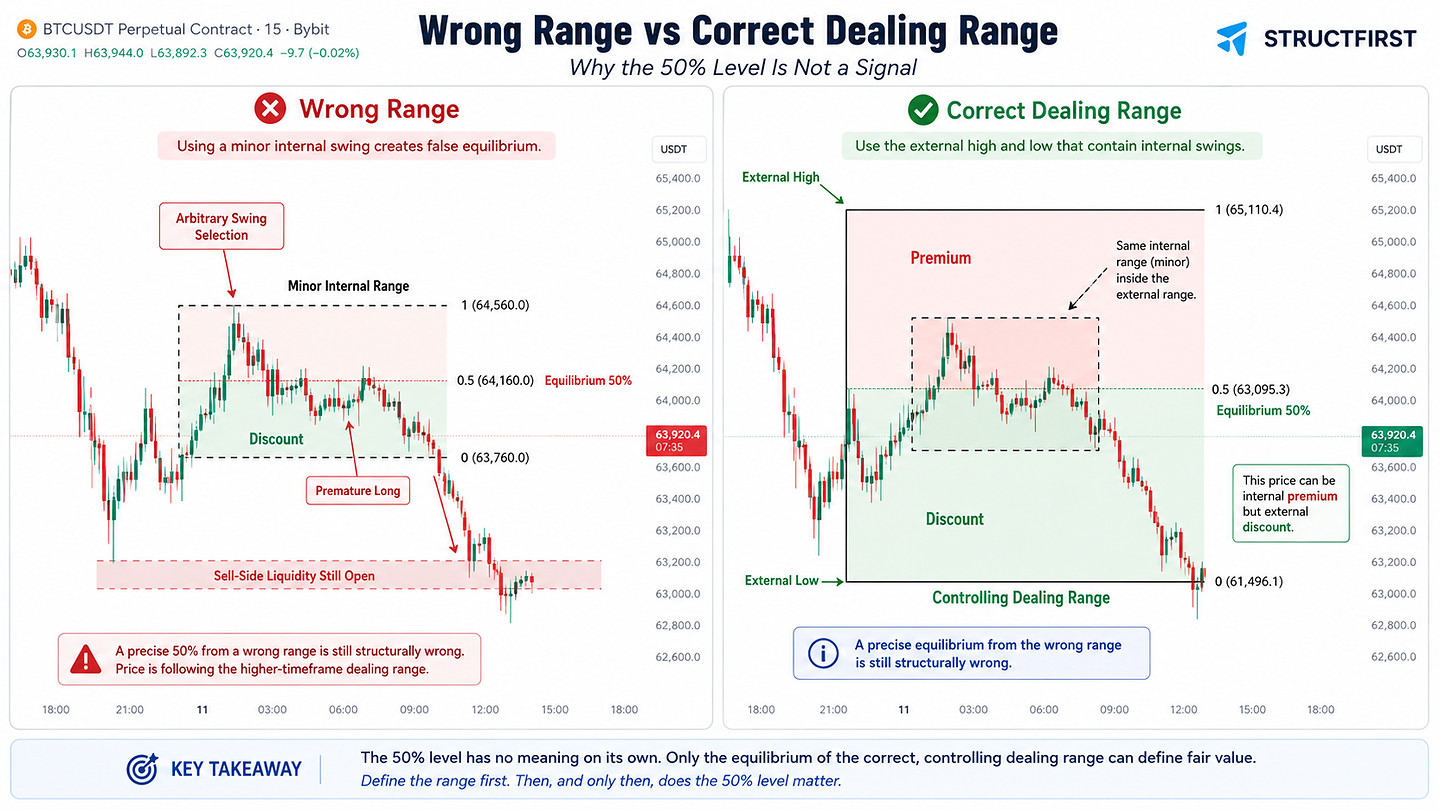
Both panels contain a mathematically correct 50% level, but only one uses the range controlling the broader auction.
In the first example, the trader selects a minor internal swing and treats its lower half as a buying opportunity. External bearish pressure remains active, and sell-side liquidity below the selected range remains open.
In the second example, the dealing range is defined by the meaningful external high and low containing the current internal swings. Premium and Discount now provide location within the correct structural hierarchy.
The error was not the Fibonacci calculation.
It was choosing a range that did not control the trade.
5. Equilibrium Is Not Automatic Support or Resistance
Equilibrium is the midpoint of the selected dealing range.
It can help describe whether price is operating in the upper or lower half of the range, but it is not automatically a support or resistance level.
Price may:
- React from equilibrium.
- Consolidate around it.
- Cross it repeatedly while the range remains balanced.
- Displace through it without a meaningful reaction.
- Establish acceptance on one side before continuing.
Repeated movement around equilibrium often indicates that neither side has established clear control.
This can be a poor execution environment because:
- Liquidity remains available above and below.
- Invalidation may be unclear.
- The market may be rotating rather than delivering.
- The distance to either range boundary may be insufficient.
- Internal BOS and CHoCH signals may alternate without resolving the external range.
The 50% line can organize the chart.
It should not force a trade inside an unresolved auction.
6. Discount Is Not Automatically Bullish
One of the most expensive Premium and Discount mistakes is repeatedly buying as price moves deeper into Discount.
The trader begins with one position, then adds because the market appears cheaper, then adds again because price reaches a deeper Fibonacci level.
This can turn an invalidated trade into uncontrolled exposure.
Discount does not stop bearish delivery.
A Discount long remains weak when:
- The external bearish structure remains intact.
- Sell-side liquidity remains open beneath price.
- Bearish displacement continues through internal lows.
- The protected bullish low has already failed.
- Candle bodies establish acceptance below the range.
- Rebounds fail beneath broken support.
- No bullish displacement changes meaningful structure.
Price moving deeper into Discount is not a reason to defend a failed thesis.
“Cheaper” inside an invalidated range is not the same as structurally supported value.
7. Premium Is Not Automatically Bearish
The reverse mistake occurs when traders short every move into Premium.
Price reaches the upper half of the range, looks extended, and produces a small bearish candle. The trader assumes the market must return to equilibrium.
But bullish markets can remain in Premium while continuing toward external buy-side liquidity.
A Premium short remains weak when:
- The external bullish structure remains intact.
- Buy-side liquidity remains open above the range.
- Bullish displacement continues through relevant highs.
- The protected bullish low remains intact.
- Pullbacks remain corrective and overlap heavily.
- No bearish displacement changes delivery.
- Price establishes acceptance above the selected range.
Premium identifies a possible area of interest.
It does not prove that sellers have gained control.
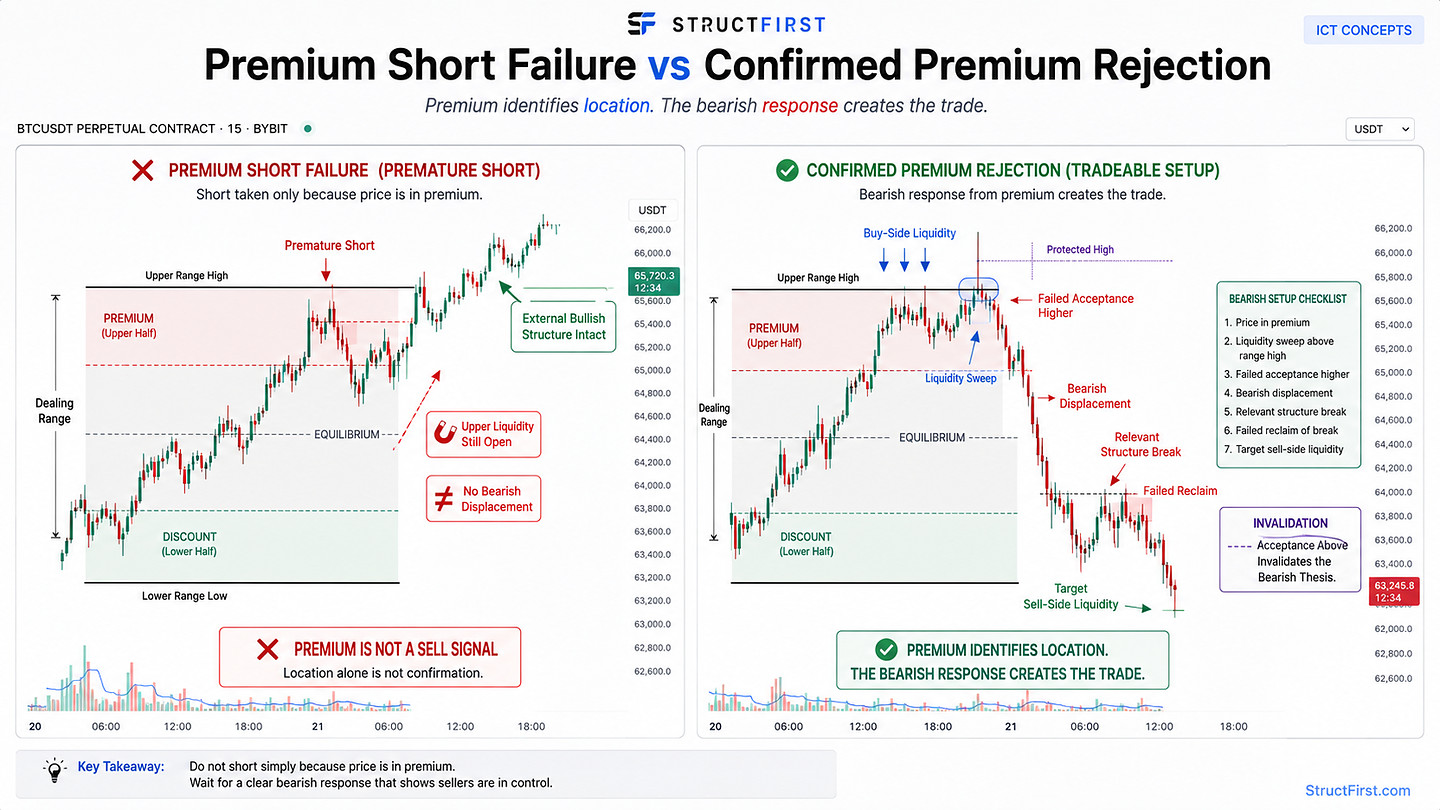
Both examples show price trading in Premium, but only one develops a defensible bearish setup.
In the first example, the trader sells because price is above equilibrium. External bullish structure remains intact, upper liquidity remains open, and no bearish displacement confirms a change in delivery. Price continues higher.
In the second example, price first accesses buy-side liquidity and fails to maintain acceptance above the range high. Bearish displacement then breaks relevant structure, and the failed reclaim confirms weakness.
Premium identified the area of interest.
The bearish response created the trade.
8. Premium and Discount With Liquidity
Premium and Discount become more useful when combined with liquidity positioning.
A potential bullish sequence may develop as:
External Sell-Side Liquidity
→ Discount Location
→ Liquidity Sweep
→ Failed Acceptance Lower
→ Bullish Displacement
→ Relevant Structure Break
→ Target Buy-Side Liquidity
A potential bearish sequence may develop as:
External Buy-Side Liquidity
→ Premium Location
→ Liquidity Sweep
→ Failed Acceptance Higher
→ Bearish Displacement
→ Relevant Structure Break
→ Target Sell-Side Liquidity
The liquidity event creates the test.
The subsequent response determines whether the location becomes useful.
A sweep does not guarantee reversal. Price may reject, continue, or establish acceptance beyond the boundary. This distinction is examined in What Is a Liquidity Sweep? Confirmation, Failure, and Execution.
The response after a liquidity event should also be evaluated through acceptance and rejection. A wick from Premium or Discount does not independently confirm reversal, and one candle close does not prove sustained acceptance. For the complete framework, read What Are Acceptance and Rejection in Trading? Why One Wick or Close Is Not Enough.
9. Premium and Discount With Displacement
Location narrows the area where the trader should pay attention.
Displacement shows whether the market response has structural force.
Useful bullish evidence inside Discount may include:
- Expanded bullish candle bodies.
- Reduced overlap during the recovery.
- A decisive reclaim of the swept level.
- A break through a relevant lower high.
- A bullish FVG created by repricing.
- Continued acceptance above reclaimed structure.
- Protection of the displacement origin.
Useful bearish evidence inside Premium may include the opposite sequence.
A large candle alone is not sufficient. The move must affect a swing that matters and preserve the structural result. The complete framework is explained in What Is Displacement in Trading? Why Strong Candles Alone Are Not Enough.
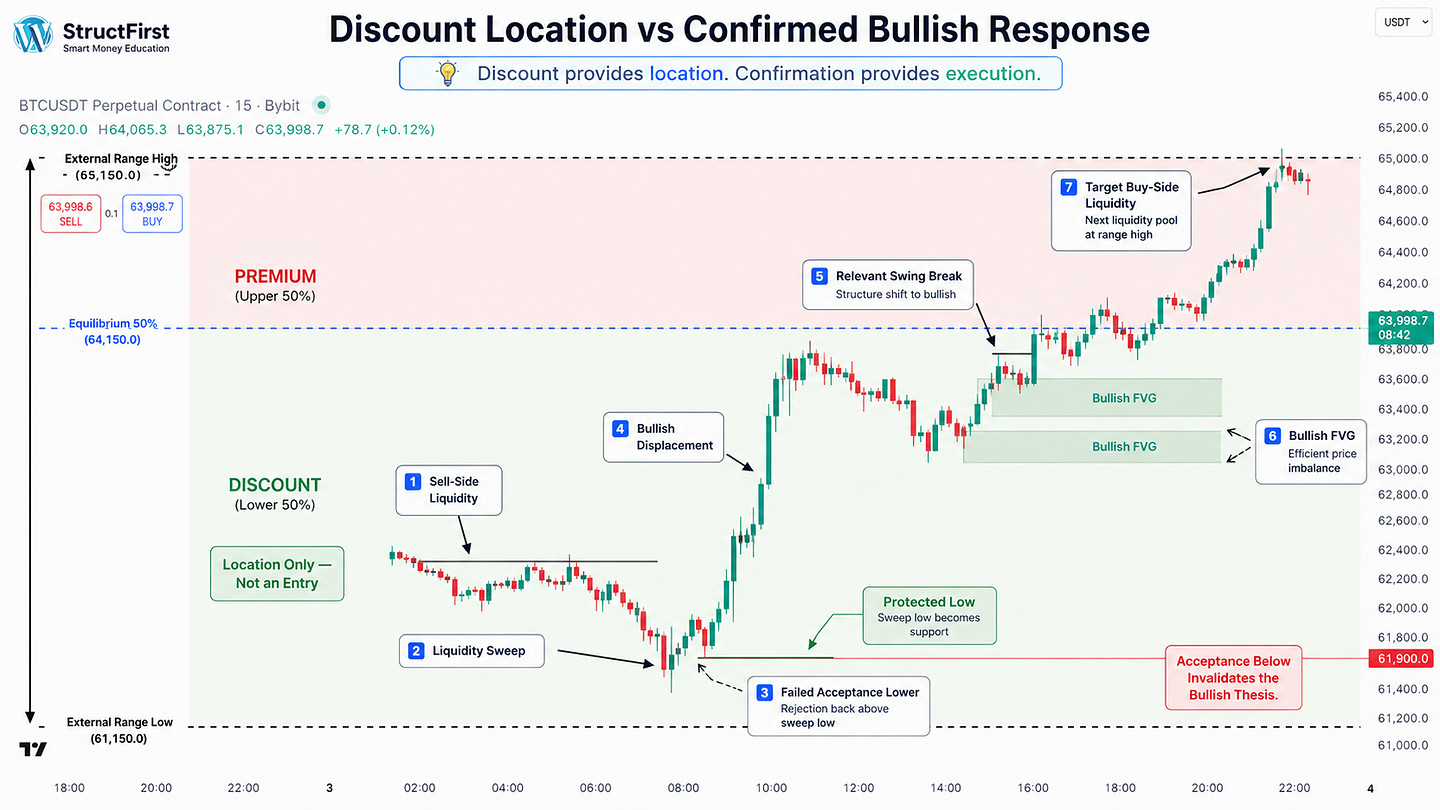
Price entering Discount does not independently establish a bullish trade.
In this example, the Discount location becomes useful only after price accesses sell-side liquidity and fails to maintain acceptance beneath the prior low.
Bullish displacement then breaks a relevant swing, creates an imbalance, and establishes a protected low.
The sequence provides both a structural reason for execution and a clear condition for failure. Acceptance beneath the protected low would invalidate the bullish thesis.
Discount narrows the area of interest.
The market response determines whether capital should be committed.
10. Premium, Discount, and Fair Value Gaps
Fair Value Gaps may become more useful when their location aligns with a correctly defined dealing range.
For bullish execution, an FVG formed in external Discount may offer more favorable positioning than an imbalance formed after price has already reached Premium.
For bearish execution, an FVG formed in external Premium may offer more favorable positioning than an imbalance formed after price has already reached Discount.
However, location does not validate the FVG.
The trader must still evaluate:
- The event that created the imbalance.
- The quality of the displacement.
- The swing affected by the move.
- The response during mitigation.
- The invalidation level.
- The remaining distance to target liquidity.
The full imbalance framework is explained in How to Read a Fair Value Gap in Market Structure.
11. Premium, Discount, and Order Blocks
Premium and Discount can help grade the location of an Order Block.
A bullish Order Block positioned in external Discount may provide stronger location than a bullish Order Block formed after price has already expanded into external Premium.
A bearish Order Block positioned in external Premium may provide stronger location than a bearish Order Block formed near the external range low.
This does not mean the correctly located Order Block will automatically hold.
It still requires:
- A relevant liquidity event.
- A meaningful displacement origin.
- A structural consequence.
- A defensible mitigation response.
- A clearly defined invalidation.
The complete distinction between an ordinary opposing candle and a structurally relevant Order Block is explained in What Is an Order Block in Trading? Why the Last Opposing Candle Is Not Enough.
12. Premium and Discount in Trending and Ranging Markets
Premium and Discount behave differently in trending and ranging markets.
Ranging Market
In a developed trading range, the external high and low may provide a relatively stable dealing range.
Price may rotate between:
- Discount and equilibrium.
- Equilibrium and Premium.
- External liquidity at the range boundaries.
Even in a range, the boundaries do not guarantee reversal. Price can sweep and reject, or break and establish acceptance.
Trending Market
In a bullish trend, price can remain in Premium while continuing higher.
In a bearish trend, price can remain in Discount while continuing lower.
New impulse ranges may form as the trend progresses, causing the relevant equilibrium to shift.
Premium and Discount do not force mean reversion in a trending market.
This is why a range must be chosen according to the current structural problem rather than reused indefinitely.
A historical example of a range resolving through confirmed weakness is available in Bitcoin Wyckoff Redistribution: How the 6H Structure Confirmed Markdown.
13. Multi-Timeframe Premium and Discount Conflict
It is common for different timeframes to produce different Premium and Discount readings.
For example:
- Daily price may be in Discount.
- Four-hour price may be in Premium.
- Fifteen-minute price may be in Discount again.
This is not necessarily a contradiction.
Each range may perform a different function.
- Daily range: Macro directional location.
- Four-hour range: Current swing and decision location.
- Fifteen-minute range: Execution refinement.
The trade must remain proportional to the structural layer that confirms it.
A fifteen-minute Discount long may provide a short-term trade toward internal liquidity while price remains inside four-hour Premium and beneath higher-timeframe resistance.
The error is not taking the smaller trade.
The error is treating the smaller trade as proof that the higher-timeframe problem disappeared.
14. Confirmation Before Entry
A Discount long should require more than location.
A stronger bullish framework may include:
- A correctly defined controlling dealing range.
- Price located in meaningful Discount.
- Sell-side liquidity access or another relevant structural event.
- Failure to establish acceptance lower.
- Bullish displacement.
- A break through a relevant swing.
- Formation of a protected low.
- A clear opposing liquidity target.
- Defined invalidation before entry.
A Premium short should require the corresponding bearish sequence.
A local CHoCH may warn that the immediate move is weakening, but the importance of the signal depends on the swing, timeframe, displacement, and follow-through.
The differences between BOS, CHoCH, and a genuine structural shift are explained in BOS vs CHoCH vs Market Structure Shift: What Actually Confirms a Trend Change?.
The protected swing helps determine whether the directional structure supporting the Premium or Discount setup still remains valid. The most recent visible pivot is not automatically the correct invalidation reference. For the complete framework, read What Are Protected Highs and Lows in Trading? Which Swing Actually Invalidates the Trade?.
15. Premium and Discount Invalidation
Invalidation must be defined before the target.
Bullish Discount Thesis Invalidation
A bullish thesis may weaken or fail when price:
- Breaks the controlling range low.
- Establishes candle-body acceptance below the swept low.
- Loses the bullish displacement origin.
- Breaks the protected low.
- Fails to reclaim the Discount zone.
- Continues toward lower external liquidity.
Bearish Premium Thesis Invalidation
A bearish thesis may weaken or fail when price:
- Accepts above the controlling range high.
- Recovers the protected high.
- Erases the bearish displacement origin.
- Converts former resistance into support.
- Fails to continue toward lower liquidity.
- Continues expanding toward external buy-side liquidity.
The statement “price is now deeper in Discount” does not repair a bullish setup after its structural invalidation.
The statement “price is now more expensive” does not repair a bearish setup after the market accepts above resistance.
16. A Practical Premium and Discount Execution Framework
Use Premium and Discount near the middle of the analysis process—not at the beginning.
The StructFirst sequence is:
Higher-Timeframe Structure
→ Correct Dealing Range
→ External and Internal Liquidity
→ Premium or Discount Location
→ Market Response
→ Displacement
→ Structural Confirmation
→ Invalidation
→ Entry
→ Target Liquidity
→ Risk Management
Do not begin with:
Price is below 50%, so I need a long.
Begin with:
Which range controls the current auction, what liquidity is being tested, and what response would make this location executable?
17. Common Premium and Discount Trading Mistakes
- Selecting a range that supports the existing position. The range should be defined before emotional attachment develops.
- Treating every 50% level equally. Internal and external ranges perform different jobs.
- Buying Discount without confirmation. Location does not stop bearish delivery.
- Shorting Premium without confirmation. Location does not stop bullish delivery.
- Forcing mean reversion in a trend. Price can remain in Premium or Discount while continuing.
- Redrawing the range after invalidation. A new range should reflect new structure, not protect the old thesis.
- Ignoring remaining liquidity. An open external objective can continue pulling price through the selected zone.
- Using an internal range for an external trend claim. Precision does not equal control.
- Treating OTE as automatic permission to enter. Fibonacci location still requires confirmation.
- Adding to a losing position because price looks cheaper. Risk must follow invalidation, not perceived value.
18. What This Framework Helps You Avoid
This framework is designed to reduce several avoidable trading errors:
- Repeatedly averaging into a bearish move because price is in Discount.
- Shorting a strong bullish trend because price is in Premium.
- Changing the dealing range to defend an existing bias.
- Confusing an internal retracement with an external reversal.
- Entering on a 50% touch without liquidity or displacement.
- Holding after the protected swing and original thesis have failed.
- Using an attractive reward-to-risk calculation built on arbitrary invalidation.
The framework will not make every Premium or Discount setup profitable.
Its purpose is to reject weaker opportunities before capital is committed and to define failure before a manageable loss becomes uncontrolled exposure.
19. Practice Drill: Build Range-Selection Discipline
Use historical BTCUSDT charts and complete the following exercise.
- Select 20 historical dealing ranges.
- Mark the high, low, and equilibrium of each range.
- Classify each range as internal or external.
- Record which swing or displacement made the range structurally relevant.
- Mark the external liquidity above and below.
- Record whether price entered Premium or Discount.
- Identify whether a liquidity event occurred at the location.
- Record whether displacement followed.
- Identify which meaningful swing was broken.
- Define the invalidation that was visible at the time.
- Separate location-only touches from confirmed responses.
- Evaluate the evidence available before the outcome became known.
The objective is not to prove that Premium or Discount always worked.
The objective is to learn which ranges mattered and which market responses earned execution.
Did the location create the trade, or did the market response earn the trade?
20. No-Trade Conditions
No-trade is appropriate when:
- The controlling dealing range is unclear.
- Several ranges conflict and no hierarchy has been defined.
- Price is rotating around equilibrium.
- No meaningful liquidity event has occurred.
- Displacement is absent.
- The relevant swing remains intact against the thesis.
- The range high or low has already failed.
- Price establishes acceptance through the proposed location.
- Invalidation is too distant relative to the next liquidity target.
- The setup depends only on the belief that price looks cheap or expensive.
An unclear 50% level is not a reason to add more Fibonacci measurements.
It may be a reason to remain flat.
21. The StructFirst Premium and Discount Decision Framework
Before using Premium or Discount for execution, ask:
- Which dealing range controls the current auction?
- Why are these specific high and low structurally meaningful?
- Is the selected range internal or external?
- Where is price within the higher-timeframe range?
- Where is price within the execution range?
- What liquidity has already been processed?
- What liquidity remains open?
- Did price reject the boundary or establish acceptance through it?
- Did displacement occur?
- Which meaningful swing was broken?
- What confirms the trade?
- What invalidates the thesis?
- Does the next liquidity target justify the required risk?
- Would no-trade be the more professional decision?
Premium and Discount become useful only when these questions can be answered as one connected decision process.
Frequently Asked Questions
Is Discount Always a Buy Zone?
No. Discount means price is in the lower half of the selected dealing range. It does not confirm bullish structure, liquidity rejection, displacement, or entry.
Is Premium Always a Sell Zone?
No. A bullish market can remain in Premium while continuing toward buy-side liquidity. A bearish trade requires evidence that bullish delivery failed.
How Do I Choose the Correct Dealing Range?
Choose the meaningful high and low associated with the swing, range, or displacement leg controlling the planned trade. The range should be selected through structural consequence rather than convenience.
Can Price Be in Premium and Discount at the Same Time?
Yes. Price can be in Premium within a small internal range while remaining in Discount within a larger external range. The two readings belong to different structural layers.
Is Equilibrium a Support or Resistance Level?
Not automatically. Equilibrium is the midpoint of the selected range. Price may react, consolidate, or pass through it without structural consequence.
Does Premium or Discount Improve a Fair Value Gap or Order Block?
It may improve location, but it does not independently validate the FVG or Order Block. Liquidity, displacement, confirmation, invalidation, and target distance still matter.
Continue the Learning Path
- Internal vs External Market Structure: Which Swing Actually Controls the Trend?
- What Is a Liquidity Sweep? Confirmation, Failure, and Execution
- What Is Displacement in Trading? Why Strong Candles Alone Are Not Enough
- How to Read a Fair Value Gap in Market Structure
- What Is an Order Block in Trading? Why the Last Opposing Candle Is Not Enough
Expand Your Structural Edge
Premium and Discount do not tell the market where it must reverse.
They tell the trader where price is located inside a selected dealing range.
The range must first be structurally valid.
Liquidity must create a meaningful test.
Displacement must show that price delivery changed.
A relevant swing must confirm structural consequence.
Invalidation must define when the thesis no longer deserves capital.
The 50% level provides the map.
The market response determines whether there is a trade.
Track the live order flow and volume footprint yourself directly on TradingView.
Leave a Reply