The Hook: Stop Funding the Smart Money
Retail traders consistently lose money because they fundamentally misunderstand market structure. When price violently breaks above a major resistance level, the average trader immediately assumes a trend continuation and executes a long position. They are taught that a breakout equals momentum. However, in the reality of institutional order flow, this specific price action is rarely the start of a new trend. Instead, it is highly likely to be a liquidity trap breakout.
You are providing the exact liquidity that institutions require to enter their massive short positions. When you prioritize predicting a breakout over reading the underlying market structure, you become the yield for smart money. My execution relies entirely on reading this structural narrative. I do not predict where the market will go; I wait for the market to reveal its intent. Structure is fundamentally more important than prediction.
In this comprehensive guide, I will deconstruct the liquidity trap breakout. We will examine the exact mechanics of how institutions manufacture these traps, why retail traders fall for them, and how you can apply the StructFirst operating order—moving strictly from Higher Timeframe (HTF) analysis to Liquidity, Intent, Confirmation, Failure, and finally Execution—to secure a true edge in the market.
Macro Context (HTF): The Anatomy of a Liquidity Trap Breakout
To survive in this market, you must elevate your perspective. From a macro, Higher Timeframe (HTF) perspective, the market only does two things: it expands, and it consolidates. Long-term consolidation ranges, or box structures, are not simply areas of indecision. The upper boundaries of these ranges are highly engineered zones of concentrated liquidity.
The Key Structural Problem
The key structural problem for retail traders is their conditioning to buy breakouts. When price pushes past a historical swing high, retail algorithms and breakout traders flood the market with buy orders. They expect an immediate expansion. But smart money does not view this level as support or resistance. They view it as a target. Institutional trading requires immense liquidity to execute positions without causing massive slippage. They cannot simply sell at market price; they need willing buyers. A liquidity trap breakout is explicitly designed to create those willing buyers.
Liquidity Positioning and Institutional Intent
Liquidity is always more important than price alone. Above any significant previous high, there is a massive pool of Buy Side Liquidity (BSL). This pool consists of two things:
- Buy Stop orders from retail traders attempting to catch the breakout.
- Stop Loss orders from traders who are already short and placed their protection just above the high.
The institutional intent behind a liquidity trap breakout is violently clear. Institutions push the price up (Markup) into this dense BSL pool. This sudden price spike triggers all the buy orders. Smart money uses this artificial wave of blind buying pressure to offload their distribution inventory or aggressively build short positions. They are not following a trend; they are hunting your liquidity.
The Wyckoff and ICT Framework
Within our core analytical frameworks, this specific liquidity trap breakout has precise definitions.
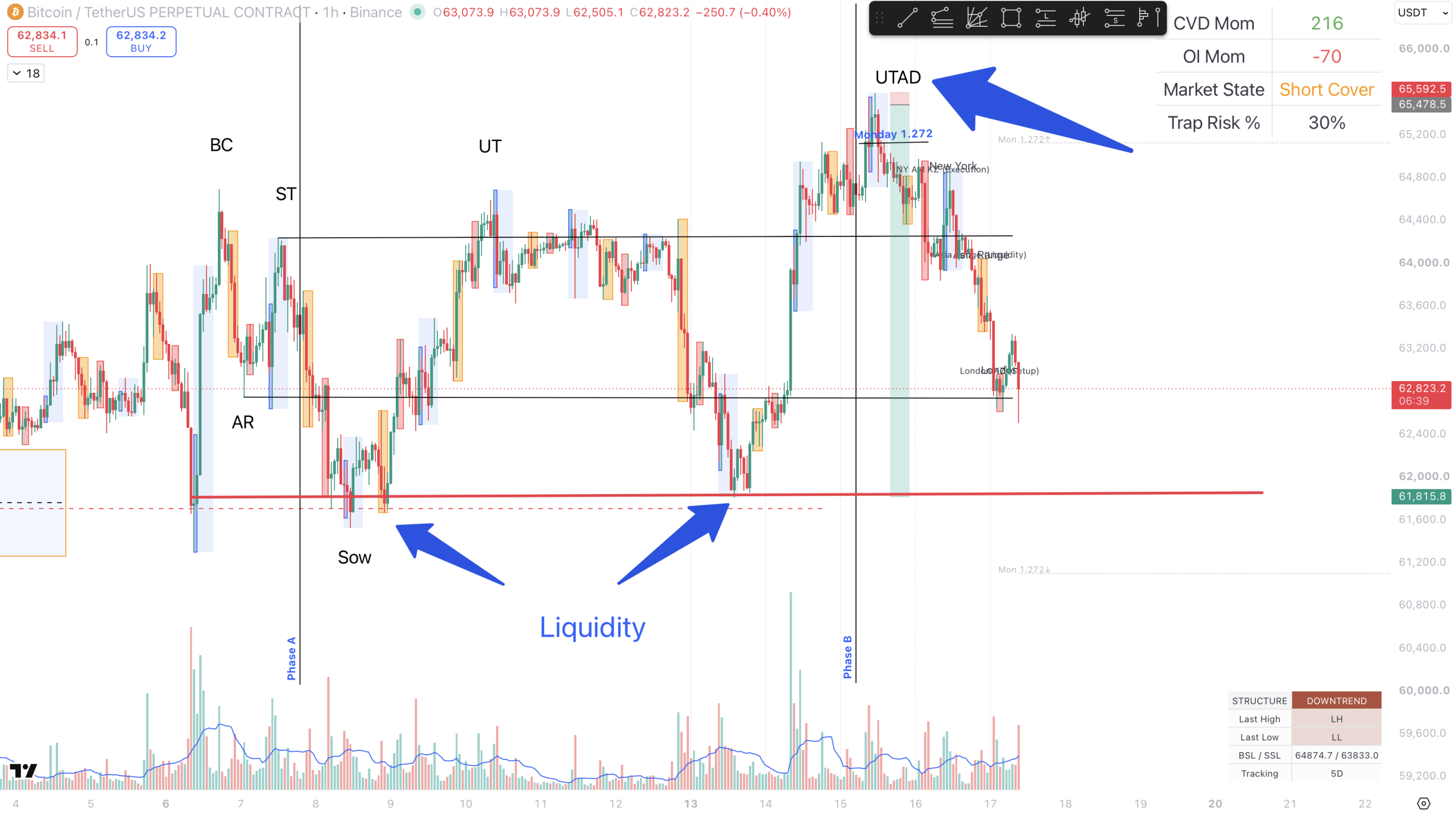
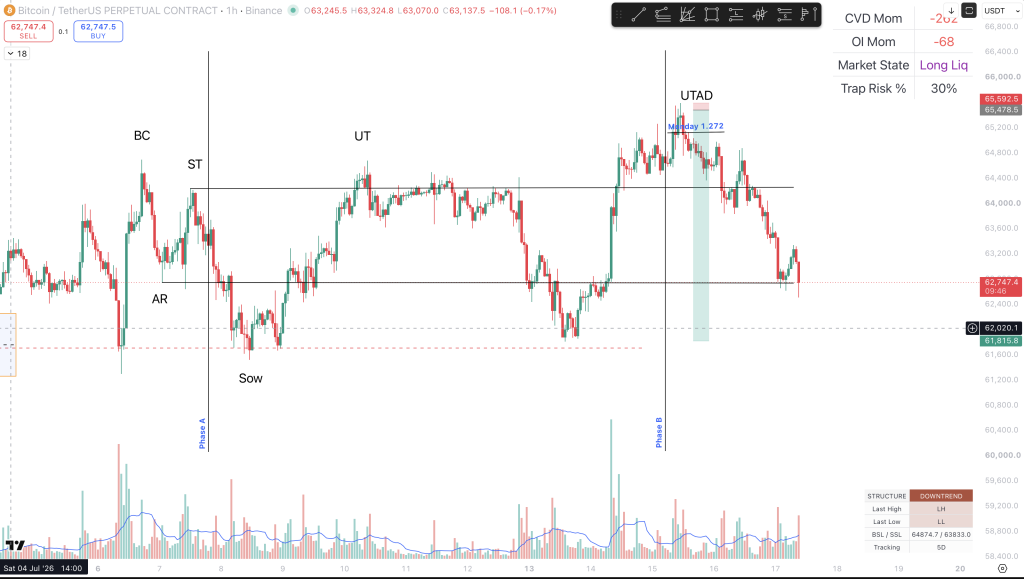
- In the Wyckoff methodology, this structural trap is classified as an Upthrust After Distribution (UTAD). It marks the final phase of distribution where the last remaining buyers are trapped before the markdown begins.
- In Inner Circle Trader (ICT) concepts, this is known as a Turtle Soup setup, representing a surgical liquidity sweep of the BSL pool.
When the price clears the high, the illusion of an impending bull run is at its absolute peak, maximizing the effectiveness of the trap.
Mid-Point Summary: StructFirst Execution Checklist
Before blindly entering a position, you must verify the structural conditions. A sweep of a high is not automatically a confirmed reversal. Ensure the following conditions are met before executing a trade around a suspected liquidity trap breakout:
- Verify the HTF range and identify the primary Buy Side Liquidity (BSL) pool above the swing high.
- Confirm the price has reached the Harmonic Potential Reversal Zone (PRZ) between the 1.272 and 1.414 Fibonacci extensions.
- Wait for a confirmed Lower Timeframe (LTF) Market Structure Shift (MS Shift) that breaks a significant swing low.
- Verify that the downward move causing the MS Shift displays aggressive Displacement (strong momentum).
- Ensure the Displacement leaves behind a clear Fair Value Gap (FVG) or a valid Order Block in the premium pricing zone.
- Set a strict invalidation level above the sweep high, understanding that sustained body closures above the high invalidate the setup.
- Identify the opposing Sell Side Liquidity (SSL) as your primary structural take-profit target.
Micro Execution (LTF): Trading the Liquidity Trap Breakout
Understanding the macro intent is useless without a surgical execution model. The defining rule of my execution is this: confirmation is exponentially more important than your assumption. Never short the exact moment a high is broken just because you assume it is a liquidity trap breakout. A breakout can be a trap, but a sweep is not automatically a reversal.
The Required Structural Confirmation
To avoid becoming part of the trap yourself, you must wait for the LTF structure to break down. The confirmation phase requires two absolute, non-negotiable elements:
- LTF Market Structure Shift (MS Shift): On the lower timeframes (such as the 5-minute or 15-minute charts), a meaningful swing low must be violated. This Change of Character (CHoCH) proves that the buying pressure has exhausted and sellers have officially taken control of the tape.
- Displacement and Energy: The breakdown cannot be slow or lethargic. After sweeping the high, the downward move must feature strong bearish candles—known as Displacement. This violent move must leave behind a Fair Value Gap (FVG), confirming that institutional volume has aggressively stepped in to shift the structure.
Harmonic Confluence and PRZ Checks
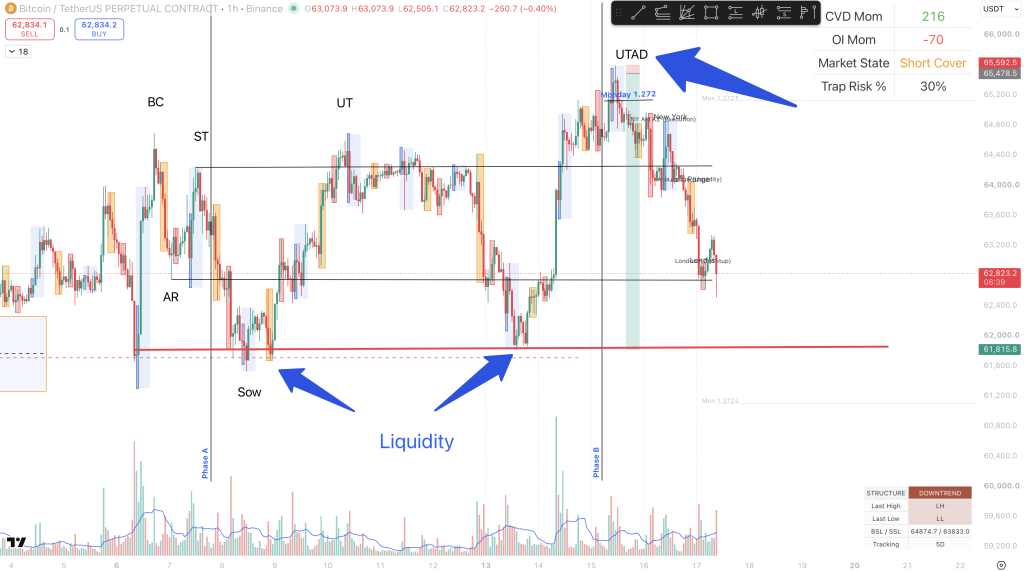
A crucial part of my edge involves identifying exactly where the liquidity trap breakout is most likely to reverse. The most frequent zone for these engineered traps lies at the 1.272 to 1.414 Fibonacci extension of the previous swing high.
This specific Potential Reversal Zone (PRZ) is mechanically significant. It pushes just far enough past the old high to convincingly trigger all retail breakout algorithms and stop losses, but not far enough to require institutions to expend unnecessary capital. Monitoring this harmonic ratio allows you to gauge the structural limits of the institutional liquidity hunt.
Multi-Dimensional Analysis (MDA) Verification
You must apply Multi-Dimensional Analysis (MDA) spanning D1 to D10 verifications. When a major HTF liquidity level is tapped, blind market entries are strictly prohibited. You must cross-reference the macro D1-D3 levels with your LTF D6-D8 (15-minute to 5-minute) execution charts. Look for the exact moment when the LTF structural shift aligns with a surge in relative volume, confirming the larger HTF narrative.
The Execution Condition
Execution only happens when the trap is confirmed. After the BSL is swept, and the LTF MS Shift occurs with aggressive Displacement, you must exercise patience. Wait for the price to retrace upward into a Premium level Fair Value Gap (FVG) or an institutional Order Block. This retracement is your designated, structurally safe zone to execute a short position. Do not chase the initial breakdown.
Trade Management & Psychology: Surviving the Reversal
A mechanical entry is only one half of the equation. Professional trade management separates profitable traders from those who merely hold good theories.
Defining Invalidation Before the Target
Your invalidation criteria must be completely rigid and defined before you even think about your profit targets. An upper wick piercing a resistance line does not guarantee a sweep. If the candle bodies consistently close above the resistance level, and the lower timeframes begin to use that old resistance as new support, the liquidity trap breakout scenario is structurally invalidated. You must exit the position immediately. Holding and hoping is not a strategy.
Primary and Secondary Scenarios
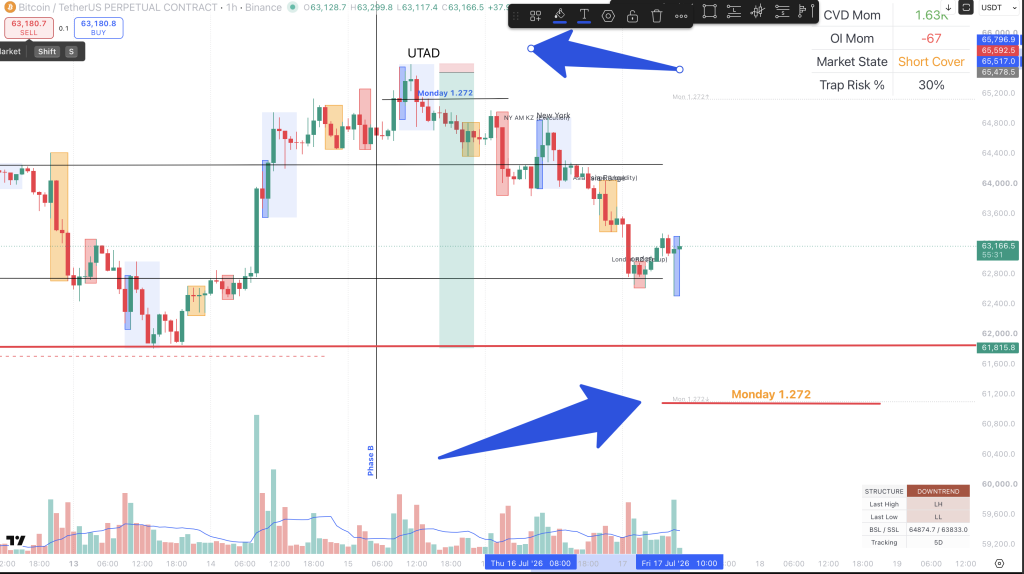
- Primary Scenario: The most structurally probable outcome is that price pierces the major high, tags the 1.272 extension to absorb all retail long liquidity, and then rapidly collapses back inside the original range, initiating a new downtrend.
- Secondary Scenario: If institutions have not finished distributing their inventory, the price may stall and consolidate near the highs. This creates a dangerous whipsaw environment as they continuously probe the upper liquidity boundaries. If you do not see a clear LTF CHoCH, you must stay on the sidelines and prepare for this exact choppiness.
Target Liquidity Identification
Once a successful UTAD (Upthrust After Distribution) is confirmed, the profit target is strictly objective. Liquidity magnetically attracts price. After sweeping the buy-side, the next logical objective is the opposing Sell Side Liquidity (SSL). This rests below the previous range lows, where the stop losses of long positions are vulnerable. Your Take Profit (TP) must be placed at these precise structural liquidity targets, not at arbitrary percentage gains.
Risk Assessment and No-Trade Conditions
The absolute greatest risk when trading a liquidity trap breakout is confirmation bias. You cannot automatically assume every sweep will lead to a macro trend reversal. A minor, lower timeframe CHoCH does not guarantee that the massive daily trend has completely flipped.
If the high is broken but the lower timeframes refuse to print a distinct MS Shift, or if the downward move lacks Displacement entirely, you must abort the mission. Do not force the Wyckoff labels onto a chart that doesn’t fit the profile. Do not attempt to guess the market’s direction. When confirmation is absent, a “No-Trade” decision is the most powerful and highly disciplined structural action you can take.
Leave a Reply