StructFirst Core Guide #007
A Fair Value Gap is one of the most widely marked—and most frequently misused—areas on a modern trading chart.
Many traders identify a three-candle imbalance, wait for price to return, and enter as though the gap itself must produce a reaction.
That process removes the Fair Value Gap from the market structure that created it.
An FVG does not independently reveal whether the market is trending or ranging. It does not prove that meaningful liquidity was taken. It does not confirm that one side gained lasting control. It does not guarantee mitigation, continuation, or reversal.
A Fair Value Gap is evidence that price moved through an area with limited two-way overlap.
The more important question is why the movement occurred and what structural consequence it produced.
At StructFirst, the decision sequence remains:
Higher-Timeframe Structure
→ Liquidity
→ Directional Intent
→ Displacement
→ Confirmation
→ Failure Logic
→ Execution
→ Risk Management
The FVG belongs inside that sequence.
It should not replace it.
Quick Definition: What Is a Fair Value Gap?
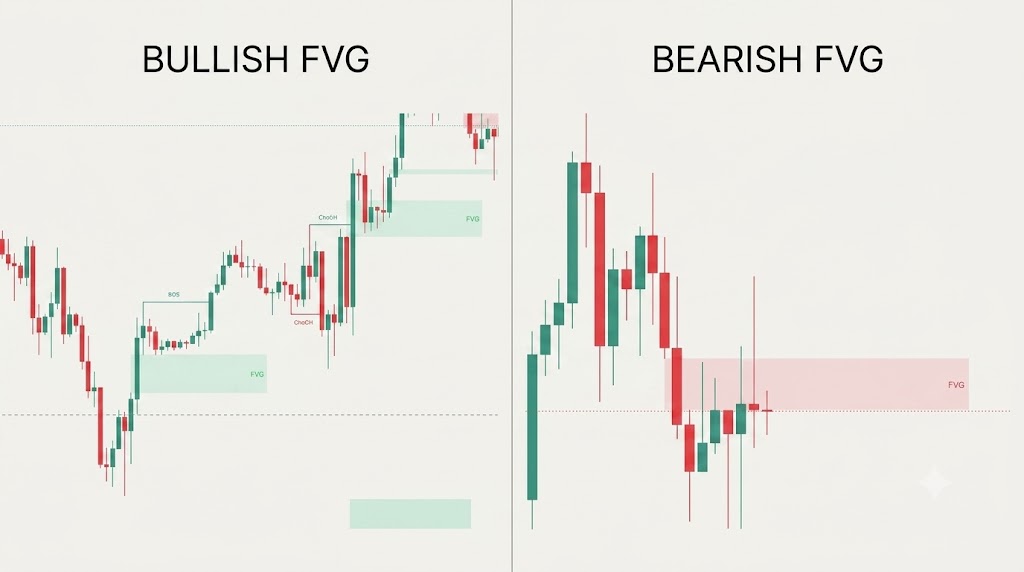
A Fair Value Gap, commonly abbreviated as FVG, is a price imbalance visible across a three-candle sequence.
In a bullish FVG, the low of the third candle remains above the high of the first candle.
In a bearish FVG, the high of the third candle remains below the low of the first candle.
The space between those candle extremes shows that price moved rapidly enough to leave limited overlap between buyers and sellers.
This is sometimes described as an inefficiency.
That description does not mean price is obligated to return and “correct” the imbalance.
A Fair Value Gap is a footprint of directional movement. Its structural context determines whether the footprint deserves attention.
How a Fair Value Gap Forms
The basic FVG model uses three candles.
Bullish Fair Value Gap
A bullish FVG forms when:
- The first candle establishes the lower boundary.
- The second candle expands aggressively upward.
- The third candle remains above the first candle’s high.
The gap lies between:
- the high of candle one, and
- the low of candle three.
Bearish Fair Value Gap
A bearish FVG forms when:
- The first candle establishes the upper boundary.
- The second candle expands aggressively downward.
- The third candle remains below the first candle’s low.
The gap lies between:
- the high of candle three, and
- the low of candle one.
The middle candle often receives most of the attention because it carries the directional expansion.
However, candle size alone is not enough.
A large candle can form during:
- thin liquidity,
- news-driven volatility,
- forced liquidation,
- the middle of a range,
- a stop run,
- or an isolated volatility spike.
For that reason, every FVG must be connected to the movement that created it.
For a complete explanation of that distinction, read What Is Displacement in Trading? Why Strong Candles Alone Are Not Enough.
Why the Imbalance Matters More Than the Gap
Traders often focus on the empty visual space.
The structural information lies in the movement surrounding it.
An FVG may show that price moved with urgency. It may indicate that available liquidity at the previous price area was insufficient to slow the auction. It may also mark the path through which price broke a relevant swing or left a failed auction.
But the existence of the gap does not tell the trader whether the movement was important.
Consider two bullish FVGs.
The first forms in the middle of a broad trading range. Price has not taken external liquidity. Candle overlap remains high. The move breaks only a minor internal pivot and runs directly into higher-timeframe resistance.
The second forms after price trades below a major low, reclaims the range, displaces through a protected lower high, and holds above the broken structure.
Both areas satisfy the three-candle definition.
They do not carry the same structural weight.
The second FVG is connected to:
- a meaningful liquidity event,
- directional displacement,
- a relevant structural break,
- a clear origin,
- and a definable invalidation point.
The first may be ordinary internal rebalancing.
The pattern defines the area. The surrounding auction defines its quality.
Higher-Timeframe Structure Comes Before the FVG
An FVG should never determine higher-timeframe bias by itself.
A bullish FVG on a five-minute chart may form during a corrective rally inside a four-hour bearish structure.
A bearish FVG may form during a temporary pullback inside a Daily uptrend.
Both can produce short-term reactions without changing the external market structure.
Before assigning directional meaning to an FVG, identify:
- whether the market is trending or ranging,
- the controlling timeframe,
- the protected external high or low,
- whether price is trading at premium or discount,
- the nearest external liquidity,
- and whether the gap aligns with or opposes the larger auction.
Internal structure can refine execution.
External structure defines the broader environment.
This hierarchy is examined in Internal vs External Market Structure: Which Swing Actually Controls the Trend?.
Liquidity Gives the FVG a Reason to Exist
Price frequently accelerates after interacting with a concentrated pool of orders.
That liquidity may rest:
- above a prior high,
- below a prior low,
- around equal highs or equal lows,
- at a session boundary,
- beyond a trading range,
- or near a heavily observed structural level.
Suppose price trades below a prior low.
The movement below the low confirms that sell-side liquidity was accessed. It does not yet confirm a bullish reversal.
If price then reclaims the low, displaces upward, breaks a meaningful lower high, and leaves a bullish FVG, the imbalance gains structural relevance.
The gap is not important merely because it is visible.
It is important because it records part of the market’s response after a meaningful liquidity event.
The opposite sequence may develop above buy-side liquidity:
Buy-Side Liquidity Sweep
→ Failed Acceptance Above the High
→ Bearish Displacement
→ Structural Break
→ Bearish FVG
→ Retest or Continuation
A liquidity sweep is not automatically a reversal. The post-sweep response must still confirm whether the level was rejected or accepted.
See What Is a Liquidity Sweep? Confirmation, Failure, and Execution for the complete liquidity framework.
A Fair Value Gap Is Not Proof of Institutional Intent
An FVG is observable.
The identity and intention of every participant are not.
It is therefore more accurate to say that the imbalance may be consistent with aggressive directional participation than to claim that institutions deliberately created every gap.
Observable evidence includes:
- candle expansion,
- limited overlap,
- strong closing location,
- a break of meaningful structure,
- continued delivery,
- and later acceptance or rejection around the imbalance.
Structural intent is inferred from that evidence.
It should not be presented as confirmed participant identity.
Consequent Encroachment: What Does the 50% Level Mean?
The midpoint of an FVG is often called Consequent Encroachment, or CE.
It represents 50% of the imbalance.
Some traders use CE as:
- a potential reaction level,
- an execution refinement,
- a partial mitigation reference,
- or a boundary between shallow and deeper penetration.
CE can be useful, but it should not become a mechanical entry line.
A touch of the midpoint does not confirm that the FVG held.
The trader must still evaluate:
- the candle response,
- whether price closes through the midpoint,
- whether the full gap is penetrated,
- whether the displacement origin remains protected,
- and whether the market preserves the structure supporting the setup.
A reaction at CE is evidence.
Acceptance away from CE is stronger evidence.
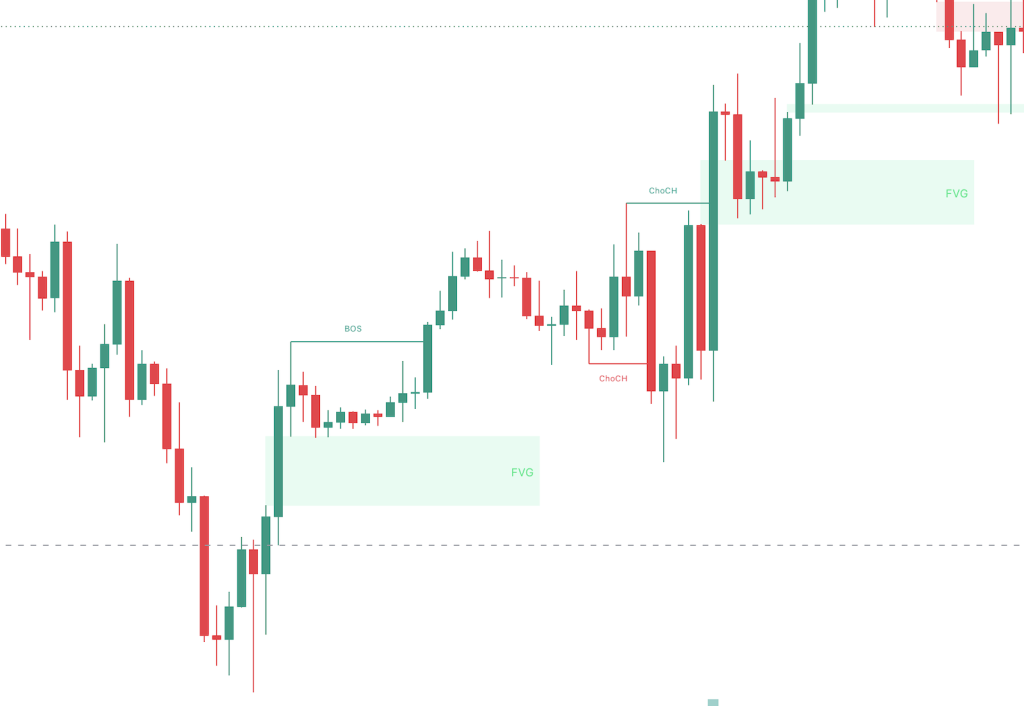
A Valid FVG Retest Needs Context
Price returning to an FVG is not enough to justify execution.
A higher-quality retest normally includes several aligned conditions.
1. The Higher-Timeframe Structure Supports the Direction
A bullish FVG carries more weight when it aligns with bullish external structure or forms after a meaningful bullish transition.
A bearish FVG carries more weight when the controlling structure is bearish or has confirmed a bearish shift.
Countertrend gaps can still react.
They require stricter expectations and usually carry closer opposing liquidity.
2. A Meaningful Event Preceded the Displacement
The strongest examples often follow:
- a liquidity sweep,
- failed acceptance outside a range,
- a Wyckoff Spring or UTAD candidate,
- a structural reclaim,
- or a break from compression.
The event gives the displacement a reason.
3. Displacement Produced Structural Consequence
The movement should do more than create a visually large candle.
It should ideally:
- break a relevant swing,
- reduce candle overlap,
- close decisively,
- establish acceptance,
- or move the auction toward a new liquidity objective.
4. The Retest Preserves the Thesis
A bullish retest should not destroy the protected low or fully invalidate the displacement leg.
A bearish retest should not reclaim the protected high or establish acceptance above the movement’s origin.
5. Invalidation Is Defined Before Entry
The trader should know whether the setup fails through:
- a wick,
- a candle close,
- a full gap violation,
- a break of the displacement origin,
- or acceptance beyond the protected swing.
Without this definition, the FVG is only an area on the chart.
Confirmation Required Before Execution
Confirmation should be proportional to the timeframe and setup.
Possible confirmation includes:
| Evidence | What It Shows |
|---|---|
| Reaction from the FVG | Price recognized the area, but control is not yet confirmed |
| Strong close away from the gap | Initial directional response |
| Lower-timeframe CHoCH | Prior local behavior was challenged |
| Market Structure Shift with displacement | The auction may be repricing |
| BOS after the retest | The new directional sequence may be continuing |
| Failed reclaim of the FVG | The opposing side could not recover the area |
| Acceptance beyond the gap | The FVG may have failed or changed role |
An FVG reaction should also be evaluated through acceptance and rejection. A wick from the imbalance may show an initial response, but continued trade through the gap, a failed reclaim, or displacement away from it determines whether the area actually held. For the complete framework, read What Are Acceptance and Rejection in Trading? Why One Wick or Close Is Not Enough.
A CHoCH after an FVG reaction is not automatically a completed reversal.
A BOS is not automatically continuation.
The meaning depends on which swing was broken and whether price accepted beyond it.
For the complete structural distinction, read BOS vs CHoCH vs Market Structure Shift: What Actually Confirms a Trend Change?.
Invalidation and Failure Logic
Invalidation must be established before targets.
A bullish FVG thesis may weaken or fail when price:
- trades deeply through the imbalance without a meaningful response,
- closes below the gap,
- accepts below the displacement origin,
- breaks the protected low,
- fails to produce continuation after the retest,
- or returns to the prior range and holds there.
A bearish FVG thesis may weaken or fail when price:
- trades through the gap without rejection,
- closes above the imbalance,
- accepts above the displacement origin,
- reclaims the protected high,
- or converts the bearish area into support.
A brief penetration does not always mean failure.
The controlling timeframe matters.
A five-minute wick through a one-hour FVG may be less important than a one-hour candle closing and accepting beyond it.
The invalidation rule should therefore define:
- the controlling timeframe,
- the structural level,
- the type of breach,
- and the acceptance behavior required to cancel the thesis.
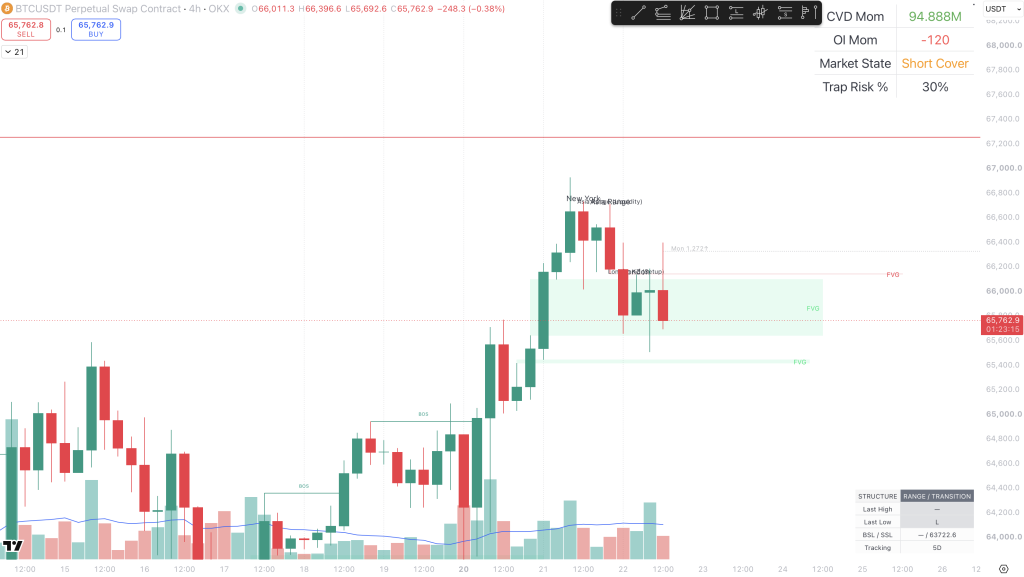
Insertion Location: After the Invalidation and Failure Logic section.
Not Every Fair Value Gap Must Fill
One of the most persistent FVG assumptions is that price must eventually return to every imbalance.
Markets do not operate under that obligation.
An FVG may remain unfilled because:
- the directional auction remains strong,
- the liquidity objective is farther away,
- a shallower imbalance provides sufficient support or resistance,
- the market establishes value at a new price area,
- or the original gap loses relevance over time.
Price may:
- touch only the edge,
- react from CE,
- fill the entire gap,
- trade through without reaction,
- or never return.
The correct question is not:
When will this FVG fill?
The more useful questions are:
Is this imbalance still connected to the active structure?
Does the market still have a reason to return?
What would the return need to confirm?
How to Prioritize Multiple FVGs
Directional moves often leave several Fair Value Gaps.
Treating every gap equally creates clutter and weakens execution.
Prioritize them by structural significance.
1. Displacement Origin
The FVG closest to the origin of the meaningful move may carry greater importance than a later gap created after price was already extended.
This does not guarantee a deeper retracement.
It identifies where the movement first gained structural consequence.
2. Higher-Timeframe Alignment
A one-hour FVG that aligns with Daily structure usually carries more weight than a small five-minute imbalance opposing the larger auction.
3. Liquidity Context
An FVG formed after external liquidity was taken is generally more meaningful than one formed during random internal rotation.
4. Structural Consequence
Give more weight to the gap associated with:
- a protected swing break,
- a confirmed MSS,
- range acceptance,
- or a failed auction.
5. Premium and Discount
For bullish execution, FVGs in discount may provide more favorable positioning than gaps formed at premium.
For bearish execution, FVGs in premium may provide better positioning than gaps formed at discount.
Location improves the trade framework.
It does not guarantee reaction.
6. Remaining Target Liquidity
A valid FVG may still offer a poor trade when opposing liquidity is too close.
The target must justify the invalidation distance.
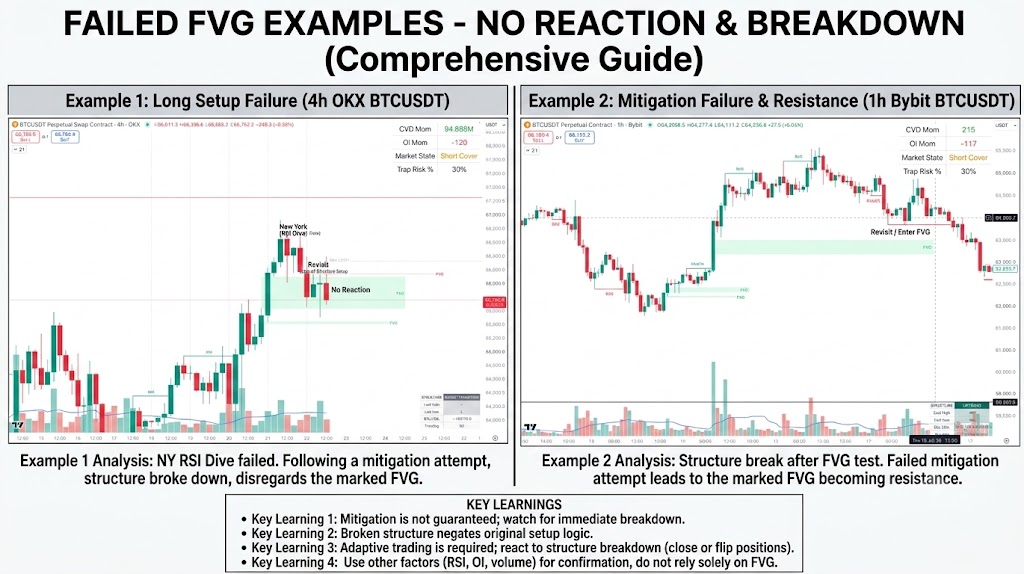
A Conditional FVG Execution Framework
An FVG execution model should begin before price reaches the gap.
Step 1: Define the Higher-Timeframe Environment
Identify:
- trend or range,
- external structure,
- protected swings,
- premium or discount,
- and the main liquidity objective.
Step 2: Identify the Event That Created the FVG
Determine whether the imbalance followed:
- a liquidity sweep,
- a breakout with acceptance,
- a failed breakout,
- a structural reclaim,
- or ordinary internal movement.
Step 3: Evaluate the Displacement
Ask:
- Did the movement break meaningful structure?
- Did candle overlap decrease?
- Were closes decisive?
- Did price continue after the initial impulse?
- Was the move immediately reclaimed?
Step 4: Define Invalidation
Invalidation may belong:
- beyond the protected swing,
- beyond the displacement origin,
- beyond the full FVG,
- or beyond the structural level that justified the trade.
Choose the level based on the thesis, not merely on the smallest available stop.
Step 5: Wait for the Retest Response
Possible evidence includes:
- rejection from the gap,
- acceptance above or below CE,
- lower-timeframe displacement,
- failed reclaim,
- CHoCH or MSS,
- and subsequent BOS.
Step 6: Evaluate the Target
Targets should be based on:
- buy-side liquidity,
- sell-side liquidity,
- external highs or lows,
- range boundaries,
- or other structurally relevant objectives.
Step 7: Reject the Trade When the Conditions Are Poor
No-trade is valid when:
- confirmation is absent,
- invalidation is unclear,
- price is already extended,
- opposing liquidity is too close,
- the FVG conflicts with higher-timeframe structure,
- the gap formed during low-quality internal noise,
- or the required reward no longer justifies the risk.
FVGs in Wyckoff and Harmonic Context
Fair Value Gaps can appear inside Wyckoff and harmonic structures, but they should not be used to force those labels.
Wyckoff Context
A bullish FVG may form after a Spring candidate reclaims range support and produces a Sign of Strength.
A bearish FVG may form after a UTAD candidate fails above range resistance and produces a Sign of Weakness.
The gap supports the interpretation only when the range behavior also supports it.
A wick below support is not automatically a Spring.
A wick above resistance is not automatically a UTAD.
Harmonic Context
An FVG may form after price reacts from a harmonic Potential Reversal Zone.
The PRZ identifies location.
The FVG may record the displacement that follows.
Neither confirms the trade independently.
A stronger sequence is:
Harmonic PRZ
→ Liquidity Event
→ Rejection or Reclaim
→ Displacement
→ Structural Change
→ FVG Retest
→ Conditional Execution
The geometry creates interest.
The structural response determines whether capital should be committed.
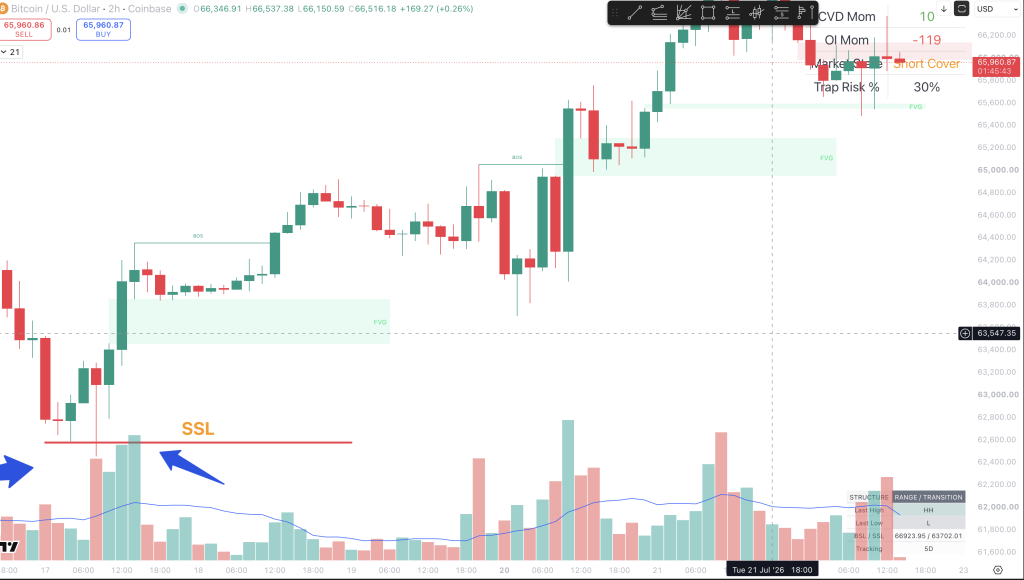
Hypothetical Bullish FVG Sequence
The following is a hypothetical educational example, not a current market call.
Bitcoin is trading inside a four-hour range.
A clearly defined sell-side liquidity pool rests below the range low.
Price trades beneath that low during an active session but does not maintain acceptance below the range.
It then:
- reclaims the range low,
- produces bullish displacement,
- breaks a meaningful lower high,
- leaves a bullish FVG,
- and holds above the broken structure.
Price later retraces toward the imbalance.
The trader does not enter merely because the gap is touched.
The trader waits for:
- a reaction inside the FVG,
- lower-timeframe bullish displacement,
- preservation of the displacement origin,
- and sufficient room toward buy-side liquidity.
Invalidation is defined beneath the protected low or the structural level supporting the reclaim.
The target is the next relevant buy-side liquidity pool.
The thesis fails if price accepts back below the range and invalidates the displacement leg.
The FVG provides a location.
The full sequence provides the trade thesis.
Common Fair Value Gap Misinterpretations
Misinterpretation: Every FVG Must Fill
Why It Fails:
The market can establish value at a new price area and continue without returning to the imbalance.
Better Decision Rule:
Evaluate whether the gap remains connected to active structure and whether a return has a logical liquidity or rebalancing reason.
Misinterpretation: An FVG Touch Is an Entry
Why It Fails:
Price may react briefly and then trade through the entire imbalance.
Better Decision Rule:
Require a response, structural preservation, defined invalidation, and sufficient target distance.
Misinterpretation: A Large Candle Makes the FVG Important
Why It Fails:
Large candles can appear during thin liquidity, liquidation, or isolated volatility without changing meaningful structure.
Better Decision Rule:
Evaluate displacement through structural consequence, acceptance, and follow-through.
Misinterpretation: The 50% Level Must Hold
Why It Fails:
CE is a reference, not a guaranteed support or resistance line.
Better Decision Rule:
Use the midpoint to monitor reaction and acceptance, not as an automatic order level.
Misinterpretation: Every FVG Shows Institutional Buying or Selling
Why It Fails:
The chart does not reveal participant identity with certainty.
Better Decision Rule:
Describe observable movement first and treat institutional intent as a structural inference.
StructFirst FVG Checklist
Before using a Fair Value Gap in a trading decision, ask:
Structure
- What timeframe controls the broader auction?
- Is the FVG aligned with internal or external structure?
- Is price trending, ranging, or transitioning?
Liquidity
- What liquidity event preceded the gap?
- Was internal or external liquidity accessed?
- Is the main liquidity objective already complete?
Displacement
- Did price break a meaningful swing?
- Did the move reduce overlap?
- Did price close decisively and follow through?
Location
- Is the FVG at premium or discount?
- Does it overlap a significant structural area?
- Is price already extended?
Confirmation
- Did the retest produce a meaningful response?
- Was there CHoCH, MSS, BOS, rejection, or failed reclaim?
- Did price preserve the structure supporting the setup?
Invalidation
- What exact price behavior proves the thesis wrong?
- Does failure require a wick, close, or sustained acceptance?
- Which timeframe controls invalidation?
Target and Risk
- Where is the next relevant liquidity pool?
- Is the target far enough to justify the stop?
- Is opposing liquidity too close?
- Is no-trade the more professional decision?
Risk Management and No-Trade Conditions
A technically valid FVG can still produce a poor trade.
The setup may be structurally sound but operationally unattractive because:
- confirmation arrived too late,
- invalidation is too wide,
- price is extended,
- the target is too close,
- volatility is unstable,
- or higher and lower timeframes conflict.
Entering at every FVG also creates correlated exposure.
Several gaps on the same directional leg do not necessarily represent several independent setups.
They may all depend on the same structural thesis.
Risk should therefore be assigned to the total idea, not multiplied because several imbalances are visible.
No-trade is appropriate when:
- the FVG formed without meaningful displacement,
- liquidity context is unclear,
- the controlling structure is unresolved,
- the retest produces no confirmation,
- invalidation cannot be defined,
- reward-to-risk is insufficient,
- the move is already extended,
- or the trader must force a Wyckoff, harmonic, or structural label to justify the entry.
Missing a reaction is less damaging than committing capital to an undefined thesis.
Frequently Asked Questions
Is a Fair Value Gap bullish or bearish?
An FVG is directional according to the movement that created it, but its future effect depends on higher-timeframe structure, liquidity, location, and the response when price returns.
Does price always return to a Fair Value Gap?
No. Price may partially mitigate the gap, fill it completely, trade through it, react from its edge, or never return.
Is the 50% level of an FVG the best entry?
Not automatically. Consequent Encroachment is a useful reference, but execution still requires structural confirmation and defined invalidation.
What invalidates a bullish FVG?
Typical failure evidence includes acceptance below the gap, loss of the displacement origin, violation of the protected low, or failure to continue after a confirmed retest.
Can an FVG be used without a liquidity sweep?
Yes, but the absence of a clear liquidity event may reduce the structural information available. The trader should still require meaningful displacement, structure, confirmation, invalidation, and target liquidity.
What is the difference between an FVG and displacement?
Displacement describes the aggressive directional movement and structural repricing. An FVG is one possible imbalance left behind by that movement. Displacement can occur without a textbook FVG, and an FVG can form without meaningful displacement.
Expand Your Structural Edge
A Fair Value Gap is useful because it records where price moved with limited two-way overlap.
It is not valuable merely because a colored rectangle can be drawn around it.
The higher-timeframe structure defines the environment.
Liquidity explains why the market may have moved.
Displacement shows whether the movement carried urgency and structural consequence.
The FVG identifies an area worth monitoring.
Confirmation determines whether the area produced a defensible setup.
Invalidation defines where the thesis fails.
Target liquidity determines whether the remaining opportunity justifies the risk.
The professional question is not:
Did price touch the Fair Value Gap?
It is:
Did the market confirm that this imbalance still matters?
Continue with What Is Displacement in Trading? Why Strong Candles Alone Are Not Enough to understand the movement that gives an FVG structural significance.
Track the live order flow and volume footprint yourself directly on TradingView.
Leave a Reply