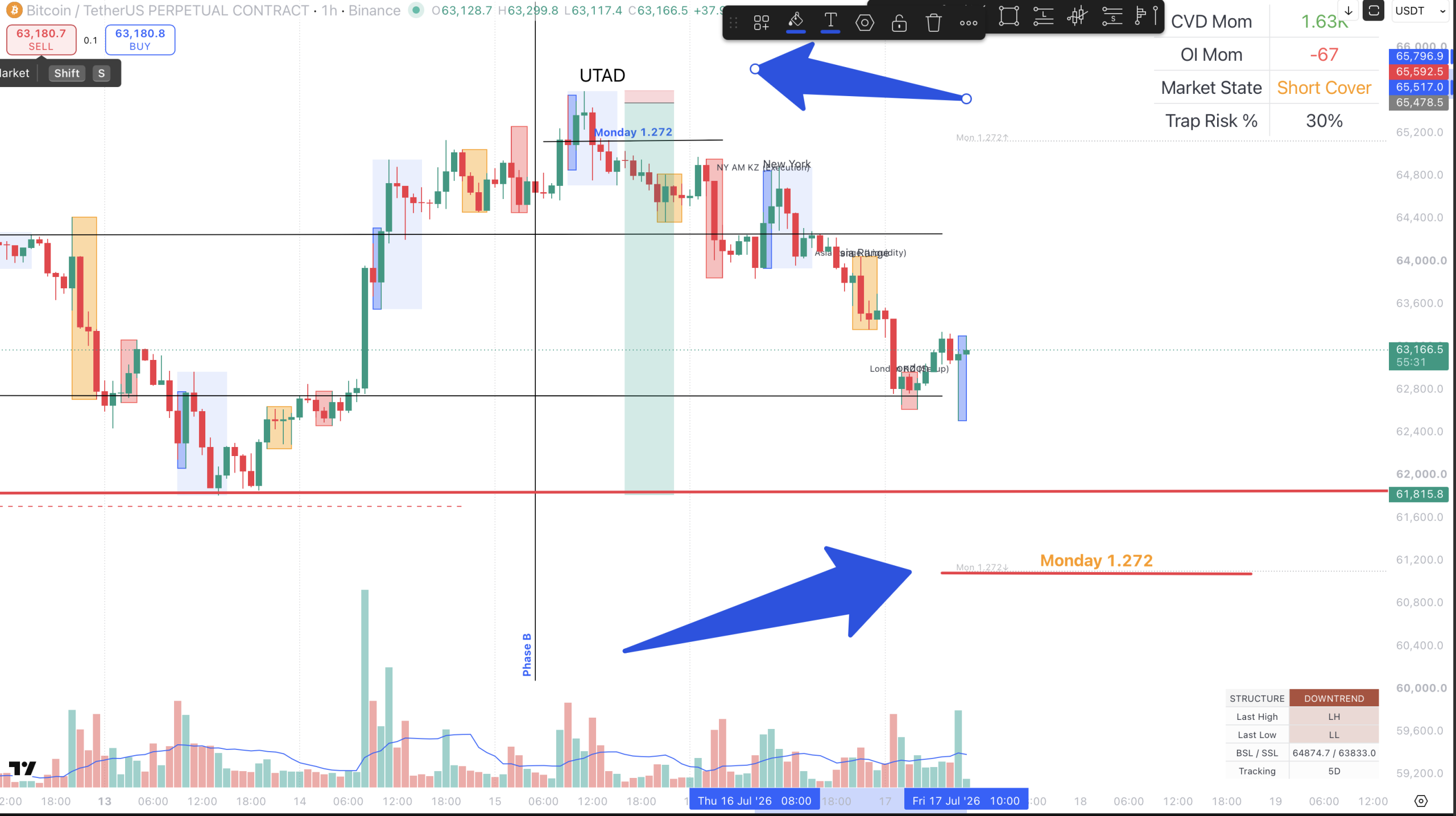
The Hook: Escaping the Breakout Slaughterhouse
Retail traders consistently hemorrhage capital because they trade the illusion of momentum instead of reading the cold, hard structural tape. What we are witnessing on the live charts right now is the textbook execution of an engineered retail slaughterhouse. When an asset violently spikes above a major Monday high—especially during the high-volume Wednesday New York Killzone—retail euphoria reaches its absolute peak. Social media timelines are instantly flooded with calls for new all-time highs. Breakout algorithms, emotional traders, and late-to-the-party momentum chasers blindly hit the buy button. They firmly believe they are catching the start of a massive, parabolic expansion.
My execution, however, is completely detached from this collective psychological hallucination. When the masses are buying the absolute top, I am actively hunting a specific, mathematically precise structural failure. In professional proprietary trading, structure is fundamentally more important than prediction. We are not here to guess where the market might go; we are here to react strictly to confirmed institutional intent. The retail crowd prioritizes predicting the breakout; the institutional operator prioritizes identifying the trap.
This is exactly where the UTAD short setup becomes your most lethal operational weapon. In this comprehensive, high-density tactical briefing, I will break down exactly how the StructFirst methodology identifies a flawless UTAD short setup in real-time. We will explore how I manage the trade through the brutal, uncompromising mechanics of Friday’s institutional squaring, and how we are now stalking the next massive structural opportunity. If you want to survive in this highly engineered market, you must stop being the liquidity for smart money. You must learn to identify the trap before it snaps shut.
HTF Framework: The Anatomy of the 1.272 Liquidity Trap
To execute a high-probability UTAD short setup, you must first completely understand the Higher Timeframe (HTF) narrative and the underlying mechanics of institutional order flow. The financial market is not a random walk; it is a relentless mechanism of liquidity engineering. Long-term consolidation ranges are not simply areas of indecision. The upper and lower boundaries of these ranges are highly engineered zones of deeply concentrated liquidity.
Smart money cannot simply enter massive short positions at random price points. Doing so would crash the market against their own execution algorithms, resulting in catastrophic slippage. They need an avalanche of eager buyers to absorb their massive, pre-planned sell orders.
During this week’s Wednesday New York Killzone, the tape revealed a surgical, highly deliberate strike on the established Monday High. Above this specific Monday High rested a massive, untapped pool of Buy Side Liquidity (BSL). This BSL pool was composed of buy-to-cover stop losses of early short sellers and the buy stop orders of retail breakout traders. The price was deliberately driven upward into this dense BSL pool strictly to trigger these resting orders. However, it tagged the precise 1.272 Fibonacci extension of the previous HTF swing structure.
Why is the 1.272 extension the ultimate kill zone for a UTAD short setup? Mathematically, it pushes price just far enough past the historical resistance to convince the retail masses that a legitimate breakout is underway. It maximizes the psychological pain of underwater shorts and the uncontrollable greed of late longs. Within the advanced Wyckoff framework, this Phase C UTAD is the terminal test of demand. It is the final, most aggressive trap designed to absorb all remaining retail buying pressure before the true markdown violently begins.
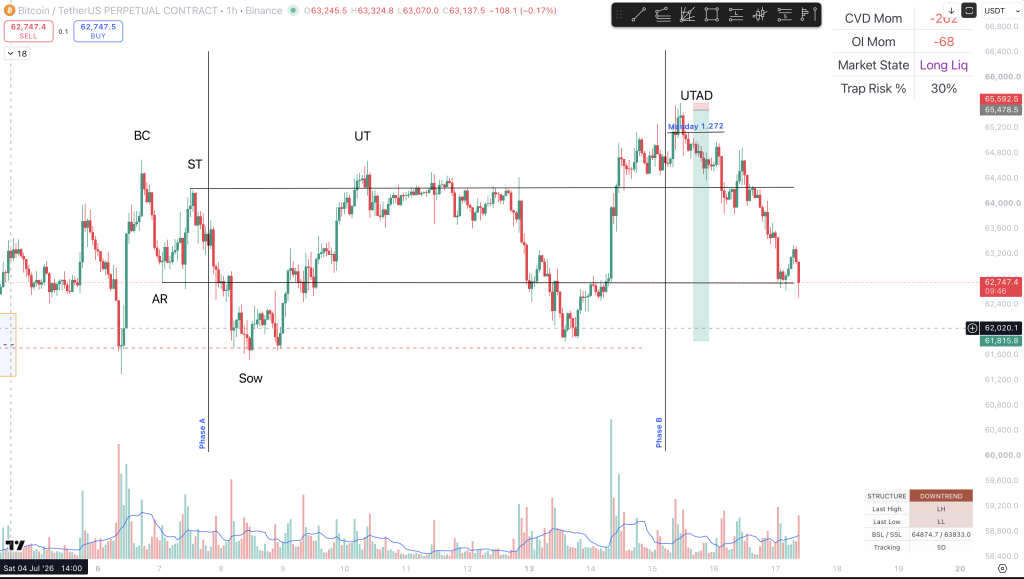
LTF Execution & Confirmation: The Trigger
Understanding the macro intent gives you context, but it does not give you an entry. Execution requires a completely different set of mechanical rules. Confirmation is more important than assumption. A sweep is not automatically a reversal, and a breakout can be a trap, but without explicit structural failure on the lower timeframes, you are merely guessing.
Inside the volatile New York session, I zoomed into the 15-minute and 5-minute structures, patiently waiting for the tape to crack. The exact, non-negotiable trigger for my UTAD short setup was a decisive Market Structure Shift (MS Shift). As price hovered at the 1.272 extension, actively absorbing the retail buying frenzy, the buying volume suddenly evaporated. The subsequent downward price reaction was immensely violent. The price sliced straight through the immediate LTF swing low with undeniable force.
This structural breakdown was accompanied by extreme Displacement—a clear, undeniable injection of institutional selling pressure. This aggressive Displacement left behind a glaring Fair Value Gap (FVG) specifically located in the premium pricing zone. This FVG represents a rapid vacuum in price delivery where sellers were so aggressive that buyers had absolutely zero opportunity to transact. Before execution, this imbalance was strictly verified through our proprietary Multi-Dimensional Analysis (MDA), cross-referencing D1 to D10 levels to ensure alignment across all institutional timeframes.
My execution for this UTAD short setup occurred precisely when the price retraced back upward into that freshly minted premium FVG. I did not chase the initial emotional breakdown. I waited patiently for the market to come back to my structurally defined execution zone, utilizing limit orders to ensure perfect fills.
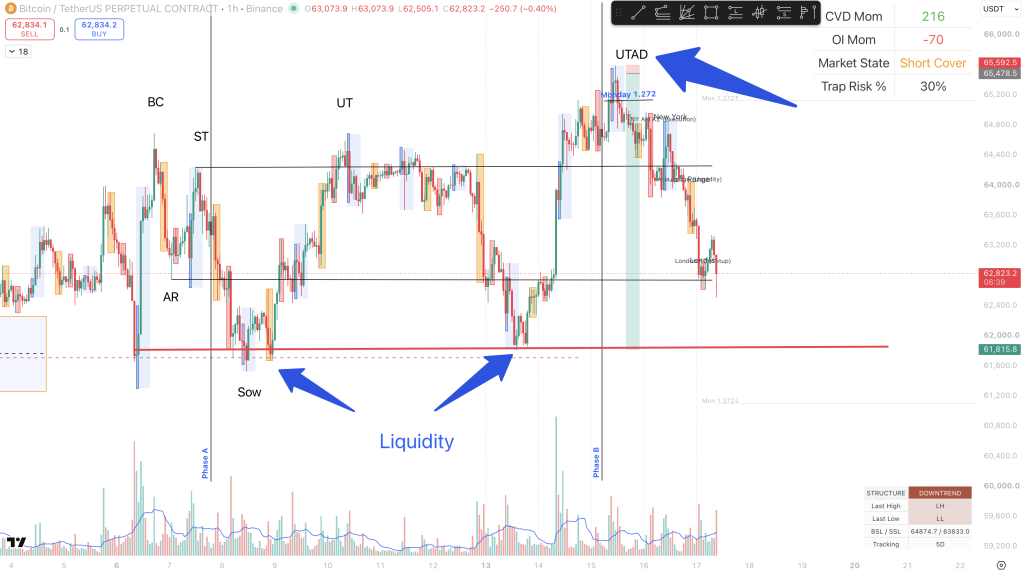
Live Structural Parameters
Before you ever attempt to trade a UTAD short setup, you must force yourself to run through a cold, emotionless mechanical checklist. A No-Trade condition is a highly profitable decision when confirmation is absent.
- Exact Entry Zone: The 5M Premium Fair Value Gap (FVG) created immediately following the LTF Displacement and MS Shift. Limit orders are placed at the proximal edge of the FVG.
- Hard Invalidation Level (Stop Loss): Mathematically positioned just above the highest wick of the UTAD structure. If a 15-minute candle body closes above that high, the structural narrative is instantly invalidated. The trade is killed immediately.
- Primary Target Liquidity (TP): The 61,815.8 structural support line, representing the densest pool of Sell Side Liquidity (SSL) engineered during the weekly markup phase.
- Harmonic / PRZ Check: Verification that the initial sweep terminated exactly at the 1.272 Fibonacci extension, validating the trap mechanics.
Trade Management: Institutional Mechanics and Squaring
Entering the UTAD short setup is only 20% of the battle. As we transitioned from Wednesday’s pristine entry into Friday’s volatile price action, a new structural dynamic took over the tape: Institutional Squaring. Smart money desks rarely hold massive directional exposure over the weekend due to the extreme risk of uncontrollable gap-opens on Sunday night.
To square a massive short position accumulated during the Wednesday UTAD short setup, institutions must buy to cover. To execute these massive buy orders without rocketing the price upward, they drive the price violently downward into areas of intense Sell Side Liquidity (SSL). They force retail traders to capitulate and sell at the worst possible moment, providing the exact counter-party liquidity institutions need.
My Take Profit 3 (TP3) was targeted precisely at 61,815.8 because that is exactly where every retail trader who blindly bought the “dip” placed their protective Stop Losses. As Friday unfolded, the institutional squaring mechanism dragged the price ruthlessly down to this exact level, sweeping the panic stops and flawlessly filling our targets.
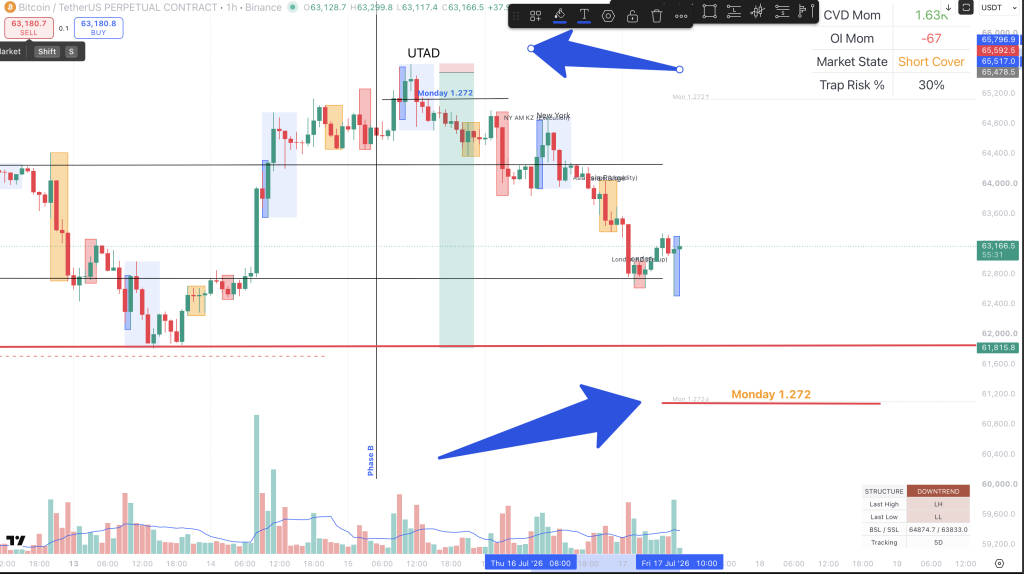
As the UTAD short setup concludes, the structural board resets. We are now heavily focused on a potential Wyckoff Spring at the lower boundaries. The market is rapidly approaching the ultimate SSL target: the Monday Low. If the price aggressively sweeps this low and is immediately followed by a violent, bullish LTF MS Shift, I will have undeniable confirmation for a Wyckoff Spring. Until that structural invalidation point is broken, this potential long setup remains the absolute highest-probability scenario on our institutional radar.
Expand Your Structural Edge
This UTAD short setup is not a theoretical concept; it is a mechanical, highly repeatable blueprint for extracting capital from trapped retail liquidity. By aggressively prioritizing HTF structure and demanding stringent LTF confirmation, you transition from a retail gambler into an institutional operator.
For a granular breakdown of the exact trigger condition that formed earlier this week, review my previous detailed analysis of the Wednesday 30M Wyckoff UTAD trap in the NY Killzone.
Leave a Reply